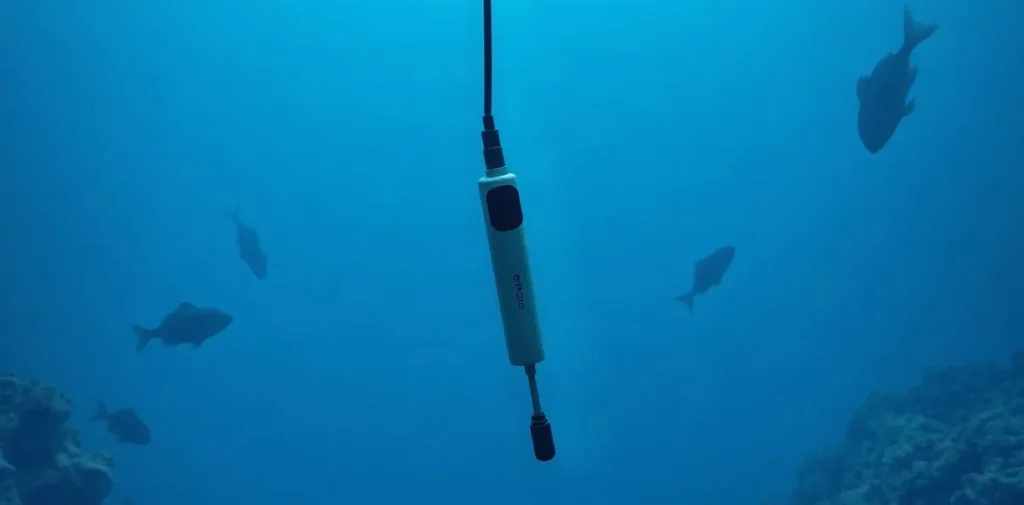
Underwater fish acoustics is the study and recording of sounds made by fish in their natural environment. Researchers use hydrophones to detect and analyse these signals, asking how sound relates to behaviour and habitat. For divers, the subject matters because sound travels differently underwater and can reveal activity beyond the limits of sight.
Why listen to fish underwater?
Fish sounds can include calls, pulses, grunts and other noises produced during activities such as communication or feeding. Their meaning varies by species and context: a recording alone does not identify the behaviour that produced a sound. Researchers therefore connect acoustic observations with the environment and, where possible, other forms of observation.
Sound offers a way to study animals that may be difficult to see. In habitats where visibility is poor, or where observing an animal directly could disturb it, a hydrophone can register acoustic activity without requiring a clear visual encounter. The challenge is separating fish sounds from other biological, geological and human-made noise.
For divers, this is also a reminder that the underwater environment is acoustically active. A familiar visual scene can contain sounds that are not obvious to a diver, while a loud sound may travel from a source that is difficult to locate by ear.
How are underwater recordings made?
A hydrophone converts pressure changes in water into an electrical signal that can be recorded and analysed. Researchers place the instrument in the water and capture sound over time. The recording may include the target sound alongside ambient noise, so equipment placement and recording conditions affect what can be interpreted.
Analysis often begins by examining a sound’s timing, frequency content and pattern. A spectrogram displays how sound energy changes across frequencies over time; it can help distinguish repeated calls from continuous background noise. Such features support comparison, but do not automatically establish which species made a sound or what it means.
- Hydrophone: an underwater sensor for detecting sound pressure changes.
- Ambient noise: the background soundscape, including biological, environmental and human sources.
- Spectrogram: a visual representation of sound frequency and intensity over time.
- Acoustic context: the conditions of the recording, including location, timing and nearby sound sources.
What makes fish sounds difficult to interpret?
Underwater sound can travel over distance, reflect from boundaries and combine with other signals. These effects can make it hard to determine where a sound originated. A recording may contain reverberation or overlapping calls, and equipment can also register handling noise or other interference.
Species identification is another step, not a simple consequence of hearing a sound. Different fish may produce signals with similar acoustic features, while the same species can make different sounds in different situations. Strong interpretation depends on comparing recordings with reliable observations and considering the habitat and recording setup.
These constraints make methodical recording important. Researchers need to document where and how a hydrophone was used, preserve the original recordings and distinguish observations from interpretations. Without that context, a sound pattern may be audible but remain biologically ambiguous.
What does acoustics add to underwater research?
Listening complements visual surveys rather than replacing them. A camera can show an animal’s appearance and immediate surroundings, while a hydrophone can capture sound when an animal is hidden or outside the camera’s view. Using different methods can help build a fuller picture of how organisms use an underwater habitat.
Acoustic work also connects biological questions with the physics of sound in water. Researchers must consider how the environment affects the signal between its source and the sensor. That same physical setting matters in diving: sound cues can be difficult to localise, and communication underwater depends on equipment and conditions.
For scientific divers, recordings can help frame questions about when and where acoustic activity occurs, while direct observation can supply context that sound alone cannot. Divers should treat underwater sounds as environmental observations, not as a dependable way to identify an animal or assess a medical condition.
What should divers take from fish-acoustics research?
The practical lesson is that hearing underwater is not the same as hearing in air. Water carries sound efficiently, but a diver may have difficulty judging its direction or distance. A sound can be informative without making its source obvious.
Fish-acoustics research is primarily a tool for understanding aquatic life and its soundscape, not a clinical test. It does not diagnose pressure-related illness, decompression sickness or other diving disorders. If you have a health concern related to diving, consult a diving-medicine physician.
Frequently asked questions
What instrument records fish sounds underwater?
Can a recording identify which fish made a sound?
Can underwater sound help assess a diver’s health?
An original research-library explainer written by the Rubicon editors. It is not a summary of a specific publication.
Related reading on Rubicon
- The Diving Reflex: What Happens Underwater
- Why Divers Get Cold Faster Underwater
- Diving Safety: Key Insights into Underwater Exploration
- Diving: Exploring Underwater Activities, Science, and Safety
- Recording Fish Sounds Underwater: Research Summary
- How Reef Fish Use Sound Underwater
- More on Diving Science
- Browse the Research Library