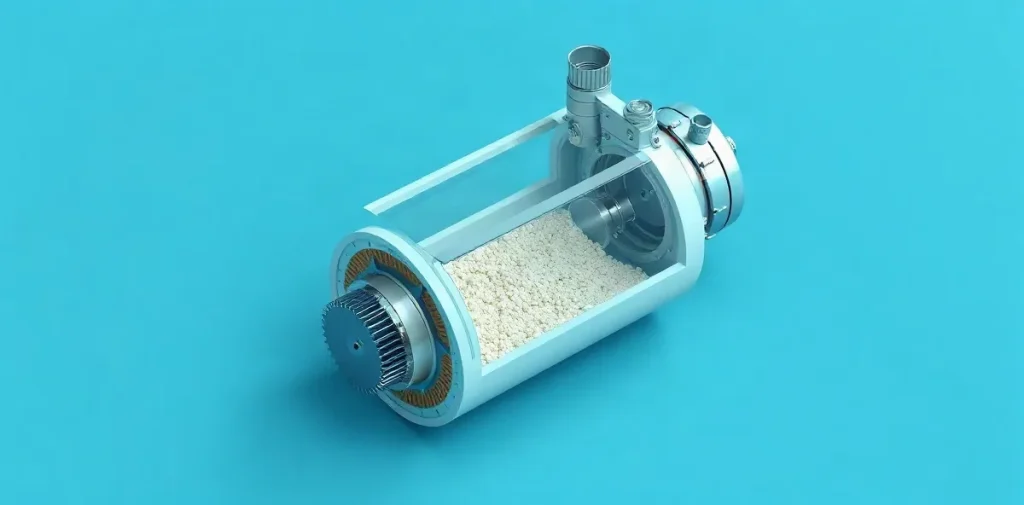
Lithium hydroxide scrubbers remove carbon dioxide from breathing gas in closed or semi-closed underwater systems. Their performance matters because a diver who rebreathes gas depends on reliable CO₂ removal: excess carbon dioxide can impair judgment and physical performance, and can become a medical emergency.
Why must a rebreather remove carbon dioxide?
When you exhale, your body has used some of the oxygen in the gas and added carbon dioxide. In a rebreathing system, gas is recirculated rather than discarded after each breath, so a scrubber must capture that carbon dioxide before the gas returns to the breathing loop.
Lithium hydroxide is a chemical absorbent. It reacts with carbon dioxide, removing it from the gas stream; the reaction also produces heat and water. This makes the scrubber a working chemical component, not simply a filter that traps particles.
If removal is inadequate, carbon dioxide can accumulate in the loop. Hypercapnia may cause headache, breathlessness, confusion and declining capacity; underwater, impaired thinking can make a developing equipment problem harder to recognise and manage.
What determines whether a scrubber works?
Scrubber performance depends on the interaction between the absorbent, the canister and the gas passing through it. Research and engineering assessment therefore consider not only the chemical reaction, but also how the packed material behaves during breathing and under changing dive conditions.
- Absorbent condition: moisture, storage and handling can affect the material’s capacity to react with carbon dioxide.
- Gas flow: the rate and pattern of breathing affect how long gas contacts the absorbent.
- Canister design: packing, dimensions and internal flow paths influence whether gas passes evenly through the material.
- Environmental conditions: temperature, pressure and the dive profile can alter operating conditions and the heat produced by the reaction.
- Use and assembly: correct packing and installation matter because gaps or uneven flow can allow gas to bypass active absorbent.
A test under one set of conditions cannot automatically represent every dive. Deep, cold or strenuous dives change the demands placed on the breathing system, so assessment needs to make its operating conditions clear.
How do researchers assess carbon dioxide scrubbers?
Laboratory testing can measure how well a canister removes carbon dioxide as gas flows through it. Tests may examine breakthrough: the point at which carbon dioxide begins to pass through the scrubber at a level that indicates its capacity is being used up. The result depends on the test setup, including gas flow, temperature, pressure and the condition of the absorbent.
Other engineering questions concern airflow resistance, temperature distribution and whether the gas uses the whole absorbent bed or finds a path around it. Researchers may also examine how packing and assembly affect performance. These measures help characterise a system, but a laboratory result is meaningful only in relation to the conditions tested.
Field use introduces additional variables, including workload, breathing pattern and changes in the surrounding environment. A central challenge is connecting controlled measurements to practical operating limits without treating any single test as a guarantee for every diver or dive.
Why does depth make the question important?
At depth, the diver relies on a breathing apparatus whose gas composition and mechanical performance must remain suitable under pressure. In a closed-circuit system, the loop recycles exhaled gas, making effective carbon dioxide removal essential alongside oxygen management and other equipment checks.
Carbon dioxide retention is especially consequential because symptoms can affect the diver’s ability to respond to an equipment fault. A scrubber problem may not be obvious from the outside, and a diver’s perception of effort or discomfort is not a dependable substitute for a properly designed, maintained and operated system.
For scientific divers, technical divers and diving physicians, the subject sits at the intersection of equipment engineering, respiratory physiology and dive safety. Understanding the scrubber’s limits helps frame risk assessments and incident investigations; it does not replace manufacturer procedures or training.
What should divers and clinicians keep in view?
Scrubber research is part of a broader history of closed-circuit underwater breathing: reusing gas reduces waste, but makes the breathing loop dependent on components that control gas quality. Carbon dioxide removal is one link in that system, alongside oxygen supply, sensors, valves and the diver’s own response to changing conditions.
For divers, practical decisions should follow the apparatus manufacturer’s instructions, training and established operating procedures. Do not extend a canister’s use beyond its approved limits or assume that a test conducted under different conditions establishes a safe duration for your dive.
Headache, unusual breathlessness, confusion or a sudden decline in performance during a dive require prompt attention to the situation and the applicable emergency procedures. Suspected carbon dioxide exposure or persistent symptoms after a dive warrant assessment by a diving-medicine physician.
Frequently asked questions
What does a lithium hydroxide scrubber do?
Can a scrubber be judged by dive time alone?
Why is carbon dioxide retention dangerous underwater?
An original research-library explainer written by the Rubicon editors. It is not a summary of a specific publication.