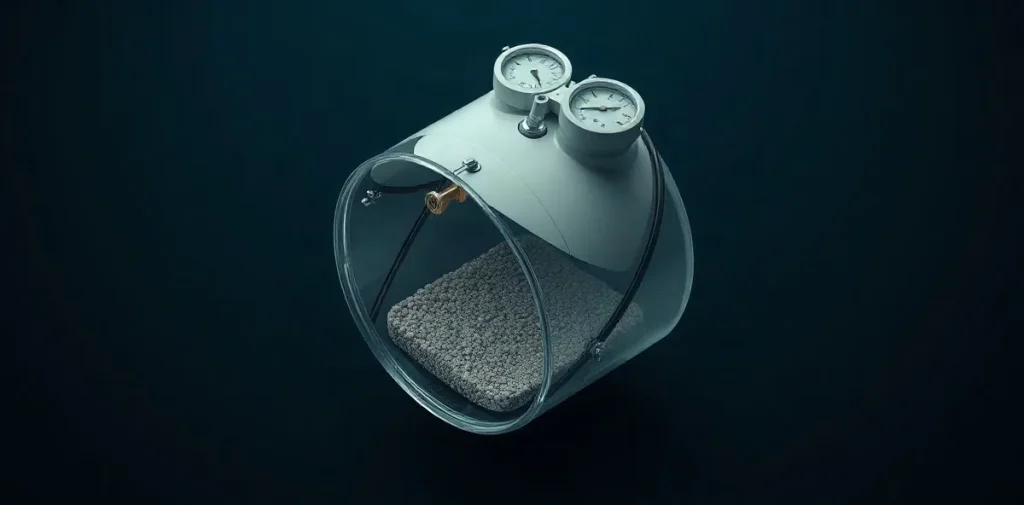
The Behavior and Capabilities of Lithium Hydroxide Carbon Dioxide Scrubbers in a Deep Sea Environment is a 1989 publication by J. R. Jaunsen, published as US Naval Academy Technical Report USNA-TSPR-157. It addresses carbon-dioxide removal by lithium hydroxide scrubbers in deep-sea conditions—a key equipment question because divers must not rebreathe dangerous levels of carbon dioxide.
Why does a breathing system need a carbon-dioxide scrubber?
A diver metabolises oxygen and produces carbon dioxide. In a closed-circuit or other recirculating breathing system, exhaled gas cannot simply be discarded: it must be processed before the diver breathes it again. A scrubber removes carbon dioxide from that circulating gas.
Carbon dioxide is not merely an unwanted component of exhaled breath. If it accumulates in the breathing loop, the diver can develop hypercapnia, meaning an elevated level of carbon dioxide in the body. The resulting physiological stress can impair performance and become a serious medical hazard; the equipment’s gas-cleaning function is therefore part of life support.
How does lithium hydroxide remove carbon dioxide?
Lithium hydroxide is a chemical absorbent. As carbon-dioxide-containing gas passes through the scrubber, the absorbent reacts with carbon dioxide and retains it rather than allowing it to continue through the breathing circuit. The diver then inhales gas with less carbon dioxide than the unprocessed exhaled gas.
That basic chemistry does not, by itself, tell you how a particular scrubber performs. Gas flow, the arrangement and condition of the absorbent, contact between gas and material, and the surrounding environment can all matter. Scrubber assessment therefore concerns a system in operation, not only the chemical identity of its absorbent.
- Carbon-dioxide removal: whether the absorbent captures carbon dioxide as gas moves through the unit.
- Breakthrough: the point at which carbon dioxide passes through the scrubber rather than being adequately retained.
- Breathing resistance: the effort required to move gas through the breathing circuit and absorbent bed.
- Environmental conditions: the pressure, temperature and operating circumstances that may affect a scrubber’s behaviour.
Why examine scrubbers in a deep-sea environment?
Deep-sea operation makes equipment performance a question of the whole operating environment. Pressure and the conditions of use can affect how a breathing system is operated and assessed. A scrubber intended for underwater service must be considered as part of a breathing apparatus, with gas flow and diver workload in view.
For divers, the practical issue is whether the system continues to remove carbon dioxide during the planned operation. For engineers and scientific divers, the related questions include how to test a scrubber under representative conditions and how to recognise the limits of an assessment. This technical problem links materials chemistry to life-support engineering and diving physiology.
How does scrubber performance connect to diving medicine?
Carbon-dioxide retention can arise from more than one part of the breathing process. A scrubber that is depleted or poorly suited to its operating conditions may allow carbon dioxide to remain in the loop; breathing resistance and the diver’s level of exertion also affect ventilation and carbon-dioxide handling. Equipment checks and physiological understanding belong together.
Symptoms associated with elevated carbon dioxide can be difficult to distinguish from other problems underwater, and a diver may be impaired before the cause is clear. This is why breathing-system design, maintenance, monitoring and training matter. A suspected diving-related health problem warrants assessment by a diving-medicine physician; a research-library discussion is not individual medical advice.
What does this publication add to the equipment question?
The title places lithium hydroxide scrubbers, carbon-dioxide control and deep-sea conditions at the centre of a technical report from 1989. It belongs to a wider line of diving research concerned with maintaining breathable gas in recirculating systems and evaluating life-support equipment in the environments where it is used.
For readers comparing scrubber designs or considering historical equipment research, the central questions remain concrete: what operating conditions were examined, how carbon-dioxide removal was assessed, and how the system’s behaviour relates to breathing effort and safe use. Those are the points to check when reading any technical evaluation of a carbon-dioxide scrubber.
Frequently asked questions
What is a lithium hydroxide scrubber used for in diving?
What does carbon-dioxide breakthrough mean?
Why does the deep-sea setting matter?
Citation details
- Title: The Behavior and Capabilities of Lithium Hydroxide Carbon Dioxide Scrubbers in a Deep Sea Environment
- Authors: J. R. Jaunsen
- Year: 1989
- Published in: US Naval Academy Technical Report USNA-TSPR-157
- Record type: Journal article
- Repository record: Rubicon Research Repository, handle 123456789/4998
This page is an original summary written by the Rubicon editors from the publication’s bibliographic record. It does not reproduce the paper, its abstract or its data; consult the publication itself for its methods and findings.
Related reading on Rubicon
- Liveaboard Diving: Essential Gear and Prep for Sea Trips
- The Physiology Behind Oxygen Toxicity in Deep Dives
- How Carbon Dioxide Buildup Affects Rebreather Safety
- The Diving Reflex: What Happens Underwater
- HPNS Suppression in Deep Human Dives: Research Summary
- Pulmonary Function and Deep Mixed-Gas Diving
- More on Equipment
- Browse the Research Library