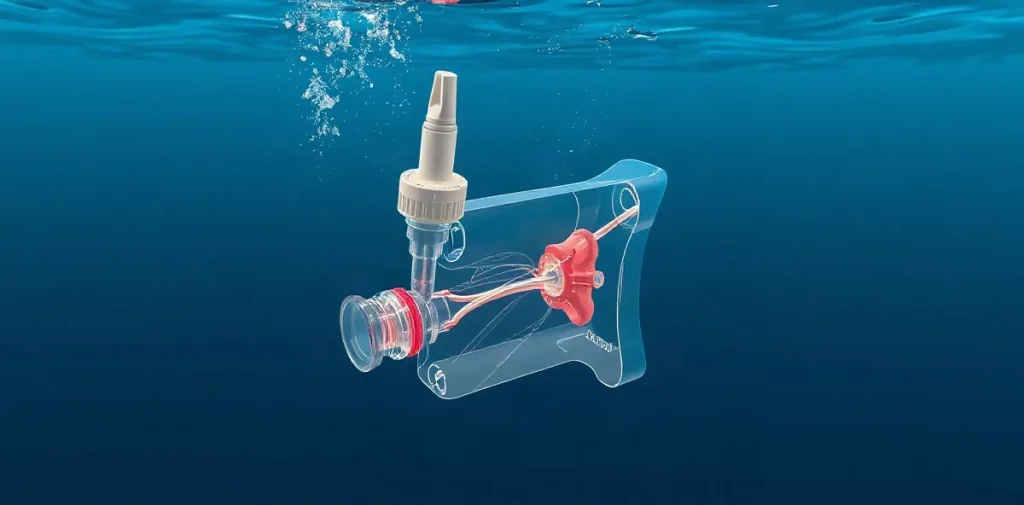
Laryngospasm is a sudden, involuntary closure of the vocal cords that can obstruct airflow. In diving, where breathing depends on a functioning airway and reliable gas delivery, this reflex matters because water, airway irritation or panic can turn a brief spasm into an urgent breathing problem.
What happens during laryngospasm?
The vocal cords sit at the entrance to the trachea, or windpipe. They normally open for breathing and close during swallowing to help protect the lungs. Laryngospasm is an exaggerated protective reflex: the cords draw together and temporarily restrict air passing through the larynx.
A person may be unable to inhale or speak during a strong episode. The spasm can ease as the reflex settles, but persistent airway obstruction is an emergency. The problem is distinct from bronchospasm, which narrows the lower airways, although both can make breathing difficult.
Why is this reflex relevant underwater?
Water contacting the larynx can trigger a protective closure. That response may help prevent water entering the lungs, but it can also interrupt ventilation. A diver who aspirates water, struggles at the surface or has a regulator displaced may face airway irritation alongside the practical danger of losing access to a breathable gas supply.
Immersion changes the demands of breathing, while equipment and the surrounding water make an airway problem harder to manage than it is on land. Distress can compound the situation: struggling increases the need for ventilation at the same time that airflow may be restricted. Laryngospasm is one possible mechanism in drowning and near-drowning events, not an explanation for every episode of underwater respiratory distress.
How is it different from other diving emergencies?
Several conditions can produce breathlessness underwater, and their mechanisms are not interchangeable. Regulator or gas-supply problems limit what reaches the diver; aspiration introduces water into the airway; bronchospasm affects the lower airways; and laryngospasm closes the vocal cords. More than one problem may occur during the same incident.
After an immersion incident, clinicians consider the circumstances, symptoms and respiratory examination rather than relying on a single presumed cause. Cough, noisy breathing, voice changes or continuing shortness of breath warrant medical assessment, particularly after suspected aspiration. A diving-medicine physician should assess questions about returning to diving after a significant respiratory event.
What does hyperbaric medicine add?
Hyperbaric medicine involves breathing oxygen at pressure, usually in a chamber. It is relevant to diving through the treatment of decompression illness and other conditions, but it does not make a closed upper airway harmless: oxygen cannot reach the lungs if ventilation is blocked.
In chamber care, airway patency and the ability to ventilate remain basic clinical concerns. The distinction between a laryngeal obstruction and a problem involving the lungs or gas delivery helps frame assessment, though the appropriate response depends on the patient and clinical setting. Hyperbaric treatment decisions belong to the treating team.
Which concepts help frame research on laryngospasm?
Research on this subject sits at the intersection of airway reflexes, aspiration, drowning physiology and emergency respiratory care. For divers, the central questions concern how an airway-protective response can become obstructive, what circumstances provoke it, and how to distinguish it from other causes of impaired breathing.
- Airway protection: closure of the vocal cords can limit entry of water or other irritants.
- Airway obstruction: the same closure can prevent effective airflow.
- Context: immersion, aspiration, equipment access and distress shape the consequences.
- Differential diagnosis: laryngospasm must be distinguished from lower-airway narrowing and gas-delivery problems.
These concepts matter to diving physicians, hyperbaric clinicians and scientific divers because respiratory symptoms can have different causes but demand prompt attention. After an incident, the practical next step is clinical evaluation; decisions about fitness to dive require individual medical judgment.
Frequently asked questions
Can laryngospasm happen after water enters the airway?
Is laryngospasm the same as bronchospasm?
Should a diver return to diving after an airway event?
An original research-library explainer written by the Rubicon editors. It is not a summary of a specific publication.
Related reading on Rubicon
- The Diving Reflex: What Happens Underwater
- Scuba Diving Regulators: Balanced vs. Unbalanced
- Scuba Diving Buddy Checks: Catch Problems Early
- Scuba Diving: Why Immersion Can Dehydrate You
- Thesis Research in Diving and Hyperbaric Medicine
- Oxygen in Diving and Hyperbaric Medicine
- More on Dive Medicine
- Browse the Research Library