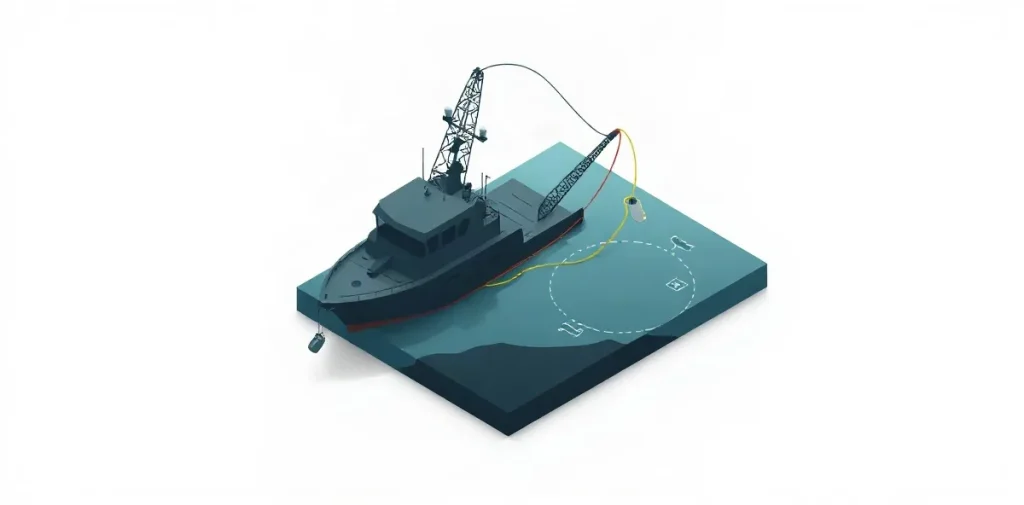
Offshore diving safety statistics turn reports of incidents and work activity into a way to examine how risk develops across commercial operations. They matter because diving hazards rarely arise from physiology alone: equipment, procedures, the worksite and the decisions made under pressure all shape exposure.
What questions can safety statistics answer?
Safety data can help describe the kinds of events occurring during underwater work and the circumstances around them. Researchers and safety teams may examine incident categories, task types, equipment involvement, environmental conditions and the sequence of events leading to an injury or near miss.
The central question is not simply how many incidents occurred. It is how risk relates to the amount and type of work performed, and whether recurring patterns point to weaknesses in planning, equipment, supervision or emergency arrangements.
Commercial diving is a system of linked controls. A problem in one part—such as communications, gas supply or the transfer between surface and underwater work—can alter the demands placed on the diver and the support team.
How are incidents counted and interpreted?
Incident records need consistent definitions. An injury, equipment malfunction, hazardous occurrence and near miss are not interchangeable categories, and changes in reporting practice can change the apparent pattern even when the underlying work has not changed.
Counts also need a meaningful measure of exposure. A total number of events, on its own, cannot show how risk compares across different activities or periods. Analysts therefore consider what work was undertaken and how much exposure the figures represent, while checking that the categories are applied consistently.
- Event classification: what happened, and whether it caused harm or had the potential to do so.
- Exposure: the amount and type of diving work against which events are considered.
- Context: the task, conditions, equipment and operational arrangements involved.
- Reporting: whether events are recorded consistently and completely.
These distinctions matter when comparing records. A change in the number of reports may reflect a change in work, risk, reporting behaviour or definitions; the figures need context before they can guide action.
Why does this matter to diver physiology and medicine?
Safety statistics are not a substitute for clinical research, but they can identify operational settings in which medical hazards deserve attention. A diver’s exposure to pressure, breathing gas, exertion, cold and workload depends on the dive profile and the work being done, while an incident may involve several of these factors at once.
For diving physicians and hyperbaric clinicians, event patterns can help frame questions about injury mechanisms, emergency response and the circumstances in which a diver needs assessment. A record of events cannot by itself establish a diagnosis or explain an individual’s symptoms; clinical evaluation depends on the person and the exposure.
The wider field connects occupational safety with decompression science, respiratory physiology, human factors and emergency medicine. Statistics can indicate where to investigate, while physiological studies and clinical evidence are needed to explain mechanisms and assess medical consequences.
What makes offshore work a distinct safety problem?
Offshore operations bring together divers, surface teams, life-support systems and work equipment in a setting where access and rescue may be constrained. The dive is only one phase of the operation: planning, preparation, deployment, underwater work and recovery each create opportunities for failures or delays.
That makes the sequence of events important. A useful safety analysis asks not only what failed, but what conditions allowed the failure to occur and whether another control could have interrupted the chain. The same incident category may have different implications depending on the task and operational context.
Records from commercial diving also sit within a broader history of efforts to make hazardous work more systematic and measurable. Their value lies in helping organisations identify recurring problems and review controls, rather than treating each event as an isolated mistake.
How should readers use safety data?
Read a statistic alongside its definitions, coverage and exposure measure. Check which activities are included, how events are classified, and whether the period and reporting rules allow a fair comparison. A headline count without those details is a weak basis for judging risk.
For divers, the practical value is in recognising that safety depends on the whole operation, not only on personal technique. For organisations, patterns can prompt closer examination of procedures, equipment, communication and emergency readiness; the appropriate response depends on the specific hazards identified.
Frequently asked questions
What do offshore diving safety statistics measure?
Can incident totals show whether diving has become safer?
Do safety statistics provide medical advice for an injured diver?
An original research-library explainer written by the Rubicon editors. It is not a summary of a specific publication.
Related reading on Rubicon
- Scuba Diving Safety: Skills, Planning, and Hazards
- Diving Safety: Training, Gear, Sites, Risk
- Diving Safety: Key Insights into Underwater Exploration
- Diving: Exploring Underwater Activities, Science, and Safety
- Scuba Diving: Physiology, Risks and Safety
- Diving Air-Pipe Failure and Underwater Safety
- More on Safety
- Browse the Research Library