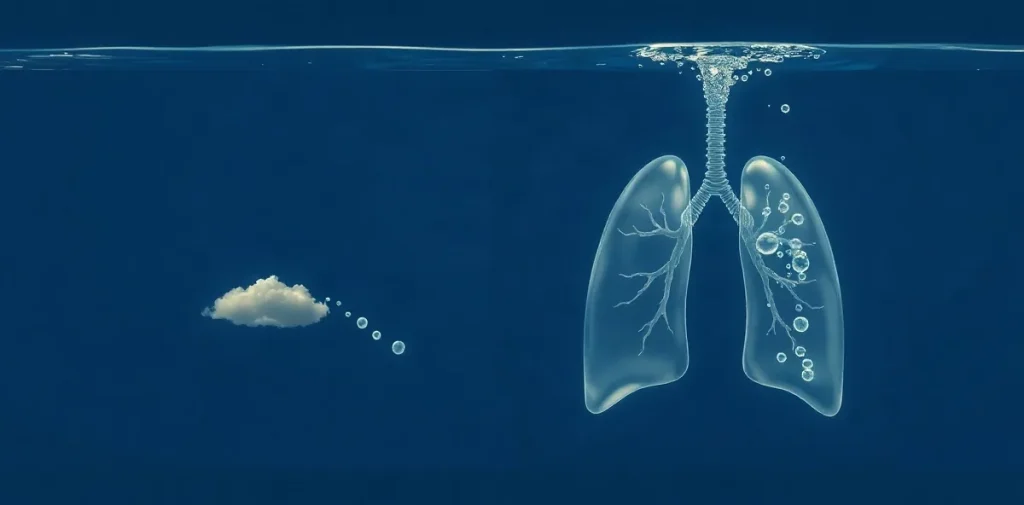
Decompression sickness (DCS) results from gas bubbles forming in the body during or after a dive; immersion pulmonary edema (IPE) is fluid accumulation in the lungs during immersion. Both can cause serious breathing problems, but they have different mechanisms and may require different responses.
The symptoms can overlap, making the distinction important for divers and anyone assisting them. This article compares Decompression Sickness vs. Immersion Pulmonary Edema, focusing on how each condition develops and why breathing difficulty after a dive should be treated as urgent.
| Condition | What the material identifies | Practical response |
|---|---|---|
| Immersion pulmonary edema (IPE) | Fluid builds up in the lungs during immersion; breathing symptoms may worsen on surfacing | Abort the dive and seek qualified medical care |
| Decompression sickness | A distinct diving-related illness; symptoms can be confused with IPE | Do not assume a respiratory symptom identifies the cause |
| Pulmonary barotrauma | Lung damage that can be confused with or occur alongside other dive problems | Seek medical assessment rather than self-diagnosing |
- 1989 Year IPE was first reported, according to the supplied source material
- 3 Distinct conditions named in the comparison: IPE, decompression sickness, and pulmonary barotrauma
- 2 Treatment types for IPE named in the supplied material: oxygen and diuretics
What is immersion pulmonary edema, and how can it develop?
Immersion pulmonary edema (IPE) is fluid accumulating in the lungs during immersion, distinct from decompression sickness and pulmonary barotrauma. It can begin at any stage of a dive, and symptoms may worsen during ascent or after a diver surfaces.
Immersion and lung-fluid shift
Water immersion shifts blood and fluid from the peripheral circulation toward the chest. This raises pressure in the pulmonary capillaries; in some circumstances, fluid is pushed out of those vessels and into lung tissue, producing IPE.
IPE was first reported in 1989 as “cold-induced pulmonary edema,” but later reports have also described it in warm water. That history means cold exposure is not a necessary condition: immersion itself can contribute to the fluid shift.
- IPE: fluid builds up in the lungs during immersion; it may occur at any point in a dive.
- Decompression sickness: a separate diving illness, not another name for IPE.
- Pulmonary barotrauma: lung injury from pressure effects, distinct from immersion-related fluid accumulation.
What symptoms can point to IPE during or after a dive?
Immersion pulmonary edema (IPE) may cause sudden or worsening shortness of breath, a persistent cough, or extreme tiredness during or after a dive. Foamy sputum can also occur, while coughing up blood is a severe presentation; symptoms may worsen as the diver surfaces.
Breathing symptoms are an emergency signal.
A cough or difficulty breathing that starts underwater and worsens during ascent warrants ending the dive and seeking qualified medical care. IPE can occur at any stage of a dive, so symptoms are not ruled out by when they begin.
- Breathing: Sudden or increasing shortness of breath is a warning sign.
- Cough: A persistent cough, especially one that begins underwater, calls for stopping the dive and getting medical assessment.
- Secretions: Foamy sputum may occur; coughing up blood signals a severe presentation.
- Other findings: Low blood oxygen and high blood pressure can accompany IPE, but neither makes self-diagnosis reliable.
These signs can overlap with other dive-related problems, so a diver should not try to identify the cause underwater. Prompt assessment by qualified medical professionals is the safer response.
How does IPE differ from decompression sickness?
Different mechanisms, overlapping warning signs
Immersion pulmonary edema (IPE) is a fluid-shift problem caused by immersion, while decompression sickness (DCS) is a separate diving illness; the supplied material identifies no proven link between DCS and swim-induced pulmonary edema. Water immersion shifts fluid from the body’s peripheral circulation toward its centre, which can raise pressure in lung blood vessels and push fluid into the lungs. IPE can begin at any point during a dive, unlike a problem defined by decompression.
- IPE: fluid accumulates in the lungs during immersion; breathing difficulty or a persistent cough can worsen as the diver surfaces.
- DCS: a distinct dive-related illness; IPE symptoms alone do not establish that DCS is present or absent.
- Other emergencies: pulmonary barotrauma, asthma-like symptoms, panic, overexertion, aspiration and cardiac problems can resemble IPE.
Respiratory distress during immersion or ascent is the practical warning—not a diagnosis. IPE may be mistaken for decompression illness or pulmonary barotrauma, and symptoms can overlap or conditions can coexist, so neither the timing of symptoms nor their pattern safely rules out another dive-related emergency. Sudden shortness of breath or a persistent cough calls for ending the dive and seeking qualified medical care.
When should a diver call emergency services?
Stop the dive; get medical help
Call emergency services for sudden shortness of breath, a persistent cough, foamy sputum or blood in sputum during or after a dive. If breathing trouble or a persistent cough starts underwater, end the dive and surface safely; do not continue the planned dive to see whether the symptoms pass.
Immersion pulmonary edema (IPE) can worsen as a diver resurfaces, so worsening breathing or coughing after surfacing is urgent—even without chest pain and even when the cause is unclear. IPE can be confused with decompression sickness and other dive-related problems, and symptoms alone cannot reliably establish the diagnosis.
Seek prompt assessment from qualified medical professionals rather than relying on a buddy’s impression or a symptom checklist. Tell emergency responders that symptoms began during or after a dive, describe how they changed on surfacing, and report any foamy or bloody sputum; these details help guide assessment without delaying the call.
Why should suspected cases not be self-diagnosed?
Overlap makes remote diagnosis unsafe
Suspected immersion pulmonary edema (IPE) should not be self-diagnosed because its breathing symptoms can resemble several emergencies, and more than one condition may be present at once. A plausible explanation—such as asthma-like symptoms—does not rule out decompression sickness or another urgent problem.
- IPE and decompression sickness: Both can arise in the context of a dive, and symptoms alone may not reliably distinguish them.
- IPE and pulmonary barotrauma: Lung injury from pressure changes can be confused with IPE or occur alongside it.
- Other look-alikes: Asthma-like symptoms, aspiration, panic, overexertion and a cardiac problem can also resemble IPE.
IPE can worsen as a diver resurfaces; warning signs include sudden shortness of breath or a persistent cough. Neither improvement in symptoms nor the absence of chest pain safely excludes a serious condition, and a presumed cause is not a reason to wait. Abort the dive and seek urgent, qualified medical assessment.
Oxygen and diuretics are described as treatments for IPE, but deciding whether either is appropriate requires professional assessment. Do not self-administer treatment or let an apparent response to oxygen delay care: clinicians need to consider IPE alongside decompression sickness, pulmonary barotrauma and other possible emergencies.
What common responses can make a suspected IPE case riskier?
Do not let a likely explanation become a diagnosis
When sudden breathlessness or a persistent cough develops underwater, continuing the dive can make a suspected immersion pulmonary edema (IPE) case riskier: abort the dive and seek qualified medical care. IPE may occur at any stage of a dive, and its symptoms can worsen during ascent, so trying to “finish” the dive is not a safe way to test whether the problem will pass.
After surfacing, do not assume that every symptom is decompression sickness (DCS), or that a suspected IPE rules DCS or another illness out. IPE, DCS and pulmonary barotrauma are distinct conditions, but their symptoms can overlap and they may be difficult to distinguish in the moment; IPE can also occur alongside other dive-related problems. A persistent cough or breathing difficulty therefore calls for assessment, not a diver’s own diagnosis.
- IPE treatment: Oxygen and diuretics are described as treatments for IPE, but that does not make either a self-diagnosis or self-medication plan.
- Other possible problems: DCS and pulmonary barotrauma must not be dismissed just because IPE seems plausible.
Because these conditions can be confused, tell qualified medical personnel what happened underwater and when the symptoms began, and follow their advice rather than choosing treatment based on a guess.
Frequently asked questions
Can immersion pulmonary edema happen in warm water?
Does IPE only happen while ascending?
Is IPE the same as decompression sickness?
What should I do if a diver becomes breathless underwater?
Key takeaways
- IPE is a distinct immersion-related lung-fluid emergency, not another name for decompression sickness.
- Sudden breathlessness, persistent cough, foamy sputum, or blood in sputum calls for urgent care.
- IPE can occur at any point in a dive and has been reported in cold and warm water.
- Stop the dive and seek medical assessment; overlapping symptoms make self-diagnosis unsafe.
Sources
- mdsearchlight.com — “Immersion Pulmonary Edema – MD Searchlight”
- CDC Yellow Book™ — “Scuba Diving: Decompression Illness and Other Dive-Related Injuries”
- divevolkdiving.com — “Immersion Pulmonary Edema Diving Risk Guide”
- dan.org — “Immersion Pulmonary Edema – Divers Alert Network”
- msdmanuals.com — “Immersion Pulmonary Edema – Injuries; Poisoning – MSD Manual Professional Edition”
