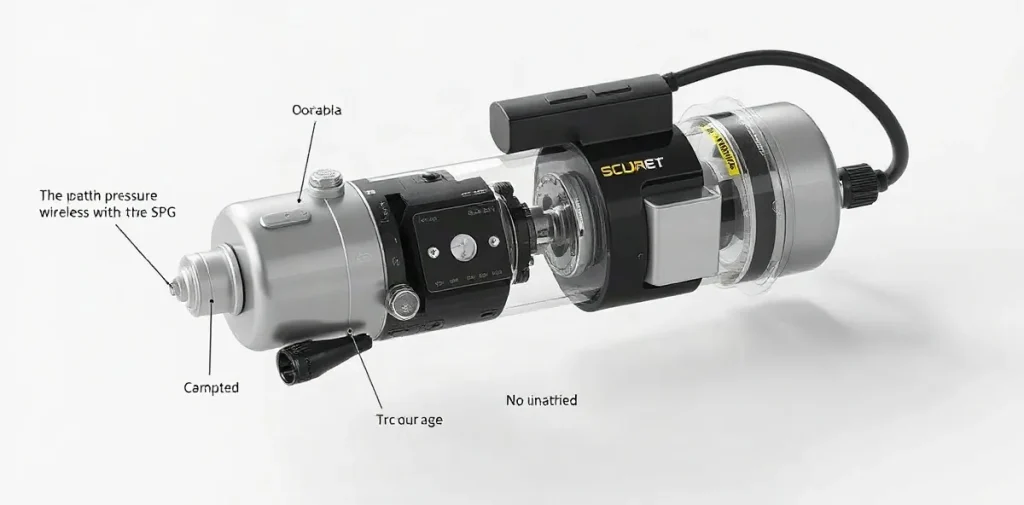
Air integration sends tank pressure to a compatible dive computer; an SPG shows it on a separate gauge. Air integration combines pressure monitoring with dive data, while an SPG provides a dedicated, independent display.
The choice comes down to how you want to read your gas supply underwater: on the same screen as other dive information or on a separate instrument. This guide to dive computers compares air integration and SPGs, including what each setup offers and what to consider when choosing between them.
| Criterion | Air-integrated computer | Traditional SPG |
|---|---|---|
| Pressure display | On the compatible dive computer | On a mechanical gauge |
| Connection | Wireless transmitter at the regulator | Mechanical high-pressure connection |
| Independent of computer and wireless link | No | Yes |
| Setup checks | Pairing and computer operation | Gauge and regulator connection |
| Main trade-off | Consolidated display; depends on electronics and wireless communication | Independent pressure check; adds a gauge and hose |
- approximately 21% Oxygen fraction in air as defined by the Oceanic PDC Safety and Reference Manual
- 79% Nitrogen fraction in air as defined by the Oceanic PDC Safety and Reference Manual
- 22 to 99% O2 Oxygen fraction range for nitrox as defined by the Oceanic PDC Safety and Reference Manual
How do air-integrated dive computers differ from an SPG?
An air-integrated dive computer receives cylinder-pressure information from a wireless transmitter mounted at the regulator; an SPG reads pressure mechanically through the regulator’s high-pressure connection. The computer can combine pressure, gas-use information and dive data on one display, while the SPG provides a separate pressure reading.
- Air integration: A wireless transmitter sends cylinder-pressure information to the dive computer, bringing gas and dive information together on its display.
- SPG: The submersible pressure gauge gives a mechanical pressure reading through the regulator’s high-pressure connection, separate from the computer’s display.
A University of Southern California Sea Grant publication, USCSG-TR-01-89, includes a session on international dive-computer experiences, including the Australian experience and experience in Canada. Its discussion of those experiences provides historical context for comparing how divers encounter computer-based information and pressure readings.
What does air integration measure—and what does it not measure?
An air-integration transmitter measures cylinder pressure and sends that reading to the dive computer; it does not independently identify or verify the breathing-gas mixture. The Oceanic PDC Safety and Reference Manual defines air as approximately 21% oxygen and 79% nitrogen, and nitrox as a nitrogen-oxygen breathing gas containing 22 to 99% O2.
That distinction matters because pressure and gas composition are different checks: a pressure display tells the diver how much pressure is in the cylinder, not which gas it contains. Before the dive, verify the gas identity separately and use the confirmed mixture when planning the dive.
An air-integrated computer can put cylinder pressure alongside dive information on one display, but that convenience does not replace gas verification or dive planning. Treat the transmitter reading as a pressure measurement, not proof that the cylinder contains air or a particular nitrox mix.
What does a wireless transmitter simplify, and what can fail?
Wireless air integration brings cylinder pressure and dive information onto one compatible computer, so a diver can check a wrist display instead of switching between it and a console SPG. The convenience depends on two devices working together: the transmitter must be paired with the computer, and the computer must be switched on and taken on the dive.
What to check before entry
A wireless setup adds a link and a display to the pressure-checking chain; either can leave the diver without a usable pressure reading if it is not ready. Before entering the water, confirm that the transmitter is paired, the computer is operating, and its displayed pressure agrees with the cylinder’s known state.
A mechanical SPG offers a different kind of check: it shows cylinder pressure without relying on a wireless transmission or a computer display. Divers who retain one alongside a transmitter have an independent mechanical way to check pressure if the wireless system or computer display fails.
When should a diver retain an SPG with air-integrated dive computers?
Retain an SPG with an air-integrated dive computer when you want a mechanical pressure check independent of the wireless transmitter, or when your training or dive operator requires one. Some divers rely on the transmitter as their only pressure display; others carry both, choosing the SPG as a backup if the wireless link or electronic display fails.
A traditional SPG also lets you check cylinder pressure before a dive without first powering up the computer or other electronic equipment. That can be useful during a pre-dive check, while the computer provides pressure and gas-use information during the dive.
Check requirements before changing your setup
Requirements vary by training protocol and dive operator, so confirm what applies to your dives before removing the SPG. The practical choice is between a transmitter-only setup and a transmitter paired with a mechanical gauge: keep both if independent pressure monitoring or a quick pre-dive check matters to you, and use the transmitter alone only when that configuration is permitted and suits your priorities.
What are the trade-offs and common setup mistakes?
Air integration trades a cleaner configuration for dependence on the dive computer and its wireless pressure link; keeping an SPG adds an independent mechanical check but also another instrument and hose. Neither arrangement removes the need to verify cylinder pressure before entering the water.
- Transmitter only: the computer displays pressure without an SPG hose, but a blank or missing wireless reading is a fault signal—not proof that the cylinder is empty or full. Check the cylinder with a backup gauge and resolve the problem before diving.
- Transmitter plus SPG: the computer provides pressure alongside dive data, while the SPG offers a separate mechanical reading if the wireless link or computer fails. The trade-off is retaining the gauge and its hose in the configuration.
Compatibility is another setup risk: a transmitter and computer do not necessarily communicate just because both support air integration. Confirm that the specific models are compatible, then complete and check their pairing before the dive. If the computer does not receive pressure, use the SPG rather than relying on an absent wireless value.
How should a diver choose a pressure-monitoring setup?
Choose air integration when a compatible dive computer’s combined cylinder-pressure and dive-data display fits the way you manage information underwater; retain a mechanical submersible pressure gauge (SPG) when independent pressure confirmation is a priority or your protocol requires it. These are different ways to organise pressure checks, not a universal rule for every diver.
- Air integration: Compare the computer with its compatible transmitter and the regulator connection the transmitter needs. The setup can bring cylinder pressure and dive information together on the computer display, but practise reading that display and checking the transmitter before relying on it underwater.
- Mechanical SPG: Include the gauge and its regulator connection in the configuration. An SPG gives you a separate mechanical way to check cylinder pressure if the wireless link or computer display is unavailable.
- Transmitter plus SPG: Assess the full arrangement: computer, compatible transmitter, regulator connection and retained gauge. This keeps the computer’s consolidated display while preserving an independent mechanical check.
Before diving, rehearse how you will read both displays and verify that the transmitter is communicating with the computer. Choose the arrangement that matches your workflow and applicable dive protocol, then practise with the complete setup—not just the computer or gauge on its own.
FAQ
Does an air-integrated dive computer replace an SPG?
What happens if the wireless transmitter stops communicating?
Can a dive computer identify whether the cylinder contains air or nitrox?
Is an SPG quicker to check before a dive?
What this piece draws on
- scubaboard.com — “SPG or Not? (Dive computer w/ air int)”
- somddivers.com — “Wrist, Console or Air-Integrated: Which Dive Computer Setup Actually Makes Sense?”
- divein.com — “Best Air-Integrated Dive Computers – divein”
- shearwater.com — “Streamlining Your Dive: Why More Divers Are Choosing”
- divingsquad.com — “15 Best Dive Computers of 2026 (From a Scuba Instructor)”