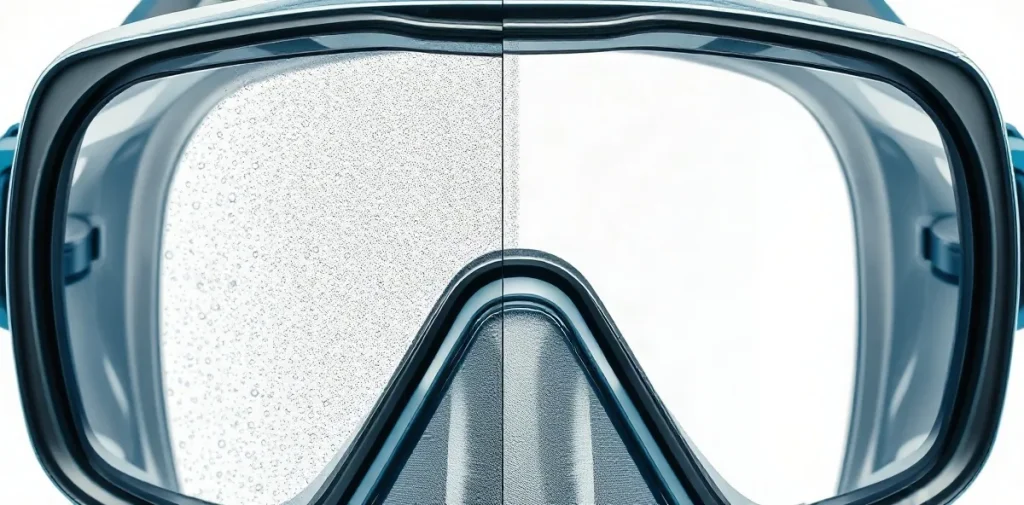
To stop a scuba mask fogging, clean its inner lens to remove residue, then use a mask defogger before diving. Rinse gently, avoid touching the treated surface, and check that the mask fits properly; moisture, residue and poor fit can all make visibility harder to maintain.
A fogged lens can turn a clear dive into a frustrating one, but repeatedly clearing the mask is not the only option. This guide to scuba equipment explains practical ways to prepare your mask and reduce fogging, while noting what to avoid so you do not damage the lens or irritate your eyes.
| Option | Best use | Trade-off or limitation |
|---|---|---|
| Non-whitening toothpaste | Preparing a new glass lens | Guidance is for glass; check care instructions for other materials. |
| Commercial mask defogger | Pre-dive anti-fog treatment | Follow the product directions; may not overcome manufacturing film. |
| Diluted soap | Routine treatment | Use a few drops in water; ideally choose reef-safe soap. |
| Baby shampoo | Alternative surfactant treatment | Avoid eye irritation and rinse as appropriate. |
| Spit or diluted spit | Quick temporary coating | Does not remove lens residue and may need reapplication. |
- 3 Common causes identified in the supplied material: temperature difference, breath moisture and manufacturing film.
- 1 Mask component addressed by these treatments: the inside lens surface.
- 0 Fixed waiting time or precise dosage provided for toothpaste, soap or defogger; follow product and mask instructions.
Why does scuba equipment fog up at the mask?
A scuba mask fogs when water vapour from the diver’s breath condenses on a lens that is cooler than the damp air inside the mask. The temperature difference encourages droplets to form, while microscopic marks on the glass can give moisture places to collect and blur vision.
Breathing out through the nose adds moisture directly to the mask’s enclosed air; exhaling through the regulator avoids that extra source. This does not remove moisture already in the mask, but it can reduce how much breath reaches the lens.
Why a new mask can fog
A new scuba mask may fog because a film left on its lenses during manufacturing interferes with a clear surface. Non-whitening toothpaste is one suggested way to clean glass lenses before use; PADI’s mask-fogging guidance also recommends it for brand-new masks. For ongoing care, regular cleaning helps remove particles, while a defogger or anti-fog solution can help moisture spread rather than gather into vision-obscuring droplets.
How should you prepare a new glass mask?
Glass lenses and manufacturing residue
Prepare a new mask with glass lenses by gently cleaning the inside of each lens with non-whitening toothpaste, then rinsing it thoroughly with water. The cleaning is intended to remove manufacturing film that can cause persistent fogging.
A defogger may not solve the problem while residue remains: a new glass mask can keep fogging despite repeated defogger applications until the lens is cleaned. After preparation, rinse away all toothpaste so cleaning residue does not impair visibility underwater.
- Glass lenses: Non-whitening toothpaste is the recommended cleaner for removing manufacturing film.
- Other lens materials: Do not assume toothpaste is suitable; check the mask manufacturer’s care instructions before using an abrasive cleaner.
Which anti-fog treatments work, and how do they differ?
Purpose-made defogger
Commercial mask defogger, diluted soap, baby shampoo and spit can all reduce fogging by helping condensation spread across the inside of a mask lens instead of clinging in droplets. A purpose-made defogger is the dedicated option: apply it as its label directs, and rinse the lens only if the instructions call for rinsing.
- Commercial mask defogger: Made for mask lenses; follow the product’s application and rinsing directions.
- Diluted soap: Mix a few drops of ideally reef-safe soap with water to create a surfactant coating.
- Baby shampoo: Use a small amount, then rinse enough to reduce the chance of eye irritation if it enters your eyes.
- Spit: Apply it to the inside of the glass for a quick, temporary coating; diluting it with salt water is another option.
Soap, shampoo and spit
Diluted soap and baby shampoo are surfactants, as is spit: they help lower the surface tension of condensation so moisture is less likely to gather in clinging droplets. Soap and shampoo are applied as a thin film; spit is a convenient short-term measure when a dedicated defogger is unavailable.
What should you do if the mask fogs during a dive?
If your scuba mask fogs during a dive, clear it using the method you have practised, then check that you can see clearly before continuing. If visibility is still impaired, do not proceed until you can see well enough to dive safely.
Quick treatment and a persistent fogging problem
At the surface, spread a small amount of spit—or spit diluted with water—across the inside glass as an immediate treatment. This can help the moisture form a thinner film instead of obscuring the view, but it may not solve a recurring problem.
Keep your breathing out of your nose while the mask is on: nose-breathing adds moisture to the air trapped inside it. If fogging persists, inspect the lenses for residue, particularly on a new mask, and clean the glass before applying a suitable defogger again. Repeatedly adding spit without addressing lens residue is a quick fix, not a reliable substitute for cleaning and defogging.
When do mask anti-fog methods fail or cause problems?
Common mistakes
Mask anti-fog methods can fail when a new mask still has manufacturing film on its glass, when a treatment leaves residue, or when moisture from nose-breathing continues to reach the lens. A defogger may not remove that film, so repeated applications alone may not solve persistent fogging.
- New glass lenses: Non-whitening toothpaste is suggested for removing manufacturing film, but it is not a universal cleaner for every mask material. Use it only where appropriate for the lens, and follow the mask maker’s care instructions.
- Soap, shampoo and defogger: Excess product can leave a film or irritate the eyes. Follow the product directions and rinse the lens as instructed rather than assuming that more treatment works better.
- Spit: It is a convenient, temporary coating, not a substitute for cleaning a lens that still has manufacturing residue or particles.
- Nose-exhalation: Breathing out through the nose adds moisture inside the mask. Reducing it addresses a different cause from regular lens cleaning, which removes residue and particles.
These methods address different problems: cleaning tackles material on the lens, while anti-fog coatings and avoiding nose-exhalation help limit condensation. If fogging persists after cleaning a new glass lens, check for remaining film before simply applying more defogger.
How can you choose a treatment for your mask?
Choose treatment by stage: use non-whitening toothpaste to remove possible manufacturing film from a new glass mask, rinse it thoroughly, then use a mask defogger or diluted soap before routine dives. For a quick surface fix, spit can coat the inside glass, but it will not remove residue left on a new lens.
- New glass mask: Treat the inside of the lens with non-whitening toothpaste, then rinse. This step addresses manufacturing film; adding defogger or spit without cleaning the film is not a substitute.
- Before a dive: Apply a mask defogger, or use diluted soap. Reef-safe soap is a preferable soap option for this purpose.
- At the surface: Spit, or diluted spit, can coat the inside glass as an immediate measure. It is a temporary treatment, not a way to clean a new lens.
Check the mask’s lens material before applying any treatment, and follow the manufacturer’s care and treatment instructions. The toothpaste advice here is specifically for glass lenses; do not assume the same approach suits every lens material. Choose a compatible product and rinse as directed so routine anti-fog treatment does not replace proper lens care.
FAQ
Why does my new scuba mask fog even after I apply defogger?
Can I use toothpaste on any dive-mask lens?
Does spit work as mask defogger?
Why does breathing through my nose make the mask fog?
What this piece draws on
- diversdirect.com — “Why Does My Scuba Mask keep Fogging up?”
- tropicalsnorkeling.com — “Prevent Snorkel Mask Fogging – Learn The Tricks”
- bsac.com — “De-mystifying de-misting your scuba mask”
- scubaguru.com — “How to Pre-Treat a New Dive Mask – ScubaGuru”
- blog.padi.com — “Tips for Preventing Mask Fog”
