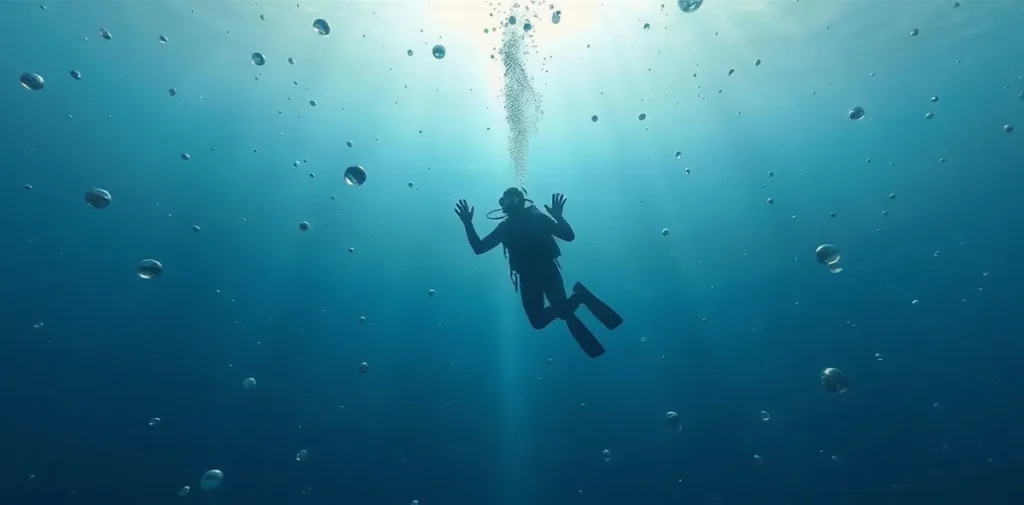
Being seen underwater is a safety problem shaped by light, water clarity, distance and the signals a diver can make. The research area examines how divers are detected and recognised in submerged environments, a practical concern for buddy contact, search and rescue, and scientific work.
What makes a diver difficult to see?
Water reduces visibility through absorption and scattering. Suspended particles scatter light, while dissolved substances and depth affect how much light remains and which colours are visible. The result can change quickly with location, depth, weather and disturbance of the bottom.
Visibility is not simply a measure of how far a person can see. A diver may detect a shape without being able to identify it, or may see a buddy only when both face a useful light source. Contrast, viewing direction, background and movement all affect detection.
These conditions matter because divers often work with limited sight lines. A buddy can pass behind structure, disappear in low visibility or be obscured by bubbles and suspended sediment. Visibility therefore belongs in planning alongside depth, gas, exposure and the task itself.
How do researchers study detection underwater?
Studies of underwater visibility can examine the distance at which an observer detects a target, how accurately people distinguish a diver from the background, and whether a signal is noticed under different conditions. Methods may use controlled viewing tasks or observations in real underwater settings, where lighting and water clarity are harder to standardise.
Researchers must separate seeing from recognising. A flash, silhouette or coloured object may attract attention without conveying who is present or what they need. Testing a signal therefore involves both whether it can be detected and whether its meaning is clear to the intended observer.
- Water clarity: suspended material and dissolved substances alter contrast and viewing distance.
- Illumination: depth, ambient light and artificial lights change visibility and colour appearance.
- Target and background: size, movement, colour and contrast affect whether a diver stands out.
- Observer and task: viewing angle, attention and the need to identify or respond shape the outcome.
Results from a controlled setting do not automatically describe every dive site. Conditions and observer tasks need to be considered when applying any finding to operational procedures.
Why does visibility matter for dive safety?
Loss of visual contact can disrupt buddy procedures and complicate a response to an emergency. If a diver is missing, poor visibility can make the search slower and less predictable; a signal that is hard to see or interpret may not resolve the problem.
Detection also has a human-factors dimension. Divers may be concentrating on navigation, instruments or a task, while a changing background competes for attention. A signal must work in the actual circumstances, not merely be conspicuous when viewed in isolation.
For scientific divers, visibility affects observation and data collection as well as team coordination. It can limit what a diver can record, how precisely a task can be performed and whether another team member can monitor the work. Planning should account for the expected conditions and a loss of visual contact.
What can equipment and signalling contribute?
Lights and visual signals can improve detection, but no single colour or device guarantees visibility in every water type and lighting condition. Colour changes with depth and distance, while a light may be masked by glare, particles or an obstructed line of sight. Equipment selection should match the environment and the communication task.
Signals also depend on shared understanding. Divers need to know what a signal means, when to use it and what response is expected. In practice, a visible signal is only useful if the recipient notices it and can act on it.
Visibility aids do not replace team procedures. A plan for separation, communication and recovery remains important when divers cannot rely on continuous visual contact. If a dive involves unusual conditions or a medical concern, discuss the plan with an appropriately qualified diving-medicine professional.
Frequently asked questions
Is underwater visibility the same as water clarity?
Does a bright colour always make a diver easier to see?
What should a buddy team do when visual contact is lost?
An original research-library explainer written by the Rubicon editors. It is not a summary of a specific publication.
Related reading on Rubicon
- Why Divers Get Cold Faster Underwater
- Glossary of Essential Underwater Physiology Terms for Divers
- The Diving Reflex: What Happens Underwater
- Diving Safety: Key Insights into Underwater Exploration
- Divers and Underwater Sound at 800–2250 Hz
- The Effects of Underwater Blast on Divers
- More on Safety
- Browse the Research Library