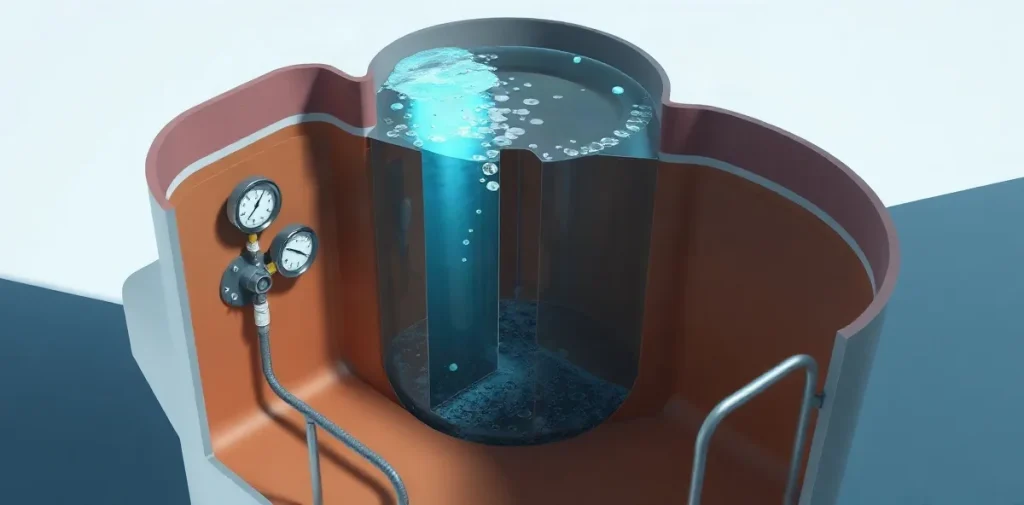
Decompression sickness in tunnel construction sits at the boundary of occupational medicine and diving physiology. Both tunnel workers and divers can absorb inert gas under elevated pressure, then face injury if pressure falls too quickly or gas forms bubbles in tissues and blood. Studying compressed-air work helps clarify how exposure, decompression and clinical care interact.
Why study tunnel work alongside diving?
Workers in pressurised tunnel environments may breathe air while exposed to pressure above that at the surface. This resembles a dive in a central physiological respect: increased ambient pressure raises the amount of inert gas, chiefly nitrogen, that dissolves in the body. During decompression, that gas must leave the body safely.
The settings are not identical. A diver moves through changing depth and may make repeated descents, while tunnel workers can remain in a pressurised working area and return through a decompression system. Comparing such exposures broadens the evidence base beyond recreational diving and helps clinicians consider how different pressure histories shape risk.
What happens during decompression?
At depth or in a pressurised workplace, elevated pressure drives more inert gas into blood and tissues. The amount taken up depends on factors including pressure, exposure duration, breathing gas and the characteristics of different tissues. During ascent or chamber decompression, pressure decreases and dissolved gas is carried back toward the lungs for elimination.
If pressure drops faster than gas can be cleared, bubbles may form. Their effects can include pain, skin or neurological symptoms, and problems involving the lungs or circulation. Decompression sickness is a clinical diagnosis, not simply the presence of bubbles; symptoms and their timing must be assessed in context.
What questions do occupational studies examine?
Research on pressurised work asks how the pressure profile, duration, decompression procedure and repeated exposures relate to illness. It also examines how work organisation and access to medical care affect recognition and treatment. These questions matter because a decompression schedule is applied to people doing real tasks, not to an abstract pressure profile alone.
- Exposure: What pressures and durations do workers experience, including repeat shifts?
- Decompression: How is pressure reduced, and how does the procedure account for the exposure?
- Clinical surveillance: Which symptoms arise, when do they appear, and how are cases assessed?
- Workplace conditions: How do task demands, communication and access to care influence response?
Such investigations need careful case definitions and exposure records. Symptoms can be delayed, and several conditions can resemble decompression sickness, so clinical assessment and a reliable account of pressure history are central to interpreting cases.
How does this research connect to diving medicine?
Diving medicine addresses a wider set of pressure-related problems, including decompression sickness, arterial gas embolism, barotrauma and effects of breathing gas at depth. Occupational studies contribute to the shared understanding of inert-gas uptake and decompression, while also highlighting differences between a work chamber and an open-water dive.
That comparison is useful but not a direct template for an individual diver. Exposure patterns, breathing gases, decompression procedures and emergency access can differ substantially. For a diver with possible decompression illness, prompt assessment by a diving-medicine physician is important; suspected serious illness requires emergency care.
Why does the workplace setting matter?
In occupational pressure environments, decompression is part of a managed work process. Procedures, supervision, symptom reporting and arrangements for medical evaluation all affect how a possible case is handled. The same physiology that concerns divers therefore has practical consequences for employers and clinicians responsible for pressurised work.
For scientific divers, the broader lesson is to treat pressure exposure as a complete history: depth or working pressure, time, breathing gas, decompression and any repeated exposure. If symptoms occur after a dive or pressure exposure, record when they began and seek medical evaluation rather than relying on a schedule alone.
Frequently asked questions
Can tunnel workers get decompression sickness?
Is tunnel decompression the same as scuba decompression?
What should a diver do about possible decompression illness?
An original research-library explainer written by the Rubicon editors. It is not a summary of a specific publication.
Related reading on Rubicon
- Decompression Sickness: Causes and Risk Reduction
- How Decompression Sickness Develops: Physiological
- Managing Suspected Decompression Sickness on a Dive Boat
- Safety Dive: Safety Stops vs Decompression Stops
- Constrictive Postures and Decompression Sickness
- Caisson and Tunnel Decompression: Research Summary
- More on Dive Medicine
- Browse the Research Library