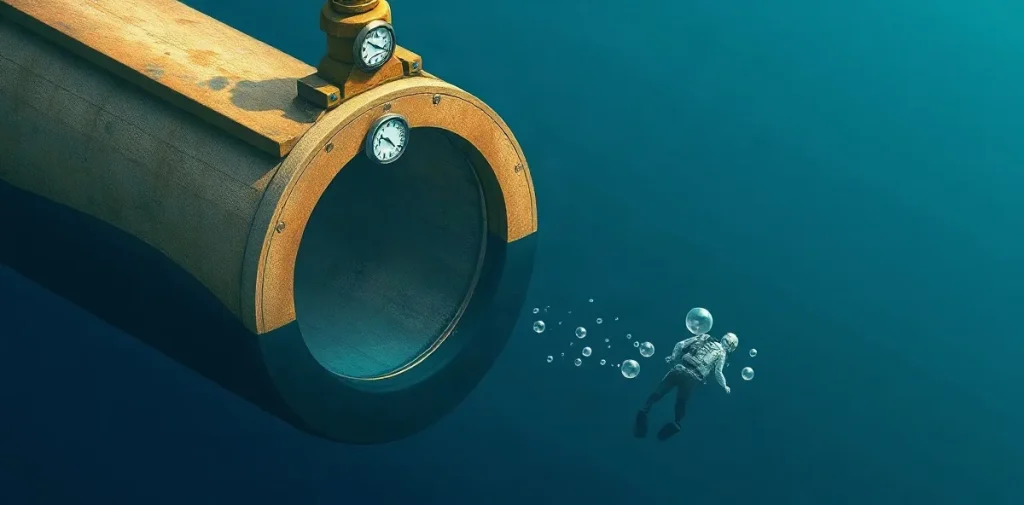
Caisson disease research examines how working under pressure and returning to surface conditions can cause decompression illness. Its history in bridge construction connects occupational medicine with modern diving: both ask how pressure exposure, gas exchange and ascent affect the body, and how illness can be recognised and treated.
What does caisson disease mean?
Caissons are pressurised workspaces used in underwater construction. Workers entered them through airlocks, where pressure was raised to match the environment around the work area. On leaving, they had to decompress as pressure returned towards the surface level.
At elevated pressure, more inert gas—principally nitrogen in ordinary breathing air—dissolves in body tissues. During decompression, that gas must leave the body through the lungs. If pressure falls faster than gas can be eliminated, bubbles may form in tissues or blood and disrupt normal function.
“Caisson disease” is a historical name associated with decompression illness in compressed-air workers. The underlying problem is closely related to decompression sickness in divers, although the work setting, exposure pattern and practical controls differ.
What questions does this research area ask?
Studies of caisson work examine the relationship between pressure exposure, time spent under pressure, decompression procedures and symptoms. They also consider how the nature of the work and the conditions of the pressure chamber may affect exposure and the recognition of illness.
The central physiological issue is not simply whether a person has been under pressure. It is how inert gas enters and leaves the body, and how the balance between uptake and elimination changes during a pressure transition. Symptoms can involve different parts of the body, so clinical assessment must consider the exposure history as well as the person’s condition.
- Pressure exposure: the pressure level and duration of work in a compressed environment.
- Decompression: the staged or continuous reduction in pressure on returning to the surface.
- Inert-gas kinetics: the uptake and elimination of gases that do not take part in normal metabolism.
- Clinical presentation: the symptoms and signs that may follow a pressure exposure.
- Prevention and treatment: work procedures and medical responses intended to reduce harm.
How do researchers study compressed-air illness?
Historical research can reconstruct working conditions, pressure practices and reported illnesses from records of major construction projects. This helps place medical problems in their occupational context, while showing how early experience shaped later thinking about decompression.
Physiological and clinical approaches address different parts of the problem. Pressure-exposure records and symptom histories help describe when illness occurs; laboratory and theoretical work can examine gas exchange and bubble formation. No single method captures every factor, and the interpretation of symptoms depends on exposure details.
Modern decompression research uses these questions to develop and assess procedures for managing pressure changes. Models are useful tools, not guarantees that an individual will avoid illness: actual risk can depend on the exposure, the person and the circumstances of the dive or work.
Why does bridge-construction history matter to divers?
Caisson workers and divers share a basic physiological challenge: pressure changes alter the movement of inert gas into and out of the body. The historical setting differs, but the questions about exposure, decompression and illness remain relevant to occupational and recreational diving.
For divers, this history helps explain why ascent procedures matter and why decompression sickness is treated as a medical problem rather than a simple measure of how deep a dive was. Dive physicians use the exposure profile and clinical presentation together when assessing a possible case. Suspected decompression illness warrants prompt professional assessment; a diving-medicine physician should guide decisions about care.
How does this subject fit into hyperbaric medicine?
Caisson disease belongs to a wider field concerned with the effects of pressure on the human body. Decompression sickness is one part of that field; other research examines oxygen exposure, gas bubbles and interactions between bubbles and blood. These are related topics, but they address distinct mechanisms and clinical questions.
Hyperbaric medicine also considers how treatment in a pressurised chamber can be used after decompression illness. Understanding the original exposure remains important: the pressure history, timing and symptoms help clinicians judge the problem and plan an appropriate response.
Frequently asked questions
Is caisson disease the same as decompression sickness?
Why can decompression cause illness?
What should a diver do if decompression illness is suspected?
An original research-library explainer written by the Rubicon editors. It is not a summary of a specific publication.
Related reading on Rubicon
- Safety Dive: Safety Stops vs Decompression Stops
- Decompression Sickness: Causes and Risk Reduction
- How Decompression Sickness Develops: Physiological
- How Hydration Affects Decompression Stress and Diver Health
- Caisson and Tunnel Decompression: Research Summary
- Thesis Research in Diving and Hyperbaric Medicine
- More on Dive Medicine
- Browse the Research Library