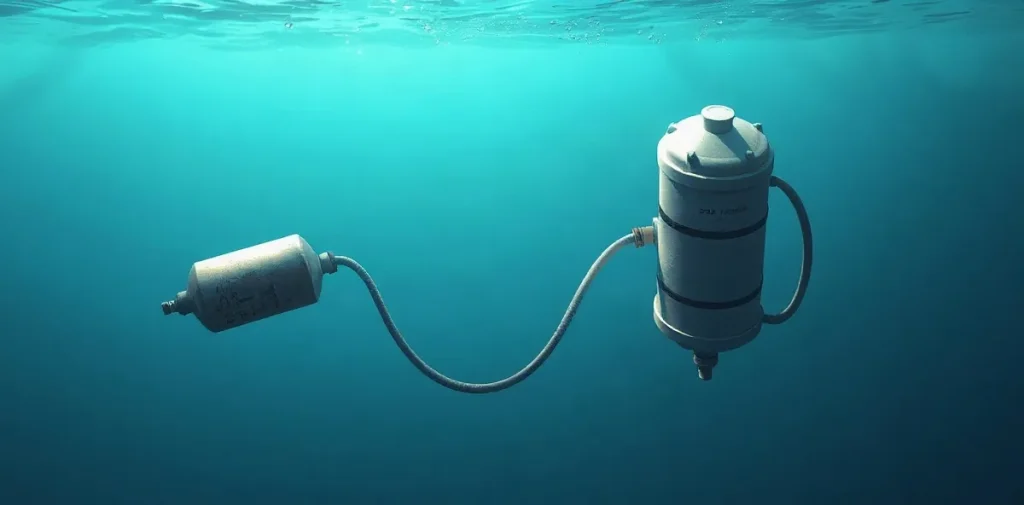
A History Of Closed Circuit Oxygen Underwater Breathing Apparatus is a 1970 technical report by Quick D, published in Sydney by the Royal Australian Navy, School of Underwater Medicine. Its subject is the development of closed-circuit oxygen breathing equipment—a history that matters because apparatus design directly shapes the diver’s gas supply, exposure and safety underwater.
What does closed-circuit oxygen equipment do?
A closed-circuit breathing apparatus returns exhaled gas to a breathing loop rather than releasing each breath directly into the water. Oxygen is supplied to replace what the diver consumes, while a carbon-dioxide absorbent removes the waste gas produced by metabolism. The diver breathes from a circulating supply that must remain suitable for the depth and task.
That basic arrangement links mechanical design to physiology. The loop, oxygen supply, breathing resistance, seals and absorbent all contribute to whether a diver can breathe effectively and whether the gas remains safe to use. The title identifies the report’s focus as oxygen-based apparatus, rather than closed-circuit systems using a mixture of gases.
Why does oxygen require careful depth management?
Oxygen is essential for life, but its partial pressure rises as ambient pressure increases with depth. A partial pressure that is safe at one pressure may become hazardous at another; excessive oxygen exposure can affect the central nervous system and may cause convulsions. In water, sudden incapacitation can quickly become life-threatening.
Oxygen apparatus therefore depends on controlling depth and exposure, not merely on carrying a supply of breathable gas. This is one reason the history of the equipment is also relevant to diving medicine: it concerns how a life-support system operates within the limits of human physiology.
What other physiological hazards matter in a closed loop?
Carbon-dioxide removal is a central function. If the absorbent is exhausted, the loop is flooded or channelled, or gas circulation is inadequate, carbon dioxide can accumulate. Elevated carbon dioxide can cause distress and impair judgment, and it can complicate the diver’s response to other hazards.
Breathing effort also matters. A diver must move gas through the apparatus while working underwater, and resistance or an unsuitable breathing configuration can increase the burden. Temperature, moisture and equipment condition affect the practical use of the loop, while oxygen supply and carbon-dioxide control remain essential to its safe operation.
- Oxygen exposure: depth and duration affect the partial pressure experienced by the diver.
- Carbon-dioxide absorption: the absorbent and gas flow must support effective removal.
- Breathing performance: resistance and loop configuration influence the effort of ventilation.
- Equipment integrity: leaks, flooding or malfunction can disrupt the breathing supply.
Why is the apparatus’s history useful to divers and clinicians?
Tracing the development of a breathing system helps readers understand why its components and operating limits matter. Historical study can place design choices in context: oxygen supply, gas circulation, carbon-dioxide removal and depth constraints are connected engineering and medical problems, not separate details.
For divers and scientific teams, closed-circuit systems can serve tasks where a self-contained breathing loop is useful. For diving physicians and hyperbaric clinicians, familiarity with oxygen exposure, carbon-dioxide retention and equipment-related emergencies supports the assessment of incidents and the interpretation of symptoms. Individual concerns about fitness to dive or oxygen exposure should be discussed with a diving-medicine physician.
How does this subject fit into diving research?
Closed-circuit oxygen apparatus sits at the intersection of equipment history, respiratory physiology and operational safety. Research and technical evaluation in this area commonly examine how a breathing loop supplies oxygen, removes carbon dioxide and performs under the pressures and demands of underwater use. The human factors of breathing effort and the consequences of malfunction are part of the same problem.
Quick D’s report belongs to the historical study of underwater breathing apparatus. Its subject provides a way to consider how life-support technology and knowledge of human limits meet in diving practice, while keeping the distinction clear between the history of a system and the medical principles that apply to its use.
Frequently asked questions
What does “closed circuit” mean in diving?
Why is oxygen depth-sensitive?
What is the role of the carbon-dioxide absorbent?
Citation details
- Title: A History Of Closed Circuit Oxygen Underwater Breathing Apparatus
- Authors: Quick D
- Year: 1970
- Published in: Royal Australian Navy, School of Underwater Medicine, Sydney
- Identifiers: RANSUM-1-70
- Record type: Technical report
- Repository record: Rubicon Research Repository, handle 123456789/4960
This page is an original summary written by the Rubicon editors from the publication’s bibliographic record. It does not reproduce the paper, its abstract or its data; consult the publication itself for its methods and findings.
Related reading on Rubicon
- Diving Safety: Key Insights into Underwater Exploration
- Diving: Exploring Underwater Activities, Science, and Safety
- Science Diving: Protocols and Techniques for Underwater
- Diving Fundamentals: An Authoritative Guide to Underwater
- CNS Oxygen Toxicity in Closed-Circuit Diving
- Closed-Circuit Oxygen Diving in the U.S. Navy
- More on Equipment
- Browse the Research Library