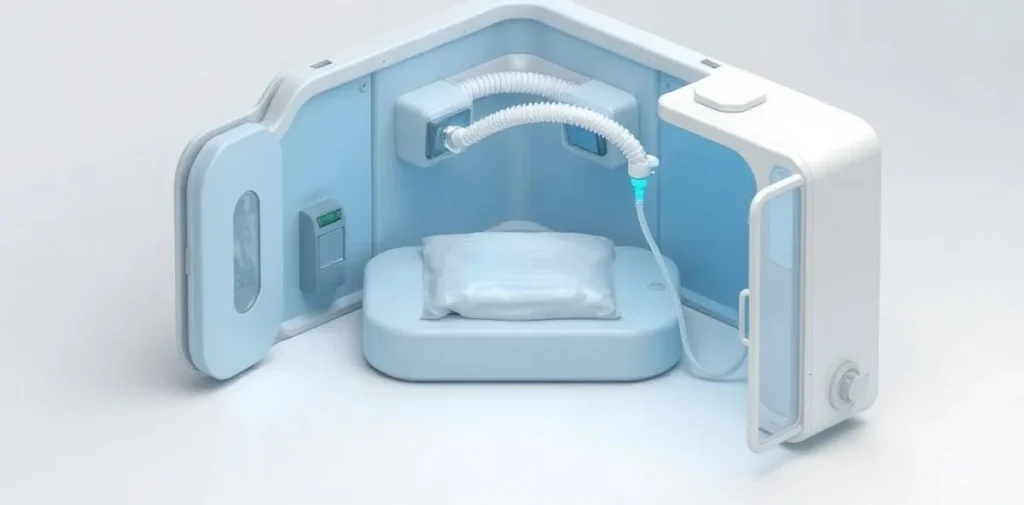
Hyperbaric oxygen and infectious disease research asks how elevated pressure and high oxygen availability affect microbes, infected tissue and the body’s defences. The subject matters in diving medicine because pressure changes oxygen delivery and tissue physiology, while infection itself can complicate assessment and treatment in people who dive.
What does pressure change in oxygen delivery?
In a hyperbaric chamber, a person breathes oxygen at a pressure above normal atmospheric pressure. This raises the amount of oxygen dissolved in blood plasma, in addition to the oxygen carried by haemoglobin. How much reaches a particular tissue also depends on blood flow, local swelling, vessel function and the distance oxygen must diffuse.
Infection can disrupt those conditions. Inflammation may cause swelling and impair small-vessel circulation, leaving some tissue poorly oxygenated even when oxygen is available in the blood. Hyperbaric research therefore considers not just the pressure setting, but whether oxygen can reach the affected tissue and how that changes the local environment.
How might oxygen and pressure affect infection?
Researchers examine several linked mechanisms rather than treating oxygen as a simple disinfectant. Oxygen availability can influence the growth and metabolism of different microbes, while pressure may alter microbial physiology. The effects are not uniform: organisms differ, and an infected wound is a changing environment shaped by tissue damage, immune activity and treatment.
Oxygen also supports parts of the immune response. Some white blood cells use oxygen-dependent chemistry to help kill microbes, so low oxygen in tissue can constrain this activity. At the same time, infection can produce tissue injury and inflammation; understanding the balance between host defence and damage is central to studying any proposed adjunctive treatment.
- Oxygen transport: how pressure changes dissolved oxygen and its movement into tissue.
- Microbial response: how oxygen availability and pressure may affect different organisms.
- Host defence: how tissue oxygenation relates to immune-cell function.
- Local conditions: how swelling, circulation and tissue damage shape exposure.
What questions do studies in this area ask?
Mechanistic studies can investigate microbial growth under controlled oxygen and pressure conditions, or examine how cells and tissues respond. Laboratory models help isolate variables, but they cannot fully reproduce an infection in a living person. Clinical research must also account for the infection’s site and severity, the organism involved, other treatments and the patient’s overall condition.
That distinction matters when interpreting the wider literature. A biological mechanism can make a treatment plausible without establishing whether it improves outcomes in a particular infection. Research therefore spans basic physiology, microbiology and clinical evaluation, with each approach answering a different part of the question.
Why does this matter to divers and clinicians?
For divers, infection is usually a separate medical problem from decompression illness, but the two can intersect in assessment and care. Illness, wounds or impaired tissue healing may affect fitness to dive, and pressure exposure is not a substitute for diagnosing or treating an infection. A diver with a significant infection or a wound that is not healing should seek advice from a diving-medicine physician before returning to exposure.
Hyperbaric oxygen is delivered in a clinical chamber under medical supervision; it is not equivalent to breathing oxygen underwater. Diving physicians and hyperbaric clinicians must distinguish research into infection mechanisms from decisions about an individual patient, which depend on diagnosis, treatment options and clinical risks.
How does this research fit into hyperbaric medicine?
Infectious disease is one part of a broader effort to understand how pressure changes human physiology and whether those changes have therapeutic value. Related work considers oxygen delivery in damaged tissue and other conditions where normal circulation or oxygen transport is impaired. Across these areas, a recurring question is whether a measurable physiological effect translates into a meaningful clinical benefit.
That question requires evidence at more than one level: a mechanism, a clinically relevant treatment protocol and outcomes that matter to patients. The infection itself also matters; findings about one organism or tissue setting cannot automatically be applied to another. For a particular diagnosis, the treating team should assess whether hyperbaric treatment is appropriate alongside established infection care.
Frequently asked questions
Does hyperbaric oxygen kill every kind of microbe?
Is chamber treatment the same as breathing oxygen on a dive?
Can a diver with an infection return to diving?
An original research-library explainer written by the Rubicon editors. It is not a summary of a specific publication.
Related reading on Rubicon
- The Physiology Behind Oxygen Toxicity in Deep Dives
- Understanding Oxygen Toxicity Risks and Prevention in Diving
- Oxygen Partial Pressure: Key to Dive Safety and Performance
- Myth Busting: Clarifying Oxygen Toxicity Limits in Diving
- Hyperbaric Oxygen Therapy for Lyme Disease
- Infectious Diseases and Hyperbaric Oxygen
- More on Dive Medicine
- Browse the Research Library