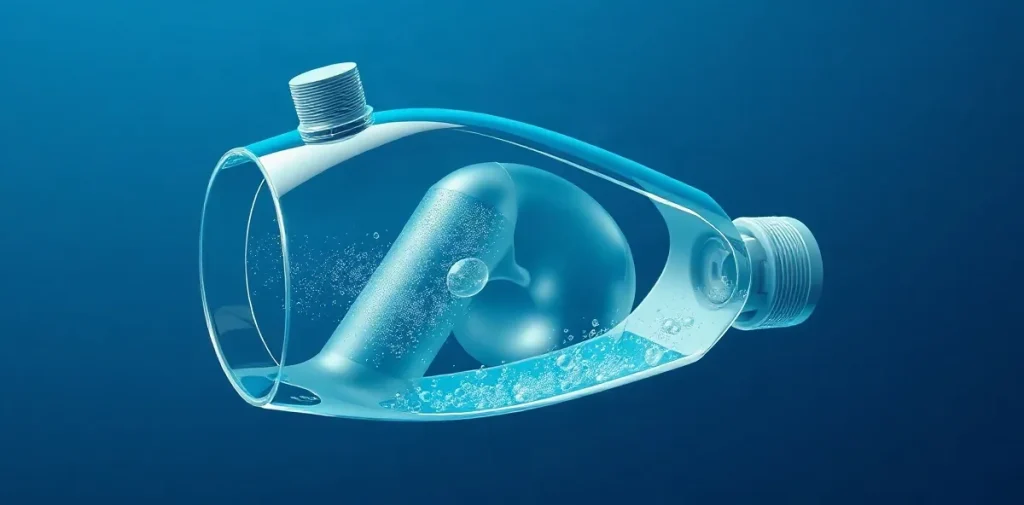
Liquid breathing is the study of whether a liquid can carry respiratory gases into and out of the lungs in place of air. It connects lung mechanics, gas exchange and pressure physiology, making it relevant to divers because breathing systems must manage oxygen and carbon dioxide while the surrounding pressure changes.
What does liquid breathing ask researchers to understand?
Ordinary breathing moves gas through branching airways to the alveoli, where oxygen enters the blood and carbon dioxide leaves it. Liquid breathing poses a different engineering and physiological problem: a dense fluid must move through the respiratory tract while carrying enough dissolved oxygen to support metabolism and removing carbon dioxide effectively.
The question is not simply whether a liquid can contain oxygen. Researchers must consider how it flows, how quickly gases move between liquid and blood, and whether the lungs can be filled and emptied without excessive effort or injury. The method also raises questions about airway protection and the body’s response to an unfamiliar breathing medium.
Why are oxygen and carbon dioxide the central challenge?
Oxygen supports cellular energy production, while carbon dioxide is a metabolic waste product that must be cleared continuously. In conventional breathing, ventilation replenishes oxygen in the alveoli and carries carbon dioxide out. With a liquid medium, both transport steps depend on gas solubility, fluid movement and the large surface area available for exchange in the lungs.
Carbon-dioxide removal deserves particular attention because rising carbon dioxide can alter blood acidity and affect breathing, circulation and consciousness. Oxygen delivery alone would not make a breathing system adequate. Any assessment has to examine the balance between oxygen supply and carbon-dioxide clearance, as well as the work required to move the medium.
- Gas solubility: how much oxygen and carbon dioxide the liquid can carry.
- Gas exchange: how efficiently gases move between the respiratory medium and blood.
- Fluid mechanics: the pressure and effort needed to move liquid through airways and lungs.
- Physiological response: how lung tissue and the rest of the body respond to liquid ventilation.
How does pressure change the problem for divers?
Underwater, ambient pressure increases with depth. Conventional scuba equipment supplies breathing gas at a pressure matched to the surrounding water, allowing the diver to inhale, but gas density and the work of breathing also increase with pressure. These constraints make respiratory physiology central to dive equipment design and to understanding the limits of underwater work.
A liquid is far less compressible than a gas, but that does not make liquid breathing a ready-made solution to pressure-related challenges. The lungs still need adequate gas exchange, and fluid movement still requires a pressure gradient. For diving research, the useful comparison is between the demands imposed by a liquid medium and those already managed by gas-breathing systems—not an assumption that one can simply replace the other.
What methods can investigate liquid breathing?
Research in this area has to connect material properties with biological function. Laboratory work can examine how respiratory liquids dissolve and transport gases, while physiological studies can assess ventilation, blood-gas exchange, respiratory effort and tissue response. Each approach answers a different part of the problem.
For a method intended to work under pressure, testing would also need to consider the surrounding pressure and the operation of the breathing apparatus. Researchers would look for changes in oxygenation, carbon-dioxide clearance, lung mechanics and signs of physiological stress. Those measurements help distinguish a promising physical principle from a system that could function safely in a living body.
Why does this research matter beyond a proposed breathing system?
Liquid-breathing research sits at the intersection of diving science, respiratory physiology and hyperbaric medicine. It prompts questions about how the lungs exchange gases, how pressure affects ventilation, and what a respiratory system must do to sustain the body. Those questions also inform the broader study of breathing apparatus and the physiological demands of underwater and hyperbaric environments.
The subject is not routine diver care, and liquid breathing should not be treated as an alternative to approved diving equipment. Divers and clinicians can use the underlying physiology to frame questions about gas exchange and breathing effort, but clinical concerns belong with a diving-medicine physician. For any practical dive, use equipment intended for that purpose and follow its operating procedures.
Frequently asked questions
What is liquid breathing?
Why is carbon-dioxide removal important?
Does liquid breathing have a practical role in recreational diving?
An original research-library explainer written by the Rubicon editors. It is not a summary of a specific publication.
Related reading on Rubicon
- Understanding the Physiology of Breath-Hold Diving
- The Science of Diving SSI: Education and Physiology Insights
- Diving Science: Physiology and Tech Behind Safe Dives
- The Physiology Behind Oxygen Toxicity in Deep Dives
- Physiology of Breath-Hold Diving: Research Summary
- Breath-Hold Diving Physiology and Japan’s Ama
- More on Diving Science
- Browse the Research Library