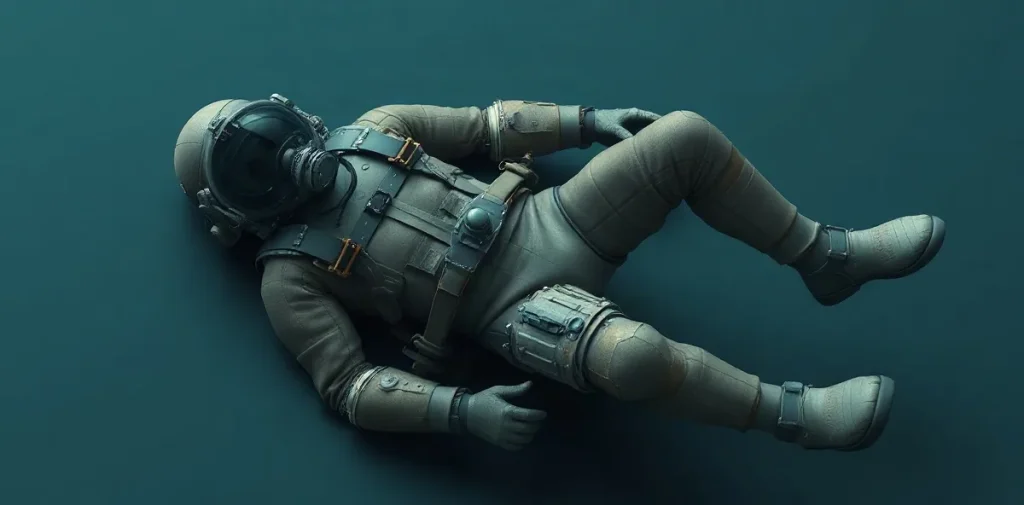
Evaluation of JIM: A One-Atmosphere Diving Suit is a 1976 publication by Carter Jr in the US Navy Experimental Diving Unit Technical Report NEDU-05-76. It addresses a pressure-resistant diving suit designed to keep its occupant at approximately surface pressure, a technical approach with consequences for mobility, life support and diver safety.
What does “one-atmosphere” mean in a diving suit?
Water pressure increases with depth, placing a diver and their equipment in an environment very different from the surface. In ordinary scuba and surface-supplied diving, breathing gas is delivered at the surrounding pressure. The diver’s body therefore experiences elevated ambient pressure, and the gas breathed must be managed accordingly.
A one-atmosphere suit takes a different approach: its rigid enclosure is intended to maintain an internal environment near surface pressure while resisting the water pressure outside. The diver does not simply breathe the surrounding water-pressure gas. The suit instead functions as a pressure vessel worn underwater, with joints and controls that must operate across the pressure boundary.
That distinction makes a suit of this kind more than protective clothing. Its enclosure, seals, joints, life-support arrangements and operating procedures all affect whether the diver can work effectively while remaining isolated from ambient pressure.
Why consider a one-atmosphere suit?
Ambient-pressure diving brings physiological demands that depend on depth, breathing gas, exposure time and ascent. Gas narcosis, oxygen toxicity and decompression illness are among the concerns that shape dive planning and medical oversight. A pressure-retaining suit changes the exposure problem by seeking to keep the diver’s body at a much lower pressure than the surrounding water.
That does not make the dive risk-free. A sealed pressure vessel introduces its own hazards, including loss of pressure integrity, restricted movement, limited visibility or difficulty using tools. The diver also depends on the suit’s life-support system and on procedures for managing faults and returning to the surface.
For scientific and other underwater work, the practical question is not pressure isolation alone. The suit must let its occupant perform tasks, communicate, maintain orientation and remain supported throughout the planned dive.
What technical questions shape an evaluation?
Evaluation of a one-atmosphere suit involves the interaction of its parts under real operating conditions. A suit can be mechanically strong yet difficult to control, or provide a stable internal environment while limiting the work its occupant can perform. Design performance is therefore assessed as a system rather than as a shell in isolation.
- Pressure integrity: whether the enclosure and its seals preserve the internal pressure boundary.
- Mobility and dexterity: how the joints permit movement and manipulation of equipment underwater.
- Life support: how breathing gas and other essential support are maintained inside the suit.
- Visibility and control: whether the diver can monitor the surroundings and operate suit systems.
- Failure management: how faults affect the diver and what recovery procedures the system requires.
These considerations connect engineering tests with human performance. Testing may address movement, task completion, controls and operating limits, alongside the suit’s response to pressure and environmental exposure. The relevant measures depend on the design and the intended work.
How does the subject fit into diving medicine?
One-atmosphere suits sit alongside other ways of managing underwater pressure exposure, including conventional scuba and surface-supplied diving. Each approach creates a different balance among depth capability, equipment complexity, diver workload and physiological exposure. The choice depends on the task and the conditions, not on a single measure of safety.
For diving physicians and hyperbaric clinicians, pressure isolation matters because it changes which physiological stresses are central to the dive. It does not remove the need to consider the diver’s health, emergency response, thermal conditions, workload or the possibility of equipment failure. Medical planning must reflect the actual system and operating procedures.
As a 1976 technical report from the US Navy Experimental Diving Unit, Carter Jr’s publication belongs to the long-running effort to assess specialized equipment for underwater work. Its subject remains relevant wherever engineers and divers weigh pressure protection against the demands of mobility, reliability and practical use.
What should readers keep in mind?
A one-atmosphere suit changes the diver’s relationship to water pressure; it does not eliminate engineering or operational risk. Understanding its value requires considering the complete system, the planned task and the conditions in which the suit is used.
Anyone assessing a particular suit or planning an operation should consult the applicable technical documentation and operating procedures. Questions about an individual’s fitness to dive or medical risks belong with a diving-medicine physician.
Frequently asked questions
Does a one-atmosphere suit keep the diver at surface pressure?
Does pressure isolation make a dive risk-free?
Who may find this publication’s subject useful?
Citation details
- Title: Evaluation of JIM: A One-Atmosphere Diving Suit
- Authors: Carter Jr, RC
- Year: 1976
- Published in: US Navy Experimental Diving Unit Technical Report NEDU-05-76
- Record type: Journal article
- Repository record: Rubicon Research Repository, handle 123456789/4790
This page is an original summary written by the Rubicon editors from the publication’s bibliographic record. It does not reproduce the paper, its abstract or its data; consult the publication itself for its methods and findings.