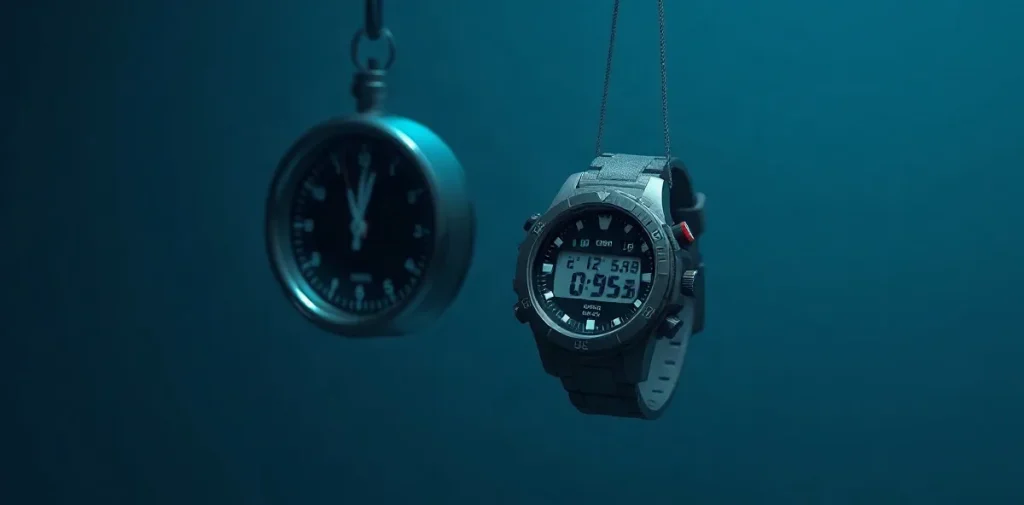
Evaluation of Digital Diving Watches is a 1983 publication by Morrison, ES, issued in Navy Experimental Diving Unit Technical Report NEDU-Evaluation-2-83. Its subject is the assessment of digital watches for diving: equipment whose timekeeping and underwater usability can matter to dive planning, task timing and safe conduct.
Why evaluate a watch for diving?
A watch used underwater must do more than keep time on land. It must remain usable in an environment where water pressure, limited light, gloves and task demands can affect how easily a diver reads and operates a device.
Time has practical consequences in diving. Divers use it to track planned stages and coordinate activities, while dive teams may rely on common timing for procedures and records. A watch is not, by itself, a decompression computer or a substitute for a planned dive profile.
Assessment of diving watches therefore sits at the intersection of equipment performance and human factors. The relevant question is not simply whether a display works, but whether the device can serve its intended role under the conditions in which a diver needs it.
What does a watch evaluation need to consider?
Digital watches display time electronically, often through numerals rather than hands. For underwater use, the display’s legibility and controls are central: a diver must be able to identify the information needed and operate the device without unnecessary distraction.
- Readability: whether the display can be interpreted in the lighting and viewing conditions of a dive.
- Operation: whether controls can be used reliably, including when dexterity is limited by gloves or the task at hand.
- Environmental suitability: whether the watch is appropriate for underwater exposure and the pressure conditions of its intended use.
- Timekeeping: whether the device provides dependable timing for the function assigned to it.
- Human factors: whether using the watch adds workload or competes with attention to the dive.
These considerations are related but distinct. A clear display does not establish pressure suitability, and a device that keeps time accurately may still be difficult to read or use underwater.
How do watches relate to decompression and dive planning?
Decompression depends on a diver’s exposure to pressure over time, alongside other factors in the dive profile. Timing is therefore relevant, but a clock alone does not calculate inert-gas uptake, model decompression, or determine whether a particular ascent is appropriate.
Historically, divers have used timing instruments as part of a broader set of equipment and procedures. The arrival of digital displays made it possible to present time in a different format, prompting practical questions about underwater reading and operation. Those questions remain separate from validation of any decompression method.
For scientific divers and working teams, reliable timing can also support coordination and consistent task records. The instrument’s role should be defined in advance: a watch can support timing, but it should not be mistaken for a complete system for managing dive risk.
What can a 1983 technical report add to the equipment history?
A Navy Experimental Diving Unit technical report places the topic in a setting concerned with diving equipment and its use. The date also makes the publication part of the earlier period of digital diving instrumentation, when the practical fit between electronic devices and underwater work was an important engineering question.
Equipment evaluation is one strand of a wider field that includes pressure-related performance, reliability, interface design and the limits of human attention underwater. A device may be technically functional yet poorly suited to a particular task or operating environment; evaluation helps separate these questions.
The publication’s subject is useful to readers tracing how digital timekeeping entered diving practice. Its bibliographic identity is: Morrison, ES; 1983; Navy Experimental Diving Unit Technical Report NEDU-Evaluation-2-83.
What should divers check before relying on a digital watch?
Check the manufacturer’s stated suitability for underwater use and the specific pressure conditions involved; ordinary water resistance does not automatically mean suitability for diving. Inspect the display and controls in conditions that resemble the intended use, and confirm that the watch’s role is clear within the dive plan.
Do not use a watch as a replacement for required dive equipment, training or established procedures. If a medical condition or decompression concern affects whether a dive is appropriate, consult a diving-medicine physician.
Frequently asked questions
What is the publication about?
Is a digital watch a decompression computer?
Why does readability matter underwater?
Citation details
- Title: Evaluation of Digital Diving Watches
- Authors: Morrison, ES
- Year: 1983
- Published in: Navy Experimental Diving Unit Technical Report NEDU-Evaluation-2-83
- Record type: Journal article
- Repository record: Rubicon Research Repository, handle 123456789/4848
This page is an original summary written by the Rubicon editors from the publication’s bibliographic record. It does not reproduce the paper, its abstract or its data; consult the publication itself for its methods and findings.