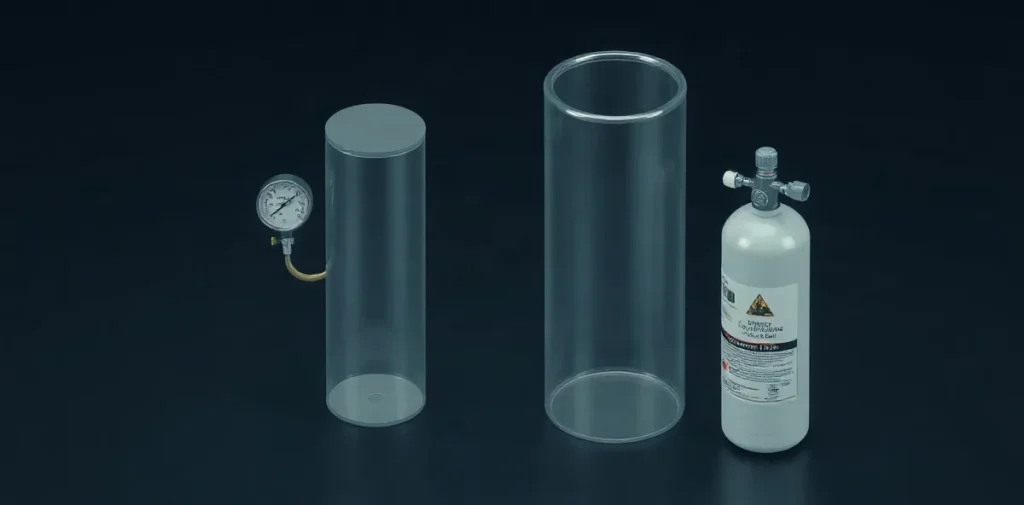
Inert-gas asphyxia occurs when a gas that does not itself support life displaces enough oxygen to impair or stop breathing-related oxygen delivery. For divers, the danger can arise in an enclosed space, during gas handling, or when breathing an unsuitable mixture; underwater, loss of consciousness can quickly become fatal.
How can an inert gas cause asphyxia?
“Inert” describes a gas’s chemical reactivity, not its ability to sustain human life. Nitrogen, helium and argon do not provide oxygen for metabolism. If one replaces air in the breathing environment, the oxygen partial pressure can fall until the body cannot maintain normal function.
As oxygen deprivation progresses, judgement and coordination may deteriorate before the person recognises the danger. More severe deprivation can cause loss of consciousness, respiratory failure and death. The onset depends on the environment and exposure; a person may not have a reliable warning sensation.
This is distinct from oxygen toxicity, in which excessive oxygen exposure causes harm, and from carbon dioxide retention, in which inadequate ventilation allows carbon dioxide to accumulate. These problems can overlap, but their causes and responses differ.
Where does the risk arise in diving?
At depth, divers breathe gas delivered at ambient pressure. A breathing mixture can be appropriate at one depth and unsuitable at another, so gas selection and depth are inseparable. An oxygen fraction that is adequate near the surface may become unsafe if the mixture is diluted or replaced by an oxygen-poor gas.
Asphyxia can also occur outside the water. Gas cylinders, storage areas, chambers and other confined or poorly ventilated spaces can contain displaced air. A leak or deliberate gas release may reduce oxygen without producing a smell or other dependable cue.
In a hyperbaric chamber, the breathing atmosphere and the chamber’s gas-management procedures matter for the same basic reason: oxygen must remain available at a safe partial pressure. Clinicians and technical staff consider both the gas composition and the pressure under which it is breathed.
Which concepts help explain the danger?
Several linked concepts help distinguish inert-gas asphyxia from other diving hazards:
- Oxygen fraction: the proportion of oxygen in a breathing mixture.
- Partial pressure: the pressure contributed by a gas in a mixture; it changes with ambient pressure as well as composition.
- Displacement: an inert gas can lower the oxygen available by replacing air in an enclosed atmosphere.
- Hypoxia: inadequate oxygen availability to the body, which can impair the brain and other organs.
- Ventilation: the movement of fresh gas into and out of the lungs; restricted or ineffective ventilation creates additional hazards.
These concepts are central to gas planning, breathing-system design and chamber practice. They also explain why identifying a gas by its intended use is not enough: the actual mixture, pressure and surrounding atmosphere determine whether oxygenation can be maintained.
How is this hazard managed and assessed?
Prevention begins with control of the breathing gas and the environment. Divers use mixtures suited to the planned depth, verify gas identity and composition using appropriate procedures, and avoid entering atmospheres that have not been assessed as safe. Confined spaces require particular caution because oxygen displacement may be invisible and rapidly dangerous.
Research and incident analysis in diving medicine examine how gas composition, pressure, ventilation and human performance interact. The subject sits alongside work on hypoxia, breathing-gas technology, oxygen exposure and confined-space safety. Each addresses a different mechanism, although more than one may contribute to an emergency.
Suspected oxygen deprivation is an emergency, not a situation for self-diagnosis underwater. Rescue and medical assessment must account for the exposure and any associated injury; divers with questions about fitness to dive or a past event should consult a physician trained in diving medicine.
What should divers remember about inert gases?
The key distinction is simple: a gas can be chemically inert and still be dangerous to breathe. The hazard is not a special toxic effect of every inert gas; it is the loss of oxygen when the gas replaces an oxygen-containing atmosphere or forms part of an unsuitable breathing mixture.
For planning, check the intended gas, depth, breathing system and surrounding atmosphere as one connected set of conditions. In a chamber, work area or confined space, follow the applicable gas-control and entry procedures rather than relying on smell, appearance or how well a person feels.
Frequently asked questions
Are inert gases poisonous?
Can a diver tell when oxygen is being displaced?
Is inert-gas asphyxia the same as nitrogen narcosis?
An original research-library explainer written by the Rubicon editors. It is not a summary of a specific publication.
Related reading on Rubicon
- Diving Physics: Gas Laws, Pressure Effects, and Safety
- Gas Laws Every Diver Must Know for Safe Diving Practice
- The Diving Reflex: What Happens Underwater
- Scuba Diving Regulators: Balanced vs. Unbalanced
- Compressed Gas Cylinders in Diving and Hyperbaric Medicine
- Thesis Research in Diving and Hyperbaric Medicine
- More on Dive Medicine
- Browse the Research Library