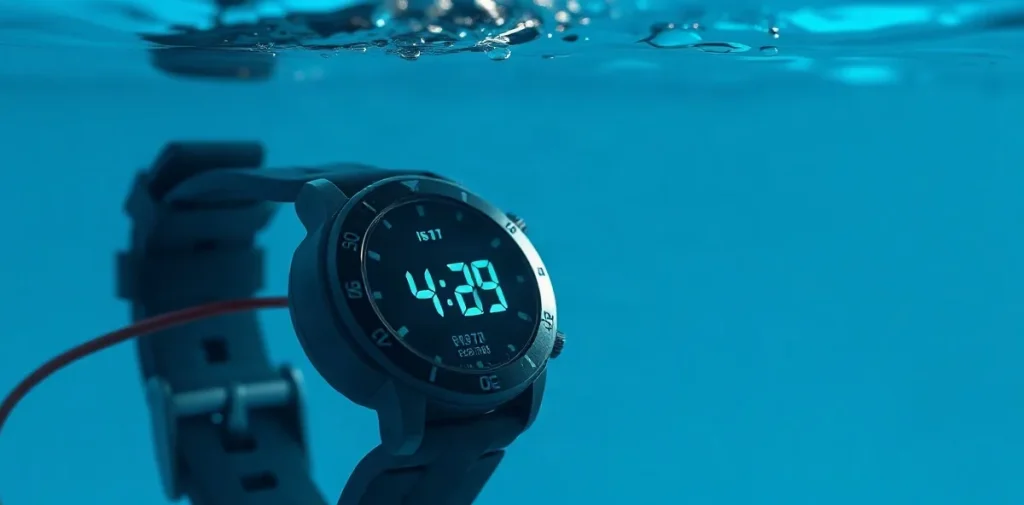
Digital diving watches bring timekeeping into an environment where pressure, cold, darkness and gloves can make ordinary controls difficult to use. Their evaluation sits at the intersection of equipment testing and human factors: a display or button must work reliably, and a diver must be able to read and operate it when attention is already divided.
What does a diving watch need to do underwater?
At its simplest, a watch gives a diver elapsed time. That matters because dive plans use time alongside depth to manage exposure and guide ascent decisions. A watch may also provide a countdown, alarm or other timing functions, but the presence of a feature does not establish that it is suitable for a particular dive task.
Underwater use changes the demands on a small instrument. A diver may be wearing gloves, looking through a mask, working in low light or dealing with reduced dexterity. A display that is legible on land can be harder to interpret underwater, and a control that is easy to press accidentally can create uncertainty about what the device is showing.
How are digital watches evaluated?
Evaluation can consider both technical performance and practical use. Technical checks address whether the watch keeps time, whether its controls and functions behave consistently, and whether the case withstands the pressure conditions for which it is intended. The exact test conditions matter: performance in one environment does not automatically establish performance in another.
Human-factors assessment asks whether divers can read and operate the instrument under realistic conditions. Useful considerations include:
- Legibility: contrast, display size and readability in changing light.
- Control use: whether buttons can be distinguished and operated with gloves.
- Accidental activation: whether normal handling can change a setting or interrupt a timing function.
- Reliability: whether the watch continues to perform its timing role during the intended use.
- Interpretation: whether the displayed information is clear enough to support a diver’s task.
A controlled test can identify repeatable performance issues; field use can expose handling problems that a bench test may miss. Neither approach alone answers every question about suitability.
Why do pressure, water and visibility matter?
Water pressure rises with depth, so equipment intended for diving must tolerate a different physical environment from everyday wear. A watch’s stated water resistance should be understood in relation to its design and intended use, not treated as a general guarantee for every dive, condition or form of exposure. Seals, case construction and controls all matter to keeping water out.
Visibility is also part of instrument performance. Light is absorbed and scattered underwater, while a mask can affect apparent size and clarity. A diver may need to check time briefly without losing awareness of a buddy, a task or the surrounding environment. That makes glanceability—not simply whether the digits can be seen—the practical question.
How does a watch fit into dive planning?
A watch is a timing instrument, not a substitute for a complete dive plan. Timing decisions interact with depth, ascent, breathing gas, decompression procedures and the diver’s condition. For this reason, an evaluation of a watch’s functions cannot by itself establish that a dive profile is safe or that a diver should rely on the device as a primary planning instrument.
Instrument choice also depends on the dive. A recreational diver checking elapsed time, a scientific diver managing a task and a professional diver working within procedures may have different demands. In each case, the device must fit the established plan and the diver’s training; any uncertainty about its role belongs in the pre-dive equipment check.
What can equipment testing tell divers and clinicians?
Testing digital diving watches belongs to the broader study of how equipment performs when the underwater environment changes both the instrument and its user. It connects with research on pressure-resistant construction, visibility, interface design and operational reliability. These are practical questions, but they also matter in dive medicine because sound timing supports decisions made within a wider system of risk management.
For divers, the useful lesson is to examine the watch’s intended use, operating instructions and condition rather than infer capability from appearance or a single label. Diving physicians and hyperbaric clinicians may encounter equipment questions when reviewing an incident or a diver’s account; the device’s role should be considered alongside the dive plan, training and other instruments. If equipment reliability affects a medical or operational decision, consult a diving-medicine physician and the relevant device documentation.
Frequently asked questions
Is a digital diving watch the same as a dive computer?
Does a water-resistance marking guarantee suitability for diving?
What matters most when choosing a watch for diving?
An original research-library explainer written by the Rubicon editors. It is not a summary of a specific publication.
Related reading on Rubicon
- The Diving Reflex: What Happens Underwater
- Diving Safety: Key Insights into Underwater Exploration
- Diving: Exploring Underwater Activities, Science, and Safety
- Science Diving: Protocols and Techniques for Underwater
- Evaluation of Digital Diving Watches: Research Summary
- Scientific Diving and Underwater Research: Research Summary
- More on Equipment
- Browse the Research Library