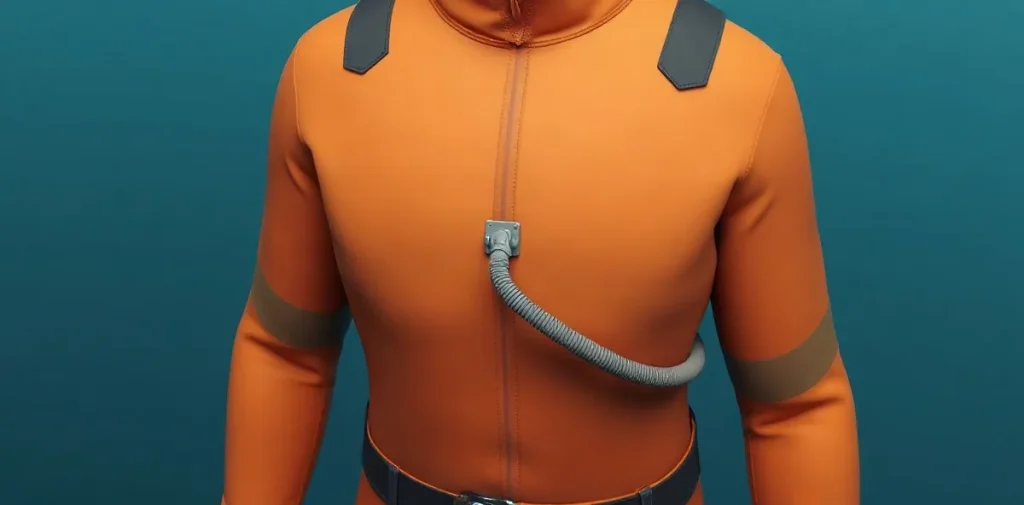
Genitourinary infection and barotrauma as complications of ‘P-valve’ use in drysuit divers is a 2009 journal article by Harris in Diving and Hyperbaric Medicine : the Journal of the South Pacific Underwater Medicine Society 39(4). It addresses two medical concerns associated with external urinary drainage during drysuit diving, where equipment function and changing pressure meet human physiology.
What is a P-valve, and why do drysuit divers use one?
A P-valve is a urinary drainage system worn inside a drysuit. It typically connects an external urinary collection device to a hose that carries urine away from the diver during immersion. The arrangement can reduce the need to end a dive to urinate, which is useful during long working dives or repeated dives in cold water.
Its convenience depends on a reliable connection between the diver and the suit’s drainage system. The equipment sits against the body, is exposed to movement and pressure changes, and must remain functional throughout the dive. A leak or blockage can create an immediate practical problem as well as a source of discomfort.
How can urinary infection enter the picture?
Genitourinary infection refers to infection involving the urinary or reproductive systems; in the context of a urinary device, the urinary tract is the central concern. External collection equipment can cause skin irritation or discomfort, while poor hygiene, moisture, friction or contamination may contribute to infection risk. These are general considerations for devices that contact the body, not a diagnosis of any individual diver.
Symptoms such as pain or burning during urination, unusual discharge, fever, or persistent irritation warrant medical assessment. Divers should not assume that symptoms are simply a consequence of equipment use or cold exposure. A diving-medicine physician can help assess fitness to dive and whether further clinical evaluation is needed.
What does barotrauma mean in this setting?
Barotrauma is tissue injury caused by a pressure difference across a body space or tissue interface. In diving, pressure changes during descent and ascent can affect air-containing spaces, while equipment can also create local pressure effects if it traps gas, obstructs flow or presses against tissue. The exact mechanism depends on the design, fit and use of the equipment.
A P-valve’s hose and collection arrangement therefore raise a practical question: can changing ambient pressure, a kink, an obstruction or a faulty valve interfere with drainage or create an unwanted pressure difference? Understanding the system’s layout matters. A diver should know how the valve operates and follow the equipment maker’s instructions rather than improvising a configuration underwater.
Why does this matter to diving medicine?
Urinary equipment is one part of the broader problem of maintaining bodily function during immersion. Exposure suits, thermal protection, duration and access to facilities all influence how divers manage hydration and urination. For scientific and occupational divers, a device that supports a longer task may also add a potential failure point that needs to be considered in planning.
Medical literature on equipment-related complications helps clinicians distinguish a problem arising from the device or its use from an unrelated condition. It also places user comfort, hygiene and equipment reliability within the same safety conversation. The concerns are relevant to divers, dive supervisors and clinicians assessing symptoms around a dive.
- Device fit: check that the collection system is correctly positioned and comfortable before entering the water.
- Flow path: understand how the hose and valve are routed, and avoid kinks or obstruction.
- Hygiene: clean and maintain reusable components according to the manufacturer’s instructions.
- Symptoms: seek clinical advice for persistent irritation, urinary symptoms or pain rather than attributing them automatically to diving.
- Dive planning: account for equipment function, the task duration and a practical response to leakage or blockage.
What should divers and clinicians consider?
Device choice and use are individual. Anatomy, skin sensitivity, dexterity, suit configuration and the type of diving can all affect whether a system works well. A diver who has difficulty fitting or operating a P-valve should resolve that problem on land, where the system can be checked without time pressure or exposure.
When symptoms occur, the timing and circumstances are useful clinical details: whether discomfort began during or after a dive, whether drainage was impaired, and whether the equipment leaked or felt restrictive. Those details do not replace an examination. Because infection and pressure-related injury require different assessment, consultation with a diving-medicine physician is appropriate when symptoms are significant or recur.
Frequently asked questions
What does a P-valve do?
Can a P-valve cause a urinary infection?
When should a diver seek medical advice?
Citation details
- Title: Genitourinary infection and barotrauma as complications of 'P-valve' use in drysuit divers
- Authors: Harris, Richard
- Year: 2009
- Published in: Diving and Hyperbaric Medicine : the Journal of the South Pacific Underwater Medicine Society 39(4)
- Identifiers: PMID 22752741
- Record type: Journal article
- Repository record: Rubicon Research Repository, handle 123456789/9482
This page is an original summary written by the Rubicon editors from the publication’s bibliographic record. It does not reproduce the paper, its abstract or its data; consult the publication itself for its methods and findings.
Related reading on Rubicon
- Why Divers Get Cold Faster Underwater
- Scuba Diving Equipment: Essential Gear for Every Diver
- Effects of Cold Water Immersion on Diver Metabolism
- How Hydrodynamics Boost Diver Efficiency and Safety
- HPNS Suppression in Deep Human Dives: Research Summary
- Flying After Diving: Research Summary
- More on Dive Medicine
- Browse the Research Library