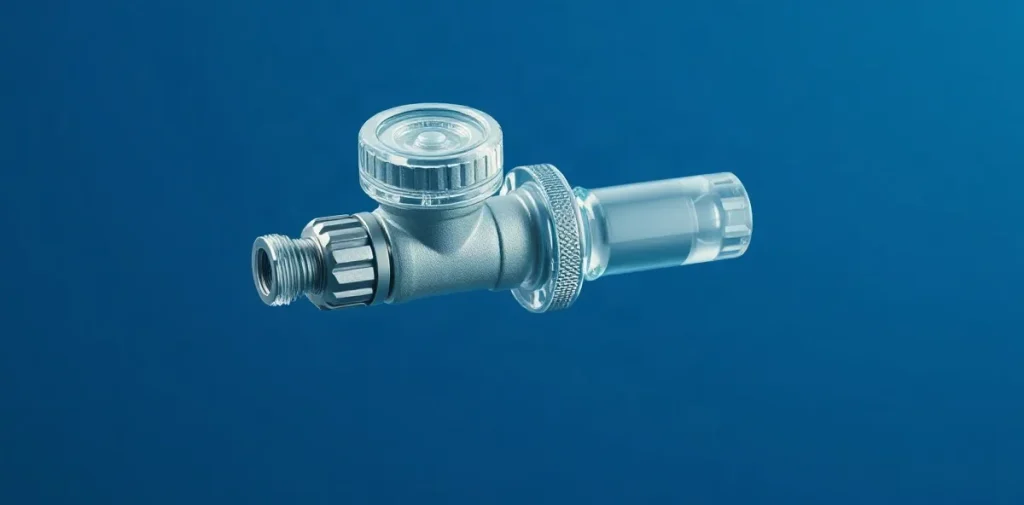
Oxygen compatibility assessment asks whether materials and equipment can safely contain or control oxygen under their intended operating conditions. For divers and hyperbaric teams, the question matters because oxygen can intensify combustion: a small ignition source or contamination may turn a component failure into a fire hazard.
Why does oxygen change the equipment risk?
Oxygen is not itself a fuel, but it supports combustion. Materials that burn slowly in air may ignite more readily, burn more vigorously or become difficult to extinguish in oxygen-enriched conditions. The risk depends not only on the gas but also on pressure, temperature, material, geometry and how the equipment is used.
In diving and hyperbaric care, oxygen may be delivered at high concentration through cylinders, regulators, valves, hoses and breathing circuits. A leak, rapid pressurisation, particle impact or friction can contribute to ignition in some circumstances. Oxygen service therefore calls for more than checking that a component fits or functions mechanically.
What does an oxygen compatibility assessment examine?
The assessment considers the whole system and its operating envelope, rather than treating a material name as a guarantee of safety. A component’s suitability can change with oxygen concentration, pressure, flow, temperature and the presence of contaminants. Design details matter too: narrow passages, seals and moving parts can create different conditions from an open, static volume.
Typical lines of inquiry include:
- Materials: whether metals, polymers, lubricants and seals are suitable for the oxygen exposure and service conditions.
- Ignition sources: whether friction, impact, compression heating or electrical effects could initiate combustion.
- Contamination: whether oil, grease, dust or other foreign material could provide fuel or promote ignition.
- System operation: whether pressure changes, flow, maintenance or foreseeable misuse alter the hazard.
Testing can inform these questions, but a test result applies to its defined conditions. Assessment also relies on engineering analysis, material selection, cleanliness controls and attention to how the equipment is assembled and operated.
How do pressure and cleanliness affect the assessment?
Pressure changes the consequences of a fault. Rapid compression can heat trapped gas, while high-pressure oxygen can make ignition and combustion more severe. That is why opening a valve slowly and using equipment in its intended configuration are important operating principles, not merely habits of careful handling.
Cleanliness is equally central. Hydrocarbon oils and greases can act as fuel in oxygen systems, and particles can contribute to ignition through impact or friction. Components intended for oxygen service need appropriate cleaning, handling and protection from recontamination; a clean appearance alone does not establish oxygen compatibility.
What does this mean for divers and clinical teams?
Divers encounter oxygen systems in enriched-gas equipment, rebreathers and oxygen delivery used in emergencies. Hyperbaric clinicians rely on oxygen delivery equipment in treatment environments. In each setting, an apparently minor component—such as a seal, valve or lubricant—forms part of a system whose risk depends on the gas, pressure and operating procedure together.
Compatibility assessment connects equipment engineering with operational safety. It helps frame procurement, maintenance, cleaning and configuration decisions, while reminding users that a component suitable for one gas mixture or pressure may not be suitable for another. Follow the equipment maker’s oxygen-service instructions and local procedures; questions about a particular setup belong with the responsible technical team.
How does this field fit into diving research?
Diving and hyperbaric research spans human physiology, medical treatment and the systems that make breathing gases available. Oxygen compatibility sits on the engineering and safety side of that wider field: it concerns whether gas-handling equipment can perform its role without creating an avoidable ignition hazard.
The subject also crosses disciplines. Materials science, combustion, mechanical design and operational practice all bear on the same question. For diving physicians and hyperbaric clinicians, understanding that connection helps distinguish a physiological oxygen concern from an equipment hazard—and makes collaboration with trained equipment specialists essential when systems are selected or maintained.
Frequently asked questions
Does oxygen compatibility mean a material cannot burn?
Why does a component’s operating pressure matter?
Can ordinary lubricant be used in oxygen equipment?
An original research-library explainer written by the Rubicon editors. It is not a summary of a specific publication.
Related reading on Rubicon
- The Physiology Behind Oxygen Toxicity in Deep Dives
- Understanding Oxygen Toxicity Risks and Prevention in Diving
- Myth Busting: Clarifying Oxygen Toxicity Limits in Diving
- The Diving Reflex: What Happens Underwater
- Oxygen Compatibility in Diving Systems: Research Summary
- Oxygen Measurement in Hyperbaric Delivery Systems
- More on Safety
- Browse the Research Library