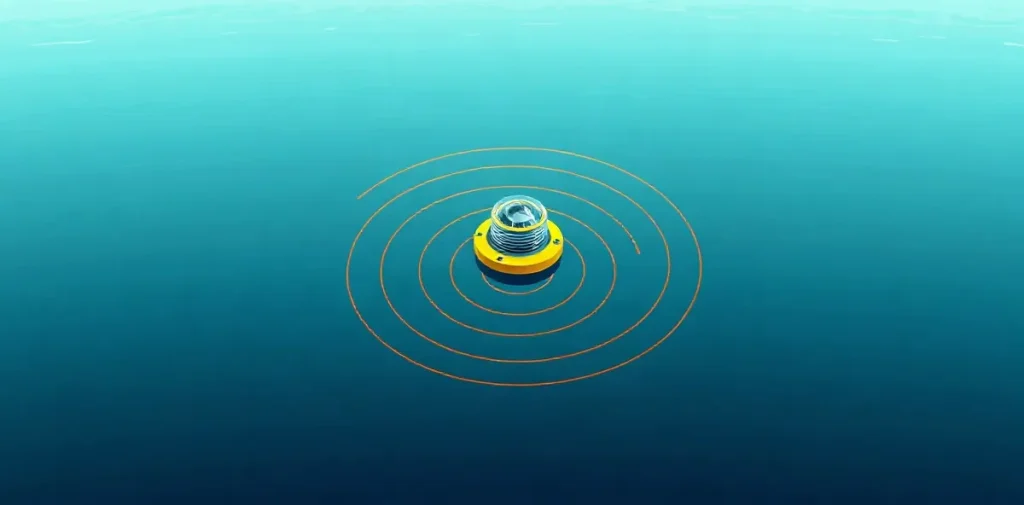
Diver location devices is a 1998 journal article by Davies, published in the Journal of the South Pacific Underwater Medicine Society. Its subject is technology for locating divers: a practical problem with direct implications for underwater safety, search and rescue, and the coordination of diving operations.
Why does locating a diver underwater matter?
Water makes it difficult to keep track of a diver from the surface. A diver may move beyond the line of sight, work in low visibility, or become separated from a team. Bubbles and surface movement can provide clues, but they are not dependable indicators of a diver’s exact position.
Location is important both during planned work and when something goes wrong. A surface team needs to know where divers are operating; in an emergency, uncertainty about position can delay a search and complicate assistance. The device is only one part of the response: communications, procedures, team roles and the conditions at the site also matter.
What does a diver location device need to do?
At its simplest, a location system helps someone outside the water estimate where a diver is. Some approaches depend on a physical connection between diver and surface, while others use signals that can be detected remotely. The useful distinction is not merely the device’s format, but what information it conveys, to whom, and under which operating conditions.
Water affects how signals travel. Radio signals that work in air do not generally provide a straightforward underwater link over useful distances, so underwater systems may rely on other forms of transmission or on a surface component. Performance depends on factors such as depth, distance, obstacles, noise and the arrangement of transmitting and receiving equipment.
- Position: whether the system indicates a direction, a range, or a position relative to a known point.
- Communication: whether it helps locate a diver, exchange messages, or both.
- Operating conditions: how water, terrain, visibility and interference affect detection.
- Integration: how the device fits with the dive plan, team procedures and emergency response.
How should a location system be assessed?
A device that can be detected is not necessarily a reliable navigation aid. The user must be able to interpret its signal, and the surface team must understand what the indicated position means. A direction without range, for example, can narrow a search area without identifying the diver’s precise location.
Practical assessment therefore considers the whole system: the diver-carried unit, the receiver, power, attachment, controls and the people using them. Ease of operation matters, especially when visibility is poor or a response is time-critical. Testing should reflect the conditions in which the device is expected to work rather than assuming performance from its design alone.
Location equipment also has to coexist with other dive equipment and procedures. A tether may provide a physical reference but can restrict movement or snag; a wireless system avoids that connection but depends on signal transmission and reception. The appropriate trade-off depends on the task and environment.
Where does this subject fit in diving safety?
Diver location sits at the intersection of equipment design, underwater communication and rescue planning. It is related to the broader problem of maintaining contact with divers, but locating a diver and communicating with one are not identical functions. A system may support one without fully providing the other.
The 1998 publication belongs to a period when dedicated diver location technology was an important subject for underwater medicine and safety discussions. The underlying question remains relevant as equipment changes: how can a team detect a diver’s position clearly enough to support ordinary operations and an emergency response?
For diving physicians and hyperbaric clinicians, location technology is part of the operational context surrounding an incident, not a treatment in itself. Clinical decisions depend on the diver’s condition and exposure; a diving-medicine physician should be consulted when assessing an individual medical concern.
What should a team check before relying on a device?
Start with the intended use. A device suitable for keeping track of a diver near a working platform may not be suitable for a search over a wider area, in strong current, or around complex underwater terrain. Confirm what the system displays and what actions its signal is meant to prompt.
Teams should also establish how the device will be checked, carried and monitored, and what fallback procedure applies if it fails or gives an ambiguous indication. Training should include realistic practice with the actual equipment and the people who will use it. For a specific model, consult its current manufacturer instructions and the dive operation’s procedures.
Frequently asked questions
What is a diver location device?
Does locating a diver mean the team can communicate with them?
What conditions affect underwater location?
Citation details
- Title: Diver location devices
- Authors: Davies, D
- Year: 1998
- Published in: Journal of the South Pacific Underwater Medicine Society 28(3)
- Record type: Journal article
- Repository record: Rubicon Research Repository, handle 123456789/5968
This page is an original summary written by the Rubicon editors from the publication’s bibliographic record. It does not reproduce the paper, its abstract or its data; consult the publication itself for its methods and findings.
Related reading on Rubicon
- How Buoyancy Control Devices Enhance Diver Safety
- Why Divers Get Cold Faster Underwater
- Scuba Diving Equipment: Essential Gear for Every Diver
- Effects of Cold Water Immersion on Diver Metabolism
- PADI Diver Rescue Training: Research Summary
- Lobster Divers of La Mosquitia: Research Summary
- More on Equipment
- Browse the Research Library