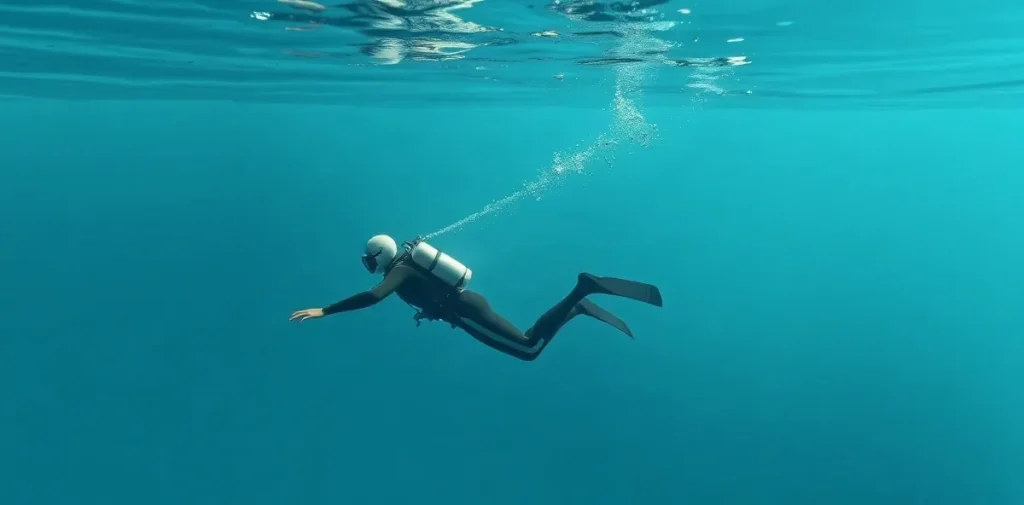
Research on drag and human movement in water examines how water resists a moving body and how that resistance shapes swimming effort, speed and control. For divers, the same mechanics affect finning, positioning and task performance: movement that is easy in air can demand sustained effort underwater.
What does drag mean for a moving diver?
Drag is the force that opposes motion through a fluid. In water, it depends on how quickly a diver moves, the body’s shape and orientation, and the area presented to the flow. Small changes in posture can therefore change the effort needed to move.
A diver’s equipment adds to the body’s profile. A cylinder, hoses, instruments or a loosely secured item can alter the flow around the diver and increase resistance. The practical effect is not simply a question of speed: extra resistance can make a task more tiring or harder to control.
How do researchers investigate movement through water?
Studies of aquatic locomotion examine the relationship between movement, force and energy expenditure. Researchers may assess how a person moves through water under controlled conditions, compare body positions or movement techniques, and measure forces or physiological effort. The exact method depends on the question being tested.
Measurements need careful interpretation. A swimmer’s movement in a pool is not identical to a diver’s movement while wearing equipment, managing buoyancy and completing a task. Water conditions, equipment configuration and the participant’s technique can all affect the result, so findings from one setting do not automatically apply to every dive.
- Body position: orientation and alignment influence the area exposed to the flow.
- Movement speed: faster movement generally requires more force to overcome water resistance.
- Equipment profile: carried gear can change a diver’s shape and flow characteristics.
- Effort: researchers can consider the physical cost of maintaining movement, not only distance or speed.
Why does drag matter to divers?
Moving against resistance uses muscular effort and can increase the work of swimming. For a diver, this matters during routine finning, when carrying or handling equipment, and when maintaining position in moving water. If a task takes more effort than expected, the diver may have less capacity for other demands.
Drag is also relevant to scientific diving, where a diver may need to move carefully while observing, sampling or operating equipment. Minimising unnecessary movement and keeping equipment secure can help preserve control. These are general considerations, not a substitute for training, dive planning or assessment of conditions.
How does this research connect with diving physiology?
Locomotion research sits at the intersection of biomechanics and exercise physiology. Biomechanics asks how forces act on the body and how movement produces them; exercise physiology considers the body’s response to the work. Together, these perspectives help explain why two movements that cover the same distance can have different physical costs.
For diving medicine, the broader issue is how exertion interacts with the demands of immersion and the dive itself. A diver’s workload is shaped by conditions and equipment as well as fitness and technique. Questions about a particular diver’s ability to undertake a task belong with a diving-medicine physician, who can consider the individual and the planned exposure.
What should readers keep in mind when applying the findings?
Drag is only one part of underwater performance. Buoyancy, current, visibility, thermal conditions and the diver’s task can change how movement feels and how much effort it requires. A technique that is efficient in one situation may not be the best choice in another.
When evaluating research on human movement in water, look at the setting, the equipment used, the movement being tested and the outcomes measured. Those details determine whether the work speaks to swimming, equipped diving or a narrower experimental question.
Frequently asked questions
Why can a small posture change affect swimming effort?
Does research on swimmers apply directly to divers?
When should a diver discuss exertion with a physician?
An original research-library explainer written by the Rubicon editors. It is not a summary of a specific publication.