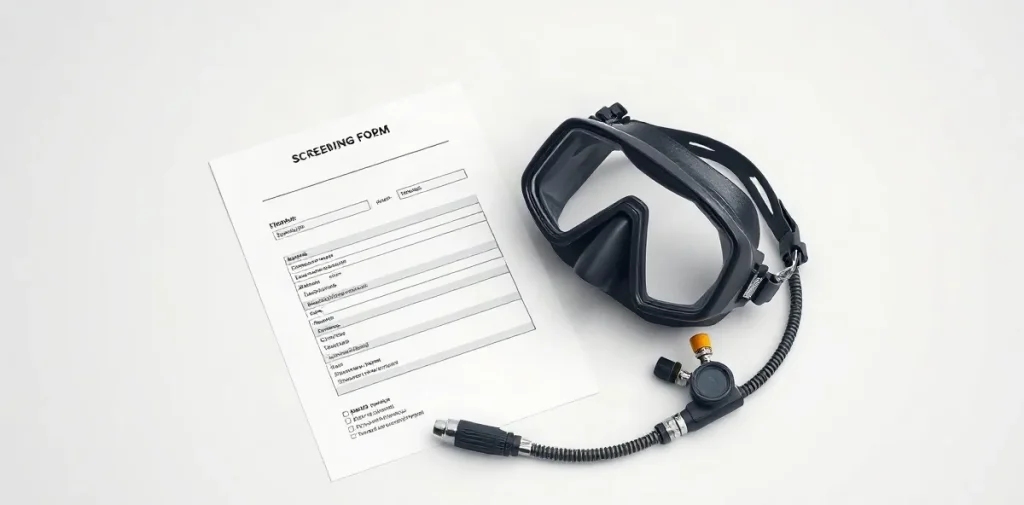
Medical screening for scuba diving is the process of identifying health conditions that could make immersion, exertion or an emergency underwater more hazardous. Candidate questionnaires and clinical assessment help match a person’s health to the demands of diving, while recognising that a form is a starting point, not a diagnosis.
What does screening try to assess?
Diving places several systems under unusual demands. Water pressure changes the volume of gas in body spaces, immersion shifts blood toward the chest, and breathing dense gas through a regulator increases respiratory work. Cold, physical effort and stress can add further strain.
Screening therefore asks whether a health condition, symptom or medication could affect a diver’s ability to equalise, breathe, exercise, remain conscious, make decisions or respond to an emergency. The concern is not simply whether a diagnosis exists, but how it behaves in the specific conditions of diving.
Common areas for review include:
- Heart and circulation: capacity for exertion and the possibility of sudden loss of consciousness.
- Lungs and airways: airflow obstruction, air trapping or conditions that may affect pressure changes.
- Neurological and psychological health: alertness, judgement, coordination and the ability to manage stress.
- Medication and recent illness: effects on performance, breathing or awareness, including changes that have not yet stabilised.
Why is a questionnaire not the whole assessment?
A screening statement is designed to prompt disclosure and identify when more assessment may be needed. It can help a candidate recognise that a past diagnosis, current symptom or treatment deserves attention before diving. It cannot examine the person or establish how a condition affects them.
Answers also need context. A condition may be stable or changing; symptoms may appear only with exertion; and treatment can alter both the underlying risk and the ability to respond underwater. A clinician’s assessment may involve medical history, examination and further tests when appropriate, rather than an automatic decision based on a single checked box.
The distinction matters in both directions. A positive answer does not by itself establish that someone cannot dive, while a negative answer cannot rule out every relevant risk. When a question raises concern, a diving-medicine physician can assess the condition in relation to the activity and the diver’s circumstances.
How does diving change ordinary medical risk?
Some risks arise from the interaction between a health condition and the underwater environment. For example, gas trapped in the lungs can expand as a diver ascends; a condition that restricts airflow may therefore require particular attention. Heart and lung function also matter because immersion and exertion affect circulation and breathing.
Other risks concern what happens if a problem develops underwater. A fainting episode, seizure, severe breathlessness or impaired judgement can become harder to manage when the person is submerged, wearing equipment and dependent on a buddy. Screening considers not only the chance of an event, but its consequences in that setting.
Risk is consequently individual and conditional. The diagnosis, its severity and stability, the treatment, the type of diving and the practical demands of the planned activity can all affect the assessment. A decision about one form of diving should not automatically be treated as a decision about every environment or level of exertion.
How does candidate screening fit into dive medicine?
Medical fitness assessment sits alongside other parts of dive safety: training, equipment, planning and the ability to respond to emergencies. It is preventive rather than predictive. The aim is to identify relevant hazards before exposure, not to promise that an incident cannot occur.
Work on screening models addresses a practical challenge in dive medicine: how to ask useful questions consistently, direct candidates toward suitable clinical review and avoid treating broad health categories as simple yes-or-no rules. The balance matters. A process that misses important conditions can leave risk unrecognised; one that treats every diagnosis as disqualifying can exclude people without considering their actual health and activity.
This is part of a wider field concerned with the medical consequences of pressure, immersion and underwater work. For recreational candidates, the central issue is personal fitness for planned diving. For scientific divers and others working underwater, medical assessment also has to account for task demands, operating conditions and the consequences of interruption.
What should a candidate do with a concern?
Answer screening questions accurately and take symptoms, diagnoses and medication changes seriously. If a response indicates that medical review is needed, pause the decision about diving until the relevant assessment has taken place. Do not use a general questionnaire as clearance for a condition it cannot evaluate.
A diving-medicine physician can consider the medical details alongside the intended diving activity. That conversation is especially important when a condition is recent, changing, associated with symptoms, or treated with medication that could affect alertness or physical performance. Individual medical decisions belong with a qualified clinician.
Frequently asked questions
Does a medical screening form diagnose a condition?
Does a health condition automatically rule out diving?
Why does the type of diving matter?
An original research-library explainer written by the Rubicon editors. It is not a summary of a specific publication.
Related reading on Rubicon
- Scuba Diving Fins: Split vs. Paddle Designs
- Scuba Diving Regulators: Balanced vs. Unbalanced
- Scuba Diving Buddy Checks: Catch Problems Early
- Scuba Diving: Why Immersion Can Dehydrate You
- Scuba Diving: Physiology, Risks and Safety
- Immersion Hypothermia in Scuba Diving: Research Summary
- More on Dive Medicine
- Browse the Research Library