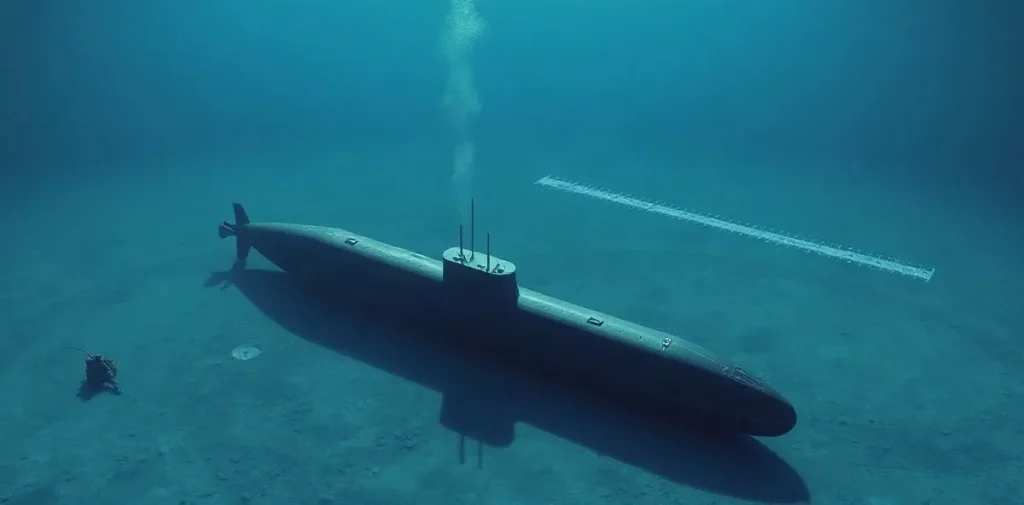
Underwater archaeology studies human history through material remains submerged in seas, rivers and lakes. Work involving a historic submarine such as the Confederate H.L. Hunley brings archaeology into close contact with diving science: researchers must document fragile evidence while managing the limits and hazards of working underwater.
What can a submerged submarine reveal?
A submarine wreck is both an archaeological site and a complex object. Its structure, contents and position may preserve evidence about construction, use and loss, while the surrounding seabed can hold additional traces of human activity.
The central task is to interpret those traces without treating the wreck as an isolated artefact. Archaeologists consider how objects relate to one another, how the vessel sits within its environment and how disturbance or deterioration may alter what remains visible.
That makes careful recording essential. A measurement, drawing, photograph or three-dimensional record can preserve spatial relationships that might be lost when an object shifts, is exposed or must be moved.
How do divers investigate a fragile site?
Underwater work combines archaeological methods with the practical demands of diving. Visibility, current, depth, temperature, access and the physical layout of a wreck can all affect how a team observes and records a site.
Researchers may use measured plans, photography, video and repeat surveys to build a record of features and their locations. The chosen method depends on the site and the research question; a record must be useful to later interpretation, not merely visually clear.
- Context: document where objects and structural features lie in relation to one another.
- Condition: note visible changes, damage and signs of instability.
- Repeatability: use consistent recording methods so later observations can be compared.
- Access: plan tasks around the limits imposed by the wreck, the environment and the dive operation.
Exploration is not the same as collecting. Removing an object can destroy information about its position and associations, so documentation and conservation planning are part of the archaeological process.
Why does the wreck change the diving plan?
A confined or obstructed site can make ordinary underwater tasks more demanding. Entanglement, restricted movement, silt disturbance and reduced visibility can complicate both navigation and the route back to open water. The site itself may also be fragile, making contact a risk to the evidence as well as to the diver.
Scientific diving adds a task-related workload: divers may need to observe, measure, photograph or manipulate equipment while maintaining awareness of depth, time, gas and team position. These demands can compete for attention. A sound plan defines the work, the limits of access and the conditions that require the task to stop.
Decompression obligations depend on the dive profile and the procedures used; they cannot be inferred from the archaeological subject alone. Dive planning must account for the actual operation and conditions, with medical questions referred to a diving-medicine physician.
What does archaeology contribute to diving science?
Underwater archaeology is not primarily a study of diver physiology, but it relies on divers working safely and consistently enough to produce reliable observations. The field therefore intersects with research on task loading, environmental exposure, equipment, team procedures and the design of scientific diving operations.
Its methods also raise questions familiar across underwater research: how to gather useful data without damaging the site, how to distinguish a real change from differences in observation, and how to balance access against exposure. These questions apply well beyond historic vessels, including surveys of reefs and habitats where divers must observe without disturbing what they study.
For diving physicians and hyperbaric clinicians, the connection is operational rather than a claim that archaeology identifies a medical effect. Understanding the work helps place a diver’s exposure and task demands in context when assessing fitness, planning support or considering a post-dive concern.
How can a historic site be protected?
Submerged remains can deteriorate through corrosion, biological activity, sediment movement and human disturbance. Recording helps track condition, but documentation alone does not preserve an object; conservation decisions must account for the material, the environment and what will happen after recovery or exposure.
There is a practical tension between access and protection. A site may attract research interest, yet every visit adds activity around a vulnerable place. Responsible work limits unnecessary contact, follows a defined recording plan and treats the wreck as a finite archaeological context rather than a source of souvenirs.
Frequently asked questions
Is underwater archaeology the same as wreck diving?
Why record an object instead of recovering it?
What makes scientific diving at a wreck demanding?
An original research-library explainer written by the Rubicon editors. It is not a summary of a specific publication.
Related reading on Rubicon
- The Diving Reflex: What Happens Underwater
- Why Divers Get Cold Faster Underwater
- Diving Safety: Key Insights into Underwater Exploration
- Diving: Exploring Underwater Activities, Science, and Safety
- CSS Georgia: Blackwater Underwater Archaeology
- Hydrodynamic Drag in Underwater Swimming
- More on Diving Science
- Browse the Research Library