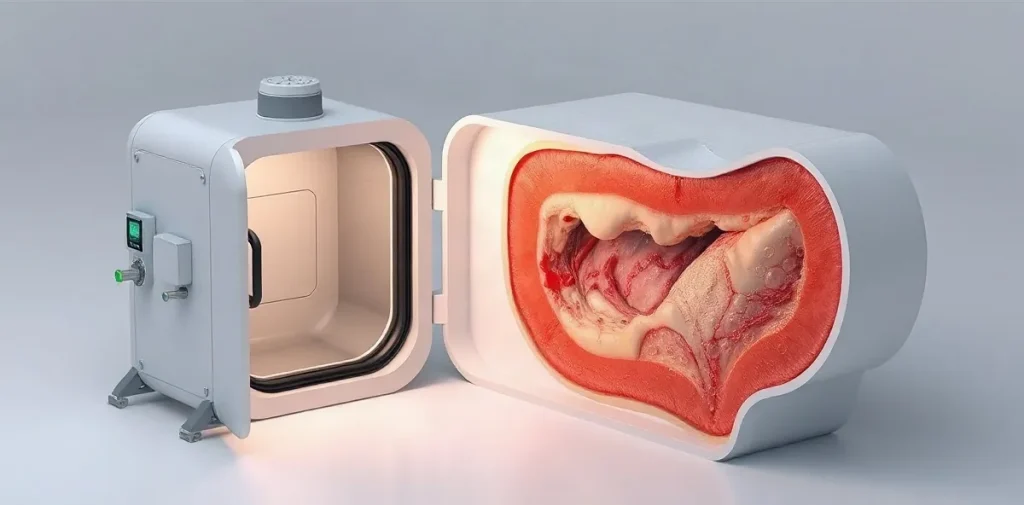
Research on hyperbaric oxygen as an adjunct to burn care asks whether breathing oxygen at increased pressure can change the course of injured tissue and affect decisions about surgery. The question connects wound physiology with a treatment also used in diving medicine, where pressure, oxygen exposure and patient selection all require careful control.
What happens to tissue after a burn?
A burn can injure tissue directly while also disrupting nearby tissue that has not been irreversibly destroyed. The surrounding zone may have impaired circulation and oxygen delivery, leaving its eventual survival dependent on the evolving injury and clinical care. Burn depth and extent therefore matter beyond the visible surface.
Oxygen is necessary for cellular energy production and tissue repair, but delivering more oxygen to the body does not automatically restore damaged tissue. Blood flow, the condition of small vessels, the burn’s depth and the patient’s overall state all affect how oxygen reaches a wound. These interacting processes make burn treatment a question of physiology as well as wound appearance.
What is hyperbaric oxygen treatment?
In hyperbaric oxygen treatment, a patient breathes oxygen in a chamber at pressure above the surrounding atmosphere. Increased pressure raises the amount of oxygen dissolved in plasma. That is distinct from simply giving oxygen at ordinary pressure, although the clinical effect depends on the injury and the treatment protocol.
For burn research, the central issue is whether this altered oxygen environment can usefully complement standard care. Investigators may examine tissue viability, wound progression and the timing or extent of surgical treatment. The intervention is considered alongside, not in place of, assessment, wound management and other necessary care.
- Oxygen delivery: how pressure and oxygen concentration affect dissolved oxygen and tissue supply.
- Burn progression: whether injured tissue changes over time and how clinicians assess its viability.
- Adjunctive treatment: how a chamber intervention fits with established burn care rather than replacing it.
- Surgical decisions: how clinicians judge the need and timing of procedures as the injury evolves.
How do studies examine the role of treatment?
Studies in this area need to distinguish the effect of hyperbaric oxygen from the many factors that influence burn outcomes. These include injury characteristics, treatment timing, other medical care and the criteria used to decide on surgery. Comparing patient groups and defining outcomes consistently are essential to interpreting any clinical study.
The phrase “need for surgery” also requires careful definition. It may refer to a clinical decision shaped by the wound’s condition, the aims of treatment and the judgement of the care team; it is not a direct measurement of oxygen in tissue. Research therefore has to connect physiological reasoning with clinically meaningful outcomes, while accounting for differences between patients and care settings.
Clinical research must also consider treatment burden and risk. Chamber treatment takes time and requires specialised facilities, and exposure to increased pressure and oxygen has potential complications. Whether those demands are justified depends on the clinical question, the patient and the evidence for the specific use.
Why does this matter to diving medicine?
Divers encounter hyperbaric oxygen in a different clinical context: treatment of selected conditions related to diving, including decompression illness. Burn care is not the same problem. Still, both fields require clinicians to understand pressure exposure, oxygen dosing, chamber procedures and the limits of applying one treatment rationale across different injuries.
The comparison is useful for diving physicians and hyperbaric clinicians because it separates the physical effects of treatment from the question of whether treatment helps a particular condition. A plausible mechanism is not, on its own, proof of clinical benefit. The same distinction matters when assessing any proposed chamber treatment for a diver.
For scientific divers, the topic also illustrates why oxygen and pressure are managed as exposure variables rather than simple remedies. The chamber environment is controlled, but treatment still requires a clear indication and clinical oversight. A diving-medicine physician should be consulted for individual health decisions.
What should readers keep in mind?
Burns vary widely, and a treatment’s relevance cannot be inferred from the word “hyperbaric” alone. The clinical question is whether a defined protocol adds value for a defined group of patients, in combination with appropriate burn care. That question is narrower than whether oxygen is important to healing.
When evaluating research in this field, look for how the injury is characterised, what comparison is made, how surgery is defined and which outcomes are followed. Also consider whether the setting and treatment protocol apply to the clinical situation at hand; chamber therapy belongs within specialist care, not self-directed treatment.
Frequently asked questions
Does hyperbaric oxygen replace burn surgery?
Why might pressure affect oxygen delivery?
Is burn treatment evidence directly applicable to diving injuries?
An original research-library explainer written by the Rubicon editors. It is not a summary of a specific publication.
Related reading on Rubicon
- The Physiology Behind Oxygen Toxicity in Deep Dives
- Understanding Oxygen Toxicity Risks and Prevention in Diving
- Oxygen Partial Pressure: Key to Dive Safety and Performance
- Myth Busting: Clarifying Oxygen Toxicity Limits in Diving
- Hyperbaric Oxygen for Diabetic Wounds: Research Summary
- Hyperbaric Oxygen Therapy in Orthopedic Care
- More on Dive Medicine
- Browse the Research Library