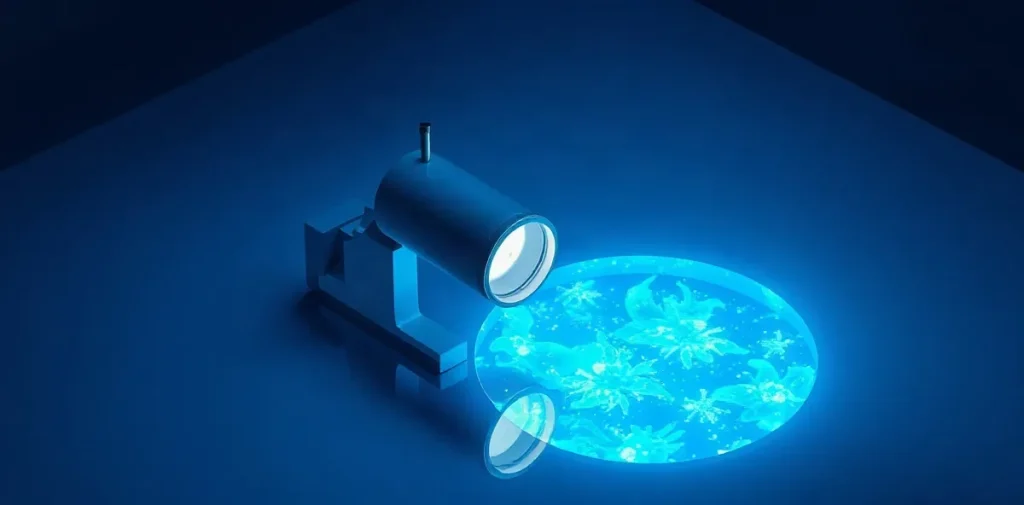
Fluorescence for Underwater Research: Principles, Tools, Techniques, Applications and Discoveries is a 2005 publication by Mazel on using fluorescence in underwater investigation. Presented in the context of a scientific-diving symposium, its subject connects optical measurement with the practical challenges of observing and studying marine environments beneath the surface.
What does fluorescence reveal underwater?
Fluorescence occurs when a substance absorbs light at one wavelength and emits some of that energy as light at a different wavelength. Researchers can use this response to distinguish fluorescent materials from surrounding water or surfaces, making the phenomenon useful as an observational and measurement tool.
Underwater, the method depends on both the properties of the target and the light available to excite it. Water absorbs and scatters light, while ambient illumination changes with depth, weather and conditions at the site. These factors shape what can be seen and how an observation should be interpreted.
What concepts matter when using the technique?
Fluorescence is not simply a matter of making an object glow. Instrument choice, illumination, viewing geometry and the optical properties of the water all affect the signal. A researcher must also consider whether the observed light comes from the target of interest or from other fluorescent materials in the scene.
- Excitation: light supplied at wavelengths that can prompt a material to fluoresce.
- Emission: the light released by the material, which may be separated from reflected excitation light using suitable optical arrangements.
- Background: ambient light, particles and nearby surfaces that can complicate detection.
- Calibration and context: procedures and environmental observations that help make measurements interpretable and comparable.
These are general considerations for underwater optical research, not a substitute for the details of a particular instrument or application. Reliable interpretation requires attention to the complete measurement setup, not just the visible signal.
Why does fluorescence research matter to scientific divers?
Scientific divers work in environments where access, visibility and time underwater can constrain observation. Optical methods can offer ways to examine features in place, supporting research that depends on detecting or characterising materials without bringing every target to the surface.
The technique also illustrates a broader relationship between diving practice and scientific instrumentation. A tool designed for use underwater must be compatible with the environment and the research task, while the diver must be able to operate it and record observations safely and consistently.
For diving physicians and hyperbaric clinicians, fluorescence is not itself a treatment or a physiological measure. Its relevance is chiefly contextual: it belongs to the scientific work carried out by divers, whose operational planning still has to account for depth, exposure, workload and the demands of the equipment they use.
How does this subject fit into diving science?
Underwater research has long relied on observation, photography and measurement adapted to the limits of submerged work. Fluorescence adds an optical approach based on how materials interact with light, complementing other ways of identifying, comparing or mapping features in aquatic settings.
The subject sits at the intersection of optics, marine investigation and scientific-diving methods. Its wider importance lies in the questions researchers can pose when an underwater signal offers information that ordinary illumination or visual inspection may not make readily apparent.
The publication appeared in Diving For Science 2005, the proceedings of the American Academy of Underwater Sciences Symposium held March 10–12, 2005, at the University of Connecticut at Avery Point in Groton, Connecticut. That venue places the topic within a scientific-diving setting concerned with methods and tools for research underwater.
Frequently asked questions
What is fluorescence in underwater research?
Why can underwater fluorescence be difficult to interpret?
Is fluorescence a diving-medicine treatment or diagnostic test?
Citation details
- Title: Fluorescence for Underwater Research: Principles, Tools, Techniques, Applications and Discoveries
- Authors: Mazel, CH
- Year: 2005
- Published in: Godfrey, JM; Shumway, SE. Diving For Science 2005. Proceedings of the American Academy of Underwater Sciences Symposium on March 10-12, 2005 at the University of Connecticut at Avery Point, Groton, Connecticut.
- Identifiers: 1-878301-10-1
- Repository record: Rubicon Research Repository, handle 123456789/9007
This page is an original summary written by the Rubicon editors from the publication’s bibliographic record. It does not reproduce the paper, its abstract or its data; consult the publication itself for its methods and findings.
Related reading on Rubicon
- Science Diving: Protocols and Techniques for Underwater
- Google Scholar Research: Search and Assess Sources
- Why Divers Get Cold Faster Underwater
- Diving Safety: Key Insights into Underwater Exploration
- Underwater Vision: Research Summary
- HPNS Suppression in Deep Human Dives: Research Summary
- More on Diving Science
- Browse the Research Library
