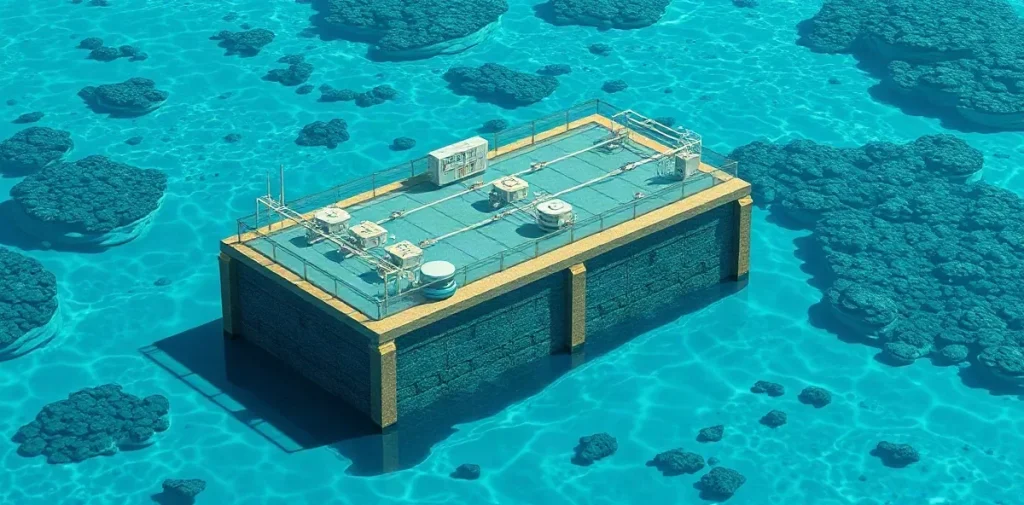
Marine mesocosms are bounded or otherwise controlled marine environments used to study ecological processes under conditions more realistic than a laboratory tank. Scientific diving can help researchers install, maintain and observe these experiments underwater, linking careful experimental control with the complexity of the sea.
What makes a marine mesocosm useful?
A mesocosm occupies a middle ground between a small laboratory experiment and observation in an open ecosystem. It can contain seawater and living communities while allowing researchers to manipulate or monitor selected conditions. The aim is to ask how a defined change affects organisms and their interactions without losing every feature of the natural setting.
That balance is difficult. A boundary can alter water movement, light, temperature or the passage of larvae and nutrients. Results therefore need to be interpreted in relation to how the enclosure works and how closely its conditions resemble the surrounding habitat.
Marine mesocosms can support questions about ecological change, including how organisms respond to altered conditions and how those responses affect a community. The design must make clear which factors are controlled, which remain variable and what the experiment can represent beyond its enclosure.
Why does the work call for diving?
Some experiments are installed in shallow or submerged habitats where divers can position apparatus, check enclosures and observe organisms directly. Underwater access can be essential when equipment must remain in place, when the experimental environment is difficult to reproduce ashore, or when repeated observation needs to avoid disturbing the system.
Scientific diving is not simply recreational diving with a research task added. A planned dive has to account for the diver’s exposure, the work to be done, equipment and communications, and the consequences of an interrupted task. Experimental procedures also need to limit disturbance: a diver’s bubbles, contact with structures or handling of organisms can change the conditions being studied.
There is a practical trade-off between collecting useful observations and protecting both the diver and the experiment. A method that is repeatable and minimally disruptive makes comparisons more credible, especially when several visits are needed.
How are underwater experiments designed?
Researchers define the question first, then decide what to manipulate, what to measure and how to distinguish an experimental effect from ordinary variation. Depending on the question, methods may involve enclosed seawater, instruments for monitoring conditions, observations of organisms, or scheduled sampling. Controls and replication help assess whether a pattern is associated with the treatment rather than a single enclosure or moment.
For divers, the experimental plan also has to fit the underwater task. Installation, inspection and sampling must be arranged so that handling is consistent and the site is not unnecessarily disturbed. Records of the dive and the apparatus help researchers interpret measurements if equipment shifts, leaks or behaves differently than intended.
- Boundaries: determine what can enter, leave or circulate through the experimental space.
- Environmental conditions: light, temperature, water movement and water chemistry can shape biological responses.
- Controls and replication: support comparison while accounting for variation among enclosures.
- Diver effects: bubbles, contact and repeated handling may influence the system under study.
- Operational planning: links the scientific task to safe, repeatable underwater procedures.
What do mesocosms reveal—and what can they miss?
Mesocosms are valuable because they make some environmental factors easier to control than they are in an open reef or coastal habitat. Researchers can compare conditions while retaining interactions among organisms that a simplified laboratory setup might omit. This makes the approach useful for studying processes rather than only isolated species.
Control comes at a cost. Enclosures can change the very processes they are intended to study, and a result within a bounded system may not transfer directly to an open ecosystem. Interpretation depends on the experiment’s scale, duration, boundary design and measured conditions, as well as on the ecological question.
Mesocosm work complements field observation and laboratory experiments; it does not replace either. Field studies capture natural complexity, while laboratory studies can isolate mechanisms more tightly. A mesocosm can help connect the two, provided its limits are treated as part of the experimental design.
Why does this research area matter to divers?
For scientific divers, underwater experiments make diving technique part of the research method. A stable, carefully documented procedure helps protect the diver and preserve the quality of observations. The same discipline matters when working around fragile habitats, instruments or experimental structures.
The wider value is ecological: controlled studies can help clarify how marine communities respond to changing conditions. Their findings may inform questions about habitat health and environmental management, but the strength of any application depends on whether the experimental setting represents the system being considered.
Diving introduces its own physiological and operational demands, which are distinct from the ecological question. Scientific teams need procedures suited to the task and the site; divers with medical concerns should consult a diving-medicine physician before undertaking a dive.
Frequently asked questions
What is the difference between a mesocosm and an aquarium?
Why use divers rather than work from the surface?
Can mesocosm results be applied to an open reef?
An original research-library explainer written by the Rubicon editors. It is not a summary of a specific publication.
Related reading on Rubicon
- Scientific Diving Course: Curriculum, Skills, Certification
- The Diving Reflex: What Happens Underwater
- Scuba Diving Regulators: Balanced vs. Unbalanced
- Scuba Diving Buddy Checks: Catch Problems Early
- Diving Techniques in Marine Mesocosms: Research Summary
- Scientific Diving and Underwater Research: Research Summary
- More on Diving Science
- Browse the Research Library