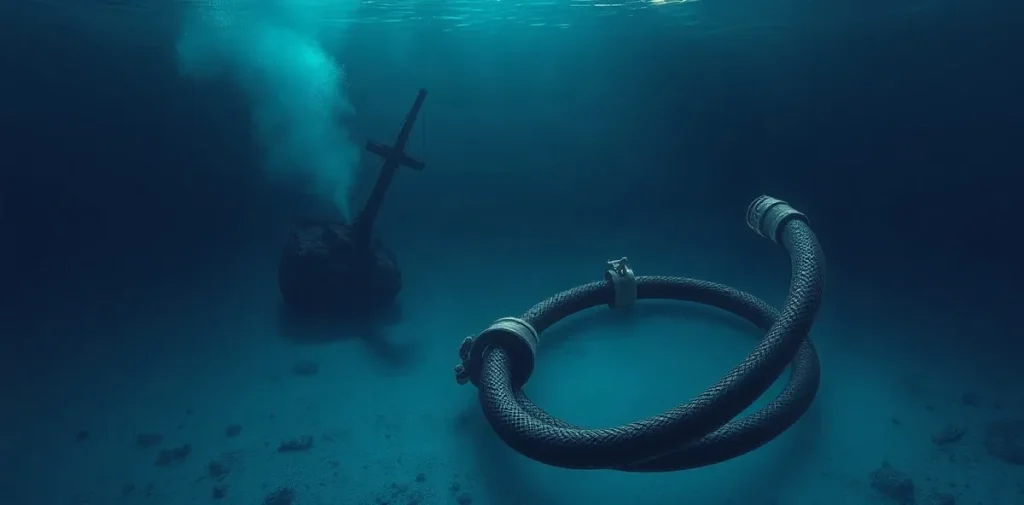
Richardson J’s 1991 journal article, “Abstract of the case of a diver employed on the wreck of the Royal George, who was injured by the bursting of the air-pipe of the diving apparatus. 1842,” addresses an early diving injury linked to equipment failure. The case connects diver health with the reliability of the system that supplies breathing gas underwater.
Why does an air-pipe failure matter to a diver?
A diver dependent on supplied air needs an uninterrupted path from the surface supply to the breathing apparatus. A damaged or ruptured pipe can disrupt that supply, expose the diver to sudden changes in pressure, or cause physical injury from the failure itself. The precise hazard depends on the equipment, depth, and circumstances.
These risks are not interchangeable. Loss of breathing gas can create an immediate threat underwater, while rapid pressure change may raise concerns about barotrauma or decompression illness. A mechanical failure can also injure the diver directly, so the incident needs to be understood as both an equipment problem and a medical emergency.
What medical concepts help frame a diving injury?
Pressure affects gas-filled spaces in the body as a diver descends or ascends. A pressure difference across the lungs or other air spaces can cause barotrauma; gas bubbles forming in tissues or circulation during or after decompression can cause decompression illness. These conditions have distinct mechanisms, even though a single incident may require clinicians to consider several hazards.
An interruption in breathing gas also has consequences beyond pressure injury. A diver who cannot breathe reliably underwater may face stress, impaired coordination, and difficulty making a controlled ascent. The injury assessment therefore includes the diver’s breathing and pressure exposure as well as any impact or trauma from the equipment event.
How does equipment design shape the risk?
Surface-supplied diving equipment relies on connected components, including the air source, hose or pipe, and diver’s breathing apparatus. Each connection must carry gas under pressure and remain functional through the demands of the dive. Inspection, maintenance, protection from damage, and procedures for responding to supply problems are central to controlling risk.
An air-pipe rupture is a reminder that equipment reliability cannot be separated from operational safety. The consequences depend on the failure mode: a sudden break, a partial leak, or a blockage presents different problems. How a particular system is arranged and what backup measures are available shape the diver’s options when supply is compromised.
- Gas supply: continuity of breathing gas from the surface to the diver.
- Pressure exposure: changes in ambient pressure and their effects on body air spaces.
- Mechanical injury: direct harm caused by a pipe, connection, or other failed component.
- Emergency response: recognition of the failure, support for the diver, and medical assessment after the event.
What does a historical case contribute to diving research?
A case associated with the wreck of the Royal George and dated 1842 places the subject in an early period of practical diving. Historical injury accounts can make hazards visible in their working context: the equipment in use, the task being performed, and the way an incident was understood at the time. They also sit alongside later work on dive equipment, pressure physiology, and the clinical management of injured divers.
Reading a historical case through modern concepts requires care. Terminology, equipment, and medical practice change, and a present-day diagnosis should not be assigned without adequate clinical detail. The enduring research question is how equipment failure interacts with pressure exposure and human physiology, and how that interaction should inform safer diving systems.
Who may find this subject useful?
Divers and equipment specialists can use the subject to think through how a gas-supply failure develops and what safeguards may interrupt the chain of events. Diving physicians and hyperbaric clinicians may find the intersection of mechanical injury, breathing interruption, and pressure-related illness relevant when assessing an incident.
This is general educational context, not a diagnosis or treatment plan. After a suspected diving injury, medical assessment should be directed by a physician experienced in diving medicine; urgent symptoms require prompt care.
Frequently asked questions
What is the article about?
Why can a breathing-gas supply failure be dangerous?
Which medical concepts are relevant to diving injuries?
Citation details
- Title: Abstract of the case of a diver employed on the wreck of the Royal George, who was injured by the bursting of the air-pipe of the diving apparatus. 1842
- Authors: Richardson J
- Year: 1991
- Published in: Undersea Biomed Res 18(1)
- Identifiers: PMID 2021022
- Record type: Journal article
- Repository record: Rubicon Research Repository, handle 123456789/2729
This page is an original summary written by the Rubicon editors from the publication’s bibliographic record. It does not reproduce the paper, its abstract or its data; consult the publication itself for its methods and findings.
Related reading on Rubicon
- Scuba Diving Equipment: Essential Gear for Every Diver
- Gas Laws Every Diver Must Know for Safe Diving Practice
- The Diving Reflex: What Happens Underwater
- Dive Computers: Air Integration vs. SPG
- PADI Diver Rescue Training: Research Summary
- The Prevention of Compressed-Air Illness: Research Summary
- More on Dive Medicine
- Browse the Research Library