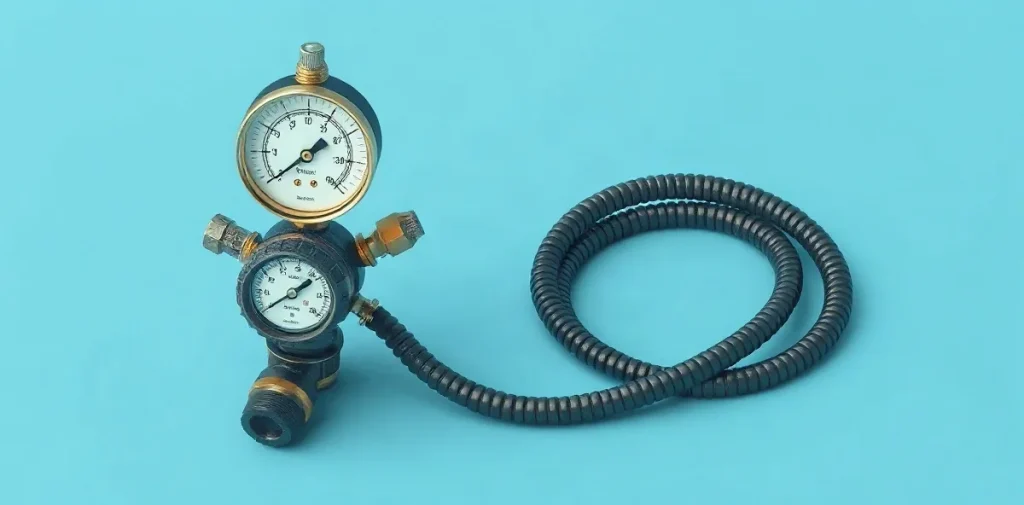
Research into demand breathing appliances at depth examines how regulators deliver gas under pressure and how much breathing gas a dive requires. These questions connect equipment performance to the diver’s respiratory workload and gas planning, making them central to deep-diving science and safety.
What does a demand breathing appliance do?
A demand regulator supplies gas when the diver inhales and reduces or stops delivery during exhalation. Its operation depends on pressure differences across the regulator’s valve and on the surrounding water pressure, which rises with depth.
The diver needs gas at a pressure suitable for breathing at ambient pressure. As depth increases, the regulator must deliver denser gas, and the diver’s breathing system must move it through the equipment and airways. The mechanical demand and the diver’s effort are therefore linked.
Comparing different appliances is not simply a matter of asking whether each one supplies gas. Relevant questions include how readily it responds to inhalation, whether delivery remains stable as conditions change, and how its design affects the work of breathing.
Why does depth change the problem?
Water pressure compresses gas in the lungs and breathing apparatus. To maintain the pressure balance needed for breathing, a regulator must provide gas at the surrounding pressure; a given volume of gas at depth contains more molecules than the same volume near the surface.
That relationship matters when calculating gas use. A diver’s breathing rate and the depth profile both affect how quickly a supply is consumed. Deeper operation can increase gas use even when the volume of gas breathed at ambient pressure appears unchanged.
Gas density also matters to breathing mechanics. Denser gas can increase resistance to flow, while regulator design, hose arrangement, posture, exertion and the diver’s physiological state may also affect breathing effort. Depth alone does not describe the full load on the respiratory system.
How are regulators and gas requirements evaluated?
Tests of this kind examine equipment under controlled pressure conditions, with attention to whether it supplies gas across a range of simulated depths. A useful comparison considers not just the regulator’s operation but also the conditions under which the measurement is made.
Gas-use measurements require a defined depth and breathing pattern, along with a clear distinction between gas volume measured at ambient pressure and gas quantity expressed at a reference pressure. Without that distinction, figures from different depths or test setups can be misleading.
- Delivery performance: whether the appliance supplies gas in response to inhalation under pressure.
- Breathing effort: the resistance and work involved in moving gas through the apparatus and respiratory tract.
- Gas accounting: how depth, breathing demand and the pressure basis of a volume measurement affect consumption.
- Test conditions: how the simulated environment and breathing pattern shape a comparison.
Bench or chamber testing can isolate variables that are difficult to control in open-water work. It does not, by itself, capture every feature of a working dive: movement, cold, task demands and individual differences may alter the practical experience of breathing.
Why does this research matter to divers and clinicians?
For divers, reliable delivery and realistic gas planning are inseparable. A supply plan must account for depth and breathing demand, while equipment choices must suit the conditions in which the diver will use them. A regulator that works acceptably in one setting cannot automatically be assumed to perform identically in another.
For diving physicians and hyperbaric clinicians, the subject connects engineering with respiratory physiology. Breathing effort, gas density and depth can contribute to the physiological load of a dive, so equipment performance is part of understanding the diver’s exposure rather than a separate technical concern.
Historically, evaluating breathing appliances and quantifying gas requirements belong to the broader effort to make deeper dives measurable and reproducible. The same questions remain relevant wherever a breathing system must deliver gas against changing ambient pressure, including scientific and hyperbaric operations.
What should a careful comparison keep in view?
A meaningful comparison needs to specify the appliance, pressure conditions, measurement method and breathing demand. It should also distinguish a controlled test of equipment from evidence about performance in actual diving, where multiple physical and operational factors act together.
Gas planning should likewise be interpreted in context: depth profile, breathing rate, reserve requirements and the way volumes are reported all matter. For decisions about an individual’s fitness to dive or medical risk, consult a diving-medicine physician.
Frequently asked questions
Why does a regulator need to respond to ambient pressure?
Does deeper diving always use more gas?
Can chamber tests predict how a regulator will feel underwater?
An original research-library explainer written by the Rubicon editors. It is not a summary of a specific publication.
Related reading on Rubicon
- Scuba Diving Regulators: Balanced vs. Unbalanced
- DIN vs. Yoke Regulators: Which Fits Your Tanks?
- Diving Physics: Gas Laws, Pressure Effects, and Safety
- Understanding Venous Gas Emboli and Diver Safety
- Pulmonary Function and Deep Mixed-Gas Diving
- Hydrogen–Helium–Oxygen and HPNS at Depth
- More on Diving Science
- Browse the Research Library