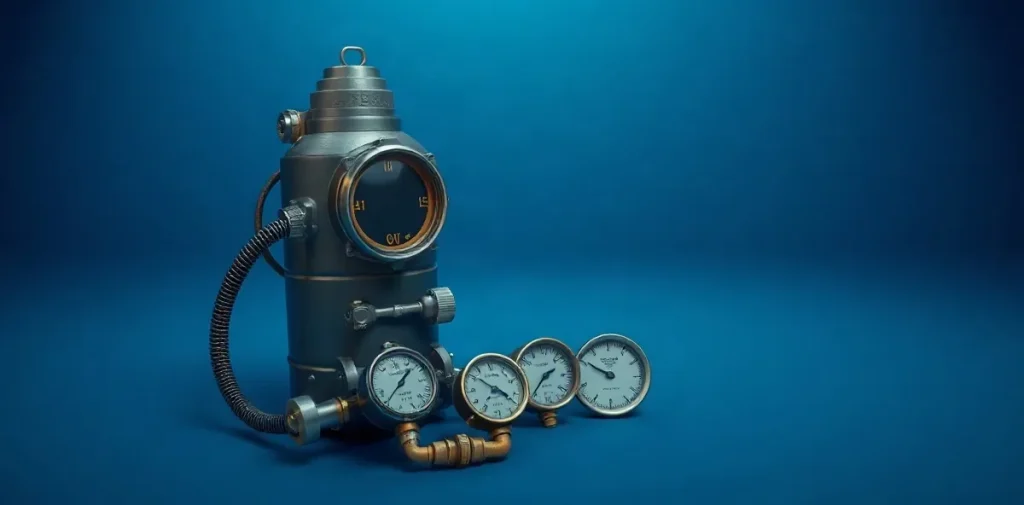
Evaluation of the Pirelli Underwater Oxygen Breathing Equipment for Use in the Naval Service is a 1952 technical report by Coates and colleagues. It addresses underwater oxygen-breathing equipment and its suitability for naval use, a question that joins apparatus design with the physiological limits and hazards of breathing oxygen underwater.
What does oxygen-breathing equipment do underwater?
An oxygen breathing set supplies oxygen to the diver and, in a closed-circuit arrangement, recirculates exhaled gas after removing carbon dioxide. Unlike open-circuit equipment, which releases exhaled gas into the water, a closed circuit can avoid bubbles and conserve gas. The report’s title identifies underwater oxygen breathing equipment as its subject, though it does not establish a particular circuit design.
Keeping a breathing circuit functional is more than delivering oxygen. The apparatus must support ventilation, remove carbon dioxide, maintain a usable breathing supply as the diver moves, and remain reliable in the underwater environment. A fault in any part of that chain can turn a compact breathing system into a serious hazard.
Why does oxygen pressure matter to a diver?
Oxygen is essential for metabolism, but breathing it at elevated partial pressure can be toxic. Partial pressure is the share of total gas pressure contributed by one gas; it rises as ambient pressure increases with depth. Consequently, a gas mixture that is tolerable at the surface may expose a diver to a much greater oxygen partial pressure underwater.
Oxygen toxicity can affect the central nervous system and may cause convulsions, which are especially dangerous underwater because a diver can lose control of the mouthpiece or drown. Pulmonary effects are also possible with prolonged exposure. Risk depends on the oxygen pressure and exposure duration, among other conditions, so equipment assessment must be understood alongside the limits of the breathing gas it delivers.
What must an equipment evaluation consider?
Evaluating a breathing set for service calls for attention to both engineering and human physiology. Important considerations include the gas supply, carbon-dioxide removal, breathing resistance, leakage, controls, and the way the apparatus behaves during use. The relevant question is not simply whether a device can deliver gas, but whether its operation remains safe and workable in its intended setting.
- Gas composition and pressure: whether the breathing supply can expose the diver to unsafe oxygen partial pressure at the operating depth.
- Carbon-dioxide control: whether exhaled carbon dioxide is removed effectively; excessive carbon dioxide can impair performance and cause distress.
- Breathing effort: resistance and the diver’s work of breathing can affect comfort and physical capacity.
- Operational reliability: leaks, component failures, and the ability to recognise or manage a problem matter underwater.
- Human factors: fit, access to controls, training, and task demands shape how equipment performs in practice.
These considerations apply broadly to underwater breathing systems. The balance between equipment performance and diver exposure depends on the operating conditions, the task, and the system’s design.
How does the report fit into diving research?
The publication sits within the practical history of naval diving research: assessing whether a breathing apparatus is suitable for use, rather than treating gas physiology as an abstract problem. Equipment evaluation connects laboratory and engineering questions to the diver’s actual exposure, workload, and ability to respond to a malfunction.
That connection remains central to diving and hyperbaric medicine. Clinicians consider pressure and gas exposure when assessing risk, while equipment specialists examine how a breathing system manages the gas and conditions that create that risk. For scientific and operational divers alike, the basic lesson is that a device’s intended use and operating envelope matter as much as its general type.
What should readers keep in mind today?
A historical evaluation is best read in its period and technical context. Oxygen breathing systems are not interchangeable with air or mixed-gas equipment, and operating procedures depend on the particular apparatus and its approved limits. A diver should not infer a safe depth, exposure duration, or present-day operating procedure from a publication title.
Anyone considering oxygen equipment needs current training, the manufacturer’s instructions, and procedures appropriate to the system and dive. Questions about personal medical risk or fitness to dive belong with a diving-medicine physician.
Frequently asked questions
What is the publication about?
Why can oxygen breathing be hazardous at depth?
Does this historical subject provide operating guidance for modern equipment?
Citation details
- Title: Evaluation of the Pirelli Underwater Oxygen Breathing Equipment for Use in the Naval Service
- Authors: Coates, JK; Kincaid, TC; Lanphier, EH
- Year: 1952
- Published in: Navy Experimental Diving Unit Technical Report NEDU-RR-2-52
- Record type: Journal article
- Repository record: Rubicon Research Repository, handle 123456789/3393
This page is an original summary written by the Rubicon editors from the publication’s bibliographic record. It does not reproduce the paper, its abstract or its data; consult the publication itself for its methods and findings.
Related reading on Rubicon
- The Diving Reflex: What Happens Underwater
- Scuba Equipment: Stop Your Mask Fogging
- Why Divers Get Cold Faster Underwater
- Diving Safety: Key Insights into Underwater Exploration
- Oxygen-Enhanced Breath-Hold Diving: Research Summary
- First Aid Oxygen for Diving Injuries: Research Summary
- More on Equipment
- Browse the Research Library