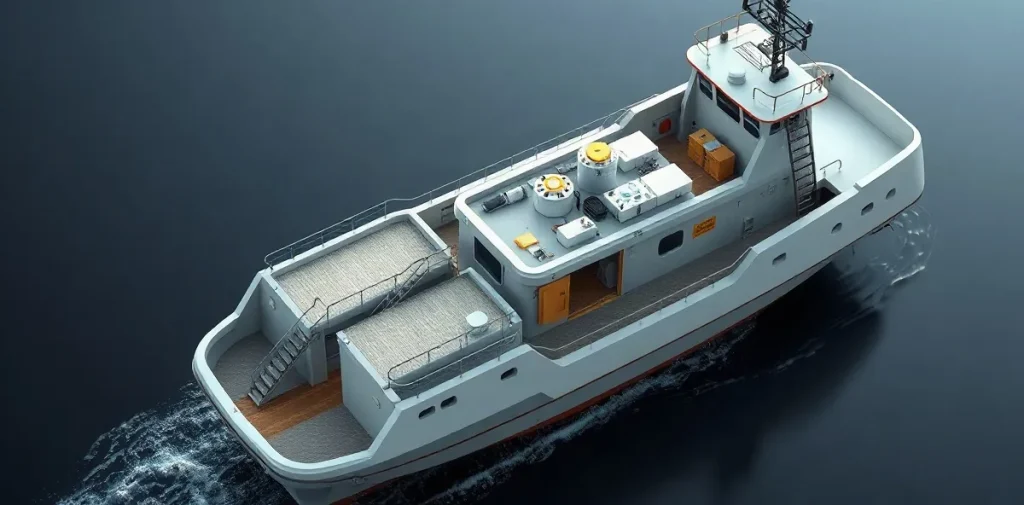
Research vessel design is the study of how a ship can support work at sea, including scientific diving. Its questions span deck layout, launch and recovery, communications, medical response and the working environment. Good design matters because a dive operation depends not only on the diver and equipment, but also on the vessel that carries and supports them.
What makes a vessel useful for scientific diving?
A research vessel must provide a workable link between the laboratory, the sea surface and the underwater site. For divers, that means a stable platform for preparing equipment, entering the water, returning aboard and beginning post-dive care. The right arrangement depends on the task, the sea conditions and the equipment used.
Designers consider how people and gear move through the vessel. A clear route from equipment storage to the dive station can reduce handling errors and avoid congestion during preparation or recovery. Space for briefings, communications and record-keeping also supports scientific work, where observations and sample handling must be coordinated with the dive plan.
How do launch and recovery shape dive operations?
Getting a diver into and out of the water is a central engineering problem. A vessel may need a suitable working deck, ladders or a mechanical handling system, with enough clearance to manage divers, hoses, instruments and samples. The arrangement should account for movement of the ship and the possibility that a diver will return tired, cold or unable to climb without assistance.
Launch and recovery are not isolated equipment choices. They affect where the dive team can work, how the vessel is positioned, how communications are maintained and how quickly an emergency response can begin. In planning a vessel, the operating sequence matters as much as the component list: preparation, water entry, bottom work, recovery and transfer to post-dive care must fit together.
- Access: a safe route between the vessel and water for divers and equipment.
- Stability: a working platform suited to the vessel’s operating conditions.
- Communications: reliable coordination between divers, the deck team and the bridge.
- Recovery: a practical means to bring a diver aboard and respond to changing conditions.
- Support space: room for equipment checks, observation and post-dive care.
What does vessel design have to do with diving physiology?
Underwater work exposes divers to pressure, cold, exertion and the demands of breathing underwater. A vessel cannot remove those physiological stresses, but its layout and support systems can influence how an operation is prepared and managed. Warm, sheltered areas, accessible supplies and an orderly return from the water can matter when a diver needs prompt assessment or care.
Decompression planning is also connected to vessel operations. The dive profile, available breathing gas, working depth and time underwater shape the plan; the vessel must support the planned method and the response if the dive does not proceed as expected. For a medical concern after diving, the vessel’s ability to communicate, monitor the diver and arrange onward care is part of operational readiness.
These are general design considerations, not a substitute for an operation-specific risk assessment. Diving medicine decisions, particularly after symptoms or a suspected decompression illness, should involve a physician experienced in diving medicine.
How are research-vessel designs evaluated?
Design work typically starts by defining the mission: where the vessel will operate, what science it must support, and which people, instruments and diving systems it must carry. Requirements can then be compared against the vessel’s physical limits, including deck space, storage, power, access and the effects of weather and sea state.
Engineering analysis and operational review address different parts of the problem. A proposed layout can be assessed for equipment handling and diver transfer, while operational planning tests whether the team can carry out the intended sequence safely. The relevant trade-offs include capability, complexity, maintenance and flexibility: a system suited to one kind of diving may not serve every scientific mission.
Why does this research area matter beyond the ship?
Scientific diving brings research work into an environment where access, time and safety depend on coordinated systems. Vessel design connects the diver’s underwater task to surface support, and therefore belongs alongside research on dive equipment, physiology, operational practice and emergency response.
The field also has a practical historical dimension: research vessels and diving practices change as scientific tasks and equipment change. For a particular expedition, the useful questions are concrete: does the vessel support the planned dive method, can the team recover a diver under expected conditions, and is there a workable route to medical assistance if needed?
Frequently asked questions
Is a research vessel the same as a dive-support vessel?
Which vessel features matter most to scientific divers?
Can vessel design prevent decompression illness?
An original research-library explainer written by the Rubicon editors. It is not a summary of a specific publication.
Related reading on Rubicon
- Scuba Diving Fins: Split vs. Paddle Designs
- Scientific Diving Course: Curriculum, Skills, Certification
- The Diving Reflex: What Happens Underwater
- Scuba Diving Regulators: Balanced vs. Unbalanced
- Design of the Next Generation of Research Vessels
- Scientific Diving and Underwater Research: Research Summary
- More on Equipment
- Browse the Research Library