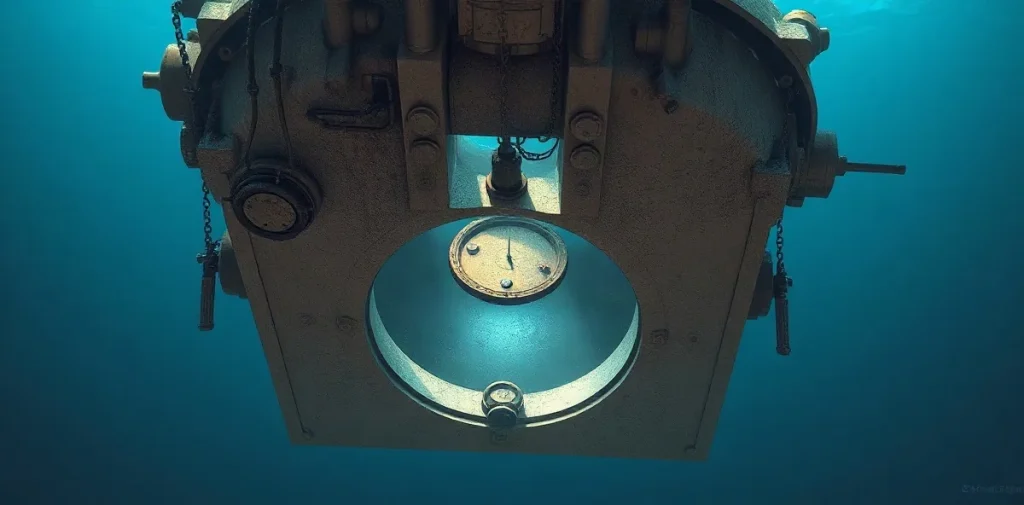
Diving bells through the centuries is a 1999 journal article by Bevan J, published in SPUMS Journal 29(1). Its subject is the history of the diving bell, a technology that lets people work underwater by carrying a pocket of air below the surface. Understanding that history also illuminates the engineering and physiological challenges that remain central to diving.
What is a diving bell, and how does it work?
A diving bell is a rigid chamber, open at its lower edge, that is lowered into water with air trapped inside. As it descends, water rises into the chamber and compresses the air. The air space remains only while its pressure balances the surrounding water pressure; the bell is not a dry, pressure-isolated room.
This arrangement can provide a breathing space and a place to work, but it imposes practical constraints. The depth, air supply, stability, access and means of raising and lowering the bell all affect its usefulness. The basic principle links a simple underwater enclosure to later systems for transporting and sustaining divers.
- Hydrostatic pressure: water pressure increases with depth, compressing trapped gas.
- Gas space: the air pocket changes in volume as pressure changes.
- Buoyancy and stability: the bell must remain controlled while suspended in water.
- Breathing and access: people need a suitable gas environment and a safe route into and out of the chamber.
Why does the history matter to modern divers?
The history of diving bells is part of the wider story of how people have extended work and observation beneath the surface. Each generation of underwater equipment has had to solve related problems: maintaining a breathable environment, managing pressure, communicating with the surface and recovering the diver or chamber safely.
For divers and scientific teams, this history provides context for the equipment and procedures used today. It also shows why underwater technology cannot be understood as hardware alone. A chamber’s design, its operating environment and the human body’s response to pressure are closely connected.
What does pressure mean for the people inside?
When a diver or a bell’s air space is exposed to greater depth, surrounding pressure rises. Gas in enclosed spaces is compressed, and body air spaces such as the middle ears and sinuses must equalise with the environment during descent. If pressure changes are not accommodated, discomfort or injury can occur.
Pressure also matters on the return to the surface. Dissolved inert gas can leave body tissues as pressure falls; a sufficiently rapid change can contribute to decompression illness. A diving bell’s historical role therefore sits alongside enduring questions about exposure time, depth, breathing gas and controlled ascent—not simply the ability to stay underwater.
How does bell technology fit into diving medicine?
Diving medicine considers how pressure and breathing gases affect the body, and how to prevent, recognise and manage problems associated with underwater exposure. Bells and other chambers are relevant because they shape the diver’s environment and can support underwater work, while also creating operational questions about gas delivery, monitoring and transfer.
In hyperbaric practice, a chamber is an enclosed space in which pressure can be controlled. A diving bell and a modern treatment chamber are not interchangeable, but both make pressure management a central concern. For any individual symptoms or fitness-to-dive question, consult a physician experienced in diving medicine.
What questions help assess an underwater system?
Historical study of underwater equipment encourages readers to look beyond its defining mechanism. The same practical questions apply when considering a bell, a surface-supplied system or other technology: what pressure conditions will the occupant experience, how is breathing gas maintained, and what happens if the operation must stop?
These questions connect engineering to human factors and safety planning. They also help explain why the history of a device can matter to clinicians and researchers: design choices influence exposure, access to assistance and the possibilities for a controlled return to the surface.
Frequently asked questions
What is the main subject of Diving bells through the centuries?
Why does a diving bell’s air space change with depth?
Why is diving-bell history relevant to diving medicine?
Citation details
- Title: Diving bells through the centuries
- Authors: Bevan J
- Year: 1999
- Published in: SPUMS Journal 29(1)
- Record type: Journal article
- Repository record: Rubicon Research Repository, handle 123456789/5991
This page is an original summary written by the Rubicon editors from the publication’s bibliographic record. It does not reproduce the paper, its abstract or its data; consult the publication itself for its methods and findings.