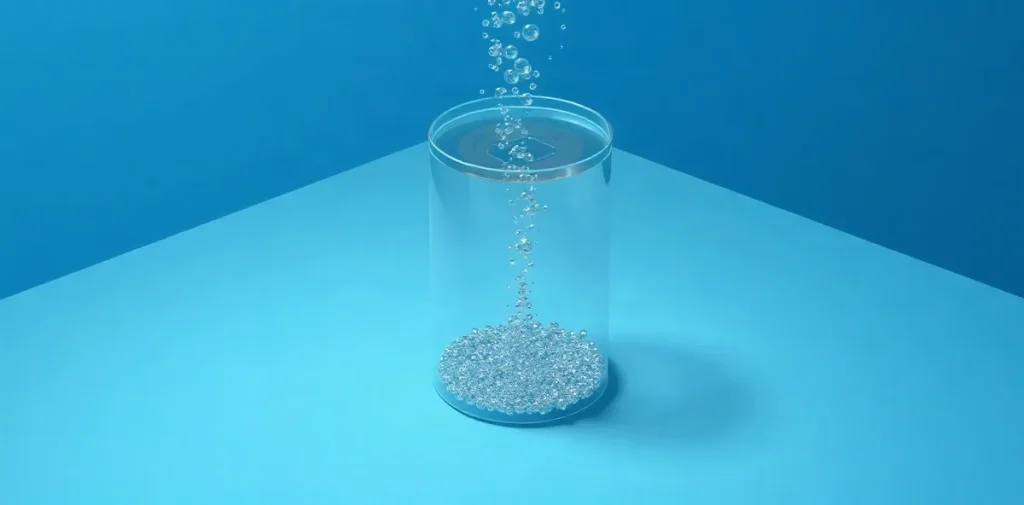
Tissue bubble dynamics research asks how gas bubbles form and change in the body during and after decompression, and how those changes relate to decompression stress. The subject matters because a diver can complete an ascent without obvious problems while physiological processes continue; understanding them may help explain risk beyond depth and time alone.
Why look at bubbles rather than pressure alone?
During a dive, increased pressure causes more inert gas, chiefly nitrogen in air, to dissolve in tissues. On ascent, pressure falls and the gas moves back towards the lungs for elimination. If local conditions allow, some gas can separate from solution and form bubbles.
Pressure exposure is therefore only part of the picture. Tissue type, circulation, gas uptake and washout, and the shape of the ascent influence what happens inside the body. Bubble dynamics offer a way to investigate the biological response to decompression rather than treating the dive profile as a complete measure of stress.
Bubble presence is not by itself a diagnosis of decompression illness. The clinical significance depends on factors such as bubble location, amount, persistence and the diver’s condition; symptoms and examination remain central to medical assessment.
What does “tissue bubble dynamics” mean?
“Tissue” refers to the body compartments that absorb and release inert gas at different rates. A simple model may represent tissues as compartments with differing gas exchange characteristics, while real tissues have more complex structures, blood flows and local environments.
“Dynamics” refers to change over time: bubble formation, growth, movement, persistence and dissolution. These processes are affected by pressure and gas gradients, as well as the exchange of gas between blood, tissue and the lungs. A decompression stress index based on bubble dynamics is a way of expressing aspects of this changing process in a form that can be examined or compared.
- Inert-gas loading: gas dissolves in the body under pressure and is eliminated during decompression.
- Supersaturation: tissue gas pressure can exceed the surrounding pressure, creating conditions that may support bubble formation.
- Bubble growth and clearance: bubbles can change as gas diffuses into or out of them and as circulation transports gas away.
- Decompression stress: a physiological concept, not a direct synonym for symptoms or a clinical diagnosis.
How do researchers study decompression stress?
Research in this area combines decompression profiles with physiological models of gas uptake and elimination. Models can estimate how inert gas behaves in different tissue compartments, then explore how assumptions about bubbles might alter a measure of stress. The purpose is to make biological processes available for systematic analysis.
Measurements of bubbles can also be used in decompression research. Doppler ultrasound detects moving gas bubbles in the circulation; other imaging approaches can examine bubbles in particular settings. Such measurements require careful interpretation: a detected bubble signal is an observation, not a stand-alone forecast of whether a diver will become ill.
Evaluation of an index involves asking whether its definition is physiologically plausible, whether it can be calculated consistently, and how it relates to relevant observations. Researchers also have to consider what the model simplifies. A useful index can organise a complex question, but it cannot capture every difference between divers, dives or clinical situations.
What could this mean for divers and clinicians?
Decompression procedures aim to manage inert-gas exchange while limiting the chance of harmful bubble formation and growth. A better account of bubble behaviour could help researchers examine why apparently similar exposures can have different physiological consequences, and how decompression schedules might be assessed.
For dive physicians and hyperbaric clinicians, bubble research contributes to the broader understanding of decompression illness, but it does not replace clinical judgement. Symptoms after diving need proper medical assessment, and decisions about diagnosis or treatment belong with qualified clinicians. A bubble measurement or theoretical index should not be treated as clearance to dive.
The same questions matter in scientific diving and other settings where exposure planning must account for the work, the environment and the diver’s health. For an individual’s fitness to dive or post-dive symptoms, consult a diving-medicine physician.
How does this research fit into decompression science?
Decompression research has long used pressure, time and gas exchange to describe exposure and plan ascents. Bubble-based approaches extend that work by focusing on a possible biological consequence of changing pressure. They sit alongside questions about decompression schedules, individual susceptibility, detection of circulating bubbles and the clinical distinction between physiological signals and illness.
That connection also links the subject to other practical strands of diving research. Gas analysis and equipment performance affect the breathing gases a diver receives; rebreather research examines systems that recycle breathing gas; submarine rescue raises questions about decompression after pressurized exposure. Each has its own technical and medical concerns, while bubble dynamics offer one lens on how pressure change affects the body.
The central challenge is to connect a measurable or modelled signal with meaningful risk without mistaking the signal for the outcome. That distinction is essential when interpreting decompression research or applying it to dive planning.
Frequently asked questions
Do bubbles always cause decompression illness?
What is a decompression stress index?
Can bubble monitoring tell a diver whether it is safe to dive?
An original research-library explainer written by the Rubicon editors. It is not a summary of a specific publication.
Related reading on Rubicon
- Microbubbles in Decompression Stress and Tissue Health
- How Hydration Affects Decompression Stress and Diver Health
- Microbubbles’ Role in Decompression Stress and Risk
- The Science Behind Bubble Formation in Decompression
- Decompression Stress Index and Tissue Bubble Dynamics
- Blood-Bubble Interaction in Decompression Sickness
- More on Diving Science
- Browse the Research Library