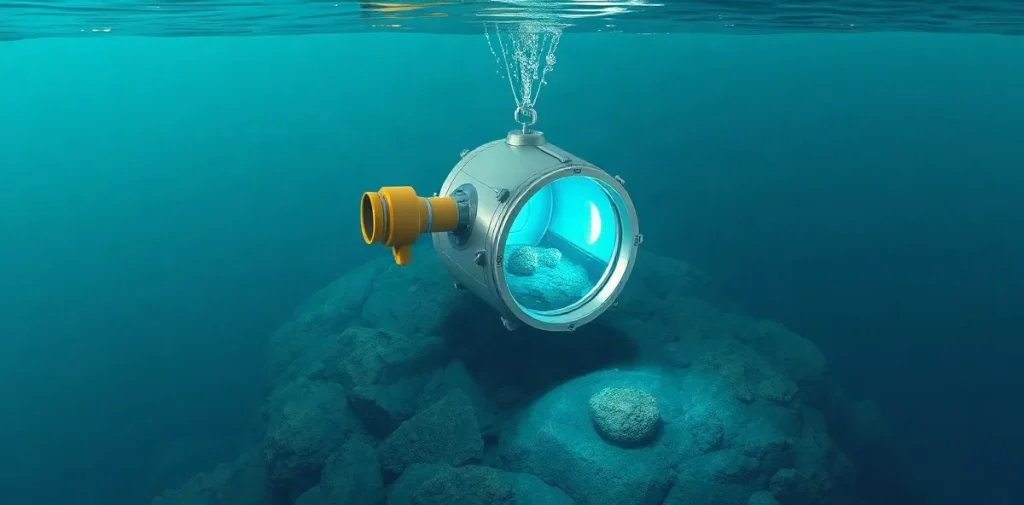
Scientific submersibles let researchers reach underwater environments that are difficult or hazardous for divers to work in directly. Their use brings together vehicle engineering, mission planning and human factors: the crew must manage a confined, pressurised environment while observing and working at depth. Understanding that combination matters to divers because it shapes how underwater research is conducted and how its risks are controlled.
What questions do scientific submersibles help answer?
A submersible can carry observers and instruments into places where a diver’s exposure time, mobility or breathing-gas supply would limit the work. Researchers may use a vehicle to inspect habitats, document geological features, collect samples or make measurements. The specific task determines the equipment, operating plan and observations needed.
The central research questions are both scientific and operational. What can be observed or measured from the vehicle? How can the vehicle reach the site, remain there safely, and return with usable records or samples? A study of submersible operations for science belongs to the broader effort to make underwater access serve a defined research purpose.
How is a submersible operation planned?
Planning starts with the site and the research objective. Depth, terrain, visibility, currents, launch and recovery arrangements, communication, and the route back to the surface all affect what a mission can accomplish. A vehicle’s endurance and available instruments also constrain the work, so researchers must decide what to prioritise before descent.
In broad terms, an operation includes preparation, deployment, work at depth, ascent and recovery. The team needs clear procedures for communication and for responding to an equipment fault or changing conditions. Any sampling or instrument use must fit the available time and preserve the quality of observations.
- Vehicle and life support: the systems that keep the crew in a suitable environment and support the mission.
- Navigation and communication: how the team tracks the vehicle and coordinates its work with surface support.
- Research payload: instruments, cameras or sampling tools selected for the scientific question.
- Launch, recovery and contingency planning: the practical steps that frame the dive from the surface.
These elements are interdependent. A change in the scientific task can alter the payload, mission duration and operating procedure; a constraint in the vehicle can narrow the research question that is practical to pursue.
What makes the crew’s environment different from a diver’s?
A submersible’s crew works inside a pressure-resistant enclosure rather than breathing the surrounding water through diving equipment. In a conventional pressure-hull vehicle, the interior is maintained near surface pressure, while the hull withstands the surrounding water pressure. This separates the crew’s immediate breathing environment from the ambient pressure experienced by an immersed diver.
That difference changes the physiological problem, but it does not remove human factors. Crew members work in a confined space, rely on life-support and control systems, and must communicate and make decisions while the vehicle is operating. Fatigue, workload, visibility and the consequences of a systems failure remain important considerations.
For diving physicians and hyperbaric clinicians, the distinction matters when evaluating an exposure or planning a response. The crew’s pressure environment and the vehicle’s operating history are relevant context; ordinary assumptions about a diver’s depth exposure may not apply. Questions about symptoms or fitness for a mission belong with a diving-medicine physician.
How does this work relate to other underwater research?
Submersibles are one of several ways to extend human observation underwater. Scientific divers work directly in the water, while remotely operated and autonomous vehicles can carry cameras or instruments without an onboard crew. Each approach offers different trade-offs in access, dexterity, endurance, direct observation and exposure of people to the underwater environment.
The choice is not simply a matter of depth. A diver may be best suited to a task requiring close contact or manual work; a crewed vehicle may be useful when observers need to reach a site and conduct sustained work from a protected cabin. The research objective, conditions and available equipment determine which method fits.
This operational field connects engineering with scientific diving practice. It asks how people, vehicles and research tools can work together underwater, and how observations can be made without losing sight of safety, data quality or the limits of the equipment.
Why should divers understand submersible operations?
Scientific divers may work alongside vehicle teams, contribute observations that guide a vehicle mission, or help plan a project that uses more than one mode of access. Knowing how the vehicle is operated helps clarify where divers can contribute and where an enclosed crewed platform offers a different capability.
The same knowledge helps readers interpret underwater research. A record made through a viewport, a sample collected by a manipulator and a measurement taken by a diver involve different methods and constraints. When assessing a scientific result, the way the observation was obtained is part of understanding what it can tell us.
Frequently asked questions
How is a submersible different from a scuba dive?
What determines whether researchers use a submersible?
Does a submersible eliminate risk to its crew?
An original research-library explainer written by the Rubicon editors. It is not a summary of a specific publication.
Related reading on Rubicon
- Scientific Diving Course: Curriculum, Skills, Certification
- The Diving Reflex: What Happens Underwater
- Scuba Diving Fins: Split vs. Paddle Designs
- Scuba Diving Regulators: Balanced vs. Unbalanced
- Scientific Diving and Underwater Research: Research Summary
- Advanced Scientific Diving: Research Summary
- More on Diving Science
- Browse the Research Library