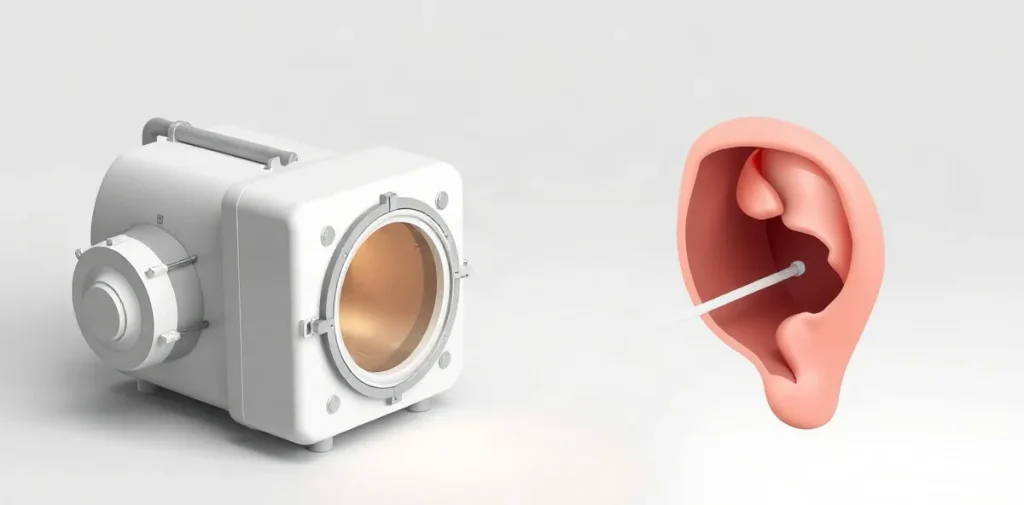
Indication for hyperbaric oxygen treatment as a predictor of tympanostomy tube placement is a 2006 journal article by Fiesseler FW and colleagues, published in Undersea & Hyperbaric Medicine. It addresses the relationship between the reason for hyperbaric oxygen treatment and placement of tympanostomy tubes, a question relevant to middle-ear pressure equalisation and patient care in hyperbaric settings.
Why connect treatment indication with ear tubes?
Hyperbaric oxygen treatment takes place in a pressurised environment. As pressure changes, gas in the middle ear must move through the Eustachian tube to keep pressure on both sides of the eardrum sufficiently balanced. If that adjustment is difficult, pressure differences can cause pain or injury.
A tympanostomy tube is a small opening through the eardrum, maintained by a tube, that allows air to pass between the middle ear and the external ear canal. Considering tube placement in relation to the indication for hyperbaric treatment brings together two parts of clinical decision-making: the condition prompting treatment and the patient’s ability to tolerate pressure changes.
How does middle-ear pressure change during chamber treatment?
During compression, pressure around the body rises. The middle ear is an air-filled space, so its pressure must rise as well; the Eustachian tube normally provides a route for air to enter from the throat. If the tube does not open readily, pressure in the middle ear may lag behind chamber pressure and pull the eardrum inward.
During decompression, the pressure relationship reverses, and gas must leave the middle ear. A pressure imbalance in either direction may produce discomfort or barotrauma. The ability to equalise can be affected by factors such as congestion, inflammation, anatomy, or difficulty performing an equalisation manoeuvre.
- Middle ear: the air space behind the eardrum, where pressure must adjust during chamber changes.
- Eustachian tube: the passage that connects the middle ear with the back of the nose and throat.
- Tympanostomy tube: a route through the eardrum that can help ventilate the middle ear.
- Barotrauma: tissue injury caused by a pressure difference across an air-containing space.
What does a treatment indication have to do with ear management?
The title frames the treatment indication as a possible predictor of tympanostomy tube placement. In clinical research, a predictor is a characteristic considered in relation to an outcome; examining one does not, by itself, establish that it causes the outcome. The question is therefore about how the clinical context of hyperbaric oxygen treatment relates to decisions about managing middle-ear pressure.
Hyperbaric oxygen is used for different medical indications, and patients may differ in health status, treatment circumstances, and ability to equalise. These factors make ear assessment part of the wider process of planning chamber treatment. The question matters to hyperbaric clinicians because pressure-related ear problems can affect comfort, safe treatment delivery, and whether a course can proceed as planned.
Why is this relevant to diving medicine?
Chamber treatment and diving both expose air spaces to changing ambient pressure. In diving, failure to equalise the middle ear can cause pain and barotrauma during descent or ascent. In hyperbaric treatment, the same basic pressure mechanics apply, although the clinical setting and reasons for exposure differ.
Research on middle-ear management in hyperbaric care fits within a broader effort to understand pressure injury, identify relevant patient factors, and make treatment decisions that account for ear function. The topic can inform discussions among hyperbaric clinicians and diving-medicine physicians, while remaining distinct from direct evidence about an individual diver’s fitness to dive.
How are tubes considered in clinical care?
A tympanostomy tube changes how the middle ear is ventilated by providing an opening through the eardrum. Whether that approach is appropriate depends on the clinical situation, including the need for hyperbaric treatment and the condition of the ear. Tube placement is a medical decision, not a general measure for everyone undergoing pressure exposure.
Assessment may include a history of ear symptoms and equalisation difficulties, examination of the eardrum, and consideration of the planned pressure exposure. Anyone with concerns about chamber treatment, diving, or previous ear barotrauma should consult a physician with relevant diving or hyperbaric medicine expertise. This information is general education and is not a substitute for individual medical advice.
Frequently asked questions
What is a tympanostomy tube?
Why can pressure changes affect the middle ear?
Does this topic apply to divers as well as chamber patients?
Citation details
- Title: Indication for hyperbaric oxygen treatment as a predictor of tympanostomy tube placement
- Authors: Fiesseler FW; Silverman ME; Riggs RL; Szucs PA
- Year: 2006
- Published in: Undersea & Hyperbaric Medicine 33(4): 231–5
- Identifiers: PMID 17004409
- Record type: Journal article
- Repository record: Rubicon Research Repository, handle 123456789/5033
This page is an original summary written by the Rubicon editors from the publication’s bibliographic record. It does not reproduce the paper, its abstract or its data; consult the publication itself for its methods and findings.
Related reading on Rubicon
- The Physiology Behind Oxygen Toxicity in Deep Dives
- Understanding Oxygen Toxicity Risks and Prevention in Diving
- Oxygen Partial Pressure: Key to Dive Safety and Performance
- Myth Busting: Clarifying Oxygen Toxicity Limits in Diving
- Hyperbaric Oxygen Therapy for Lyme Disease
- Erythromelalgia and Hyperbaric Oxygen
- More on Dive Medicine
- Browse the Research Library