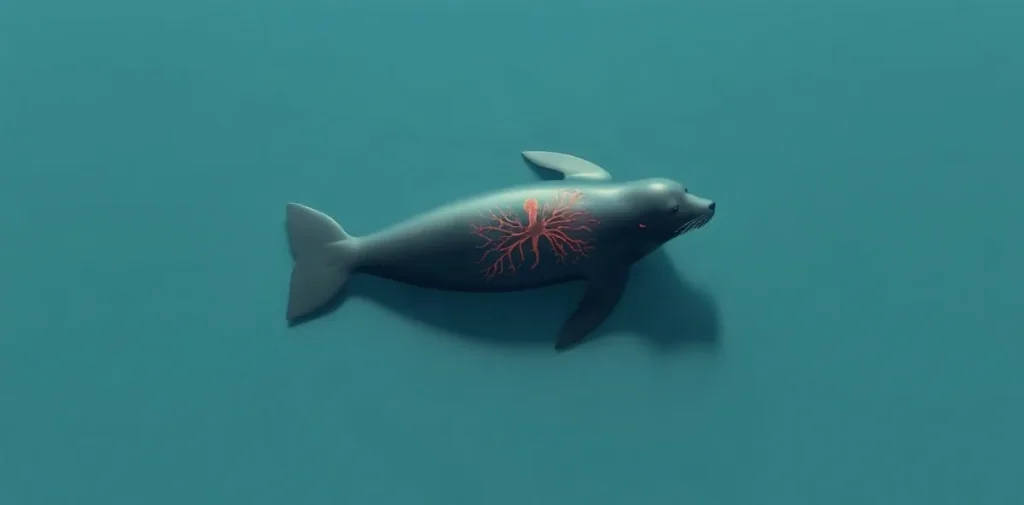
Diving seals offer a way to examine how mammals manage oxygen during prolonged breath-holding and underwater activity. Their physiology connects oxygen storage, circulation and metabolism under changing conditions—a set of questions that helps researchers understand the limits of breath-hold diving and provides useful context for human diving physiology.
Why study oxygen in a diving seal?
When a mammal dives without breathing, its lungs receive no fresh oxygen. Oxygen already present in the body must support the brain, heart and working muscles until breathing resumes. The central research question is how oxygen is stored, distributed and used during that interval.
Seals are adapted to spend time underwater, so their physiology offers a comparative model rather than a direct template for people. Studying them helps identify which features reflect general mammalian responses to breath-holding and which depend on species-specific adaptations.
Where is oxygen stored, and how is it used?
Oxygen is carried in the blood by haemoglobin and held in muscle by myoglobin; a further reserve is present in the lungs. The relative contribution of each store, and the rate at which tissues consume oxygen, shape how long a diver can remain submerged before oxygen becomes critically limited.
A dive also changes circulation. In many diving mammals, heart rate slows and blood flow is redistributed, conserving oxygen for organs that are especially sensitive to a shortage. Muscle activity, dive depth, temperature and the animal’s state before submergence can all affect oxygen demand and supply.
- Oxygen stores: the blood, muscles and lungs hold usable oxygen.
- Oxygen delivery: circulation moves oxygen to tissues, with distribution changing during a dive.
- Oxygen consumption: metabolism uses oxygen at rates that vary with activity and conditions.
- Recovery: breathing after a dive replenishes stores and helps restore normal physiology.
How do researchers investigate breath-hold physiology?
Research in this area combines measurements of oxygen with observations of diving behaviour and physiological responses. Depending on the question, investigators may examine blood oxygenation, heart rate, muscle oxygen use, breathing patterns or the timing of recovery after surfacing. Each measurement captures one part of a system that changes throughout a dive.
Interpretation depends on context. A seal resting underwater does not have the same oxygen demands as one swimming vigorously, and a measurement taken during submergence may differ from one taken during recovery. Researchers therefore consider behaviour and physiological state alongside the oxygen measurement itself.
What can seal physiology tell human divers?
Seals are not small-scale models of human divers: they have distinctive adaptations, and people use breathing equipment or follow different patterns of breath-hold activity. Still, comparative physiology clarifies basic principles, including why oxygen reserves matter, why exertion can shorten the time available underwater, and why recovery breathing is part of the dive cycle.
For scuba divers, oxygen physiology is relevant to gas exchange, exercise, and the consequences of inadequate oxygen supply. For breath-hold divers, it frames the relationship between stored oxygen, workload and time underwater. It does not provide a personal safe breath-hold limit or replace training and conservative practice.
Why does this research matter in dive medicine?
Oxygen shortage can impair judgement and coordination before a diver recognises the danger, and severe deprivation can cause loss of consciousness. Understanding how oxygen is transported and consumed helps place such risks within the wider physiology of diving, alongside pressure effects, decompression and the demands of exertion.
Seal research belongs to a broader field that compares diving animals with humans to test questions about oxygen management, circulation and metabolic response. Its value is explanatory: it helps define mechanisms that can guide further study, while clinical assessment and decisions about a diver’s health belong with a diving-medicine physician.
Frequently asked questions
Why are seals useful for studying oxygen during dives?
Does seal physiology set a safe breath-hold time for people?
Which oxygen stores matter during a dive?
An original research-library explainer written by the Rubicon editors. It is not a summary of a specific publication.
Related reading on Rubicon
- Understanding the Physiology of Breath-Hold Diving
- The Physiology Behind Oxygen Toxicity in Deep Dives
- Understanding Oxygen Toxicity Risks and Prevention in Diving
- Myth Busting: Clarifying Oxygen Toxicity Limits in Diving
- Oxygen-Enhanced Breath-Hold Diving: Research Summary
- Oxygen-Enhanced Breath-Hold Diving: Research Summary
- More on Diving Science
- Browse the Research Library