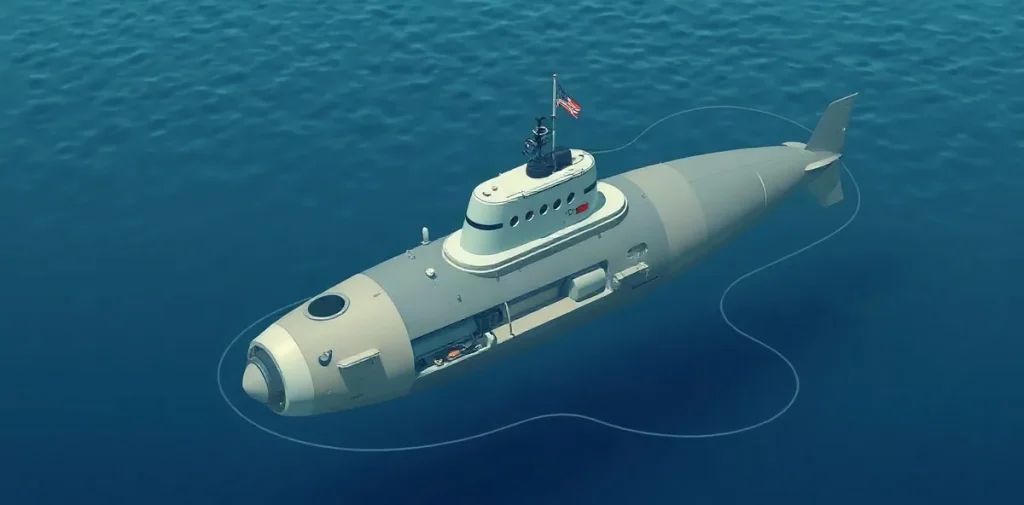
Submarines are pressure-resistant vessels that operate underwater, where the surrounding water pressure rises with depth. Their crews breathe in a controlled, enclosed atmosphere rather than the surrounding water, making submarine medicine distinct from scuba diving while closely connected to diving physiology, pressure engineering and hyperbaric care.
How does submarine pressure differ from a diver’s exposure?
A submarine’s hull separates its internal atmosphere from the water pressure outside. In normal operation, the crew’s cabin remains near surface pressure, so depth does not directly compress the air they breathe as it does for a diver breathing from a regulator underwater.
This distinction changes the main medical questions. Divers must manage pressure-related effects on gas spaces and tissues during descent and ascent; submarine crews face the health demands of living in a sealed environment, alongside risks created by pressure changes during particular operations or emergencies.
Pressure-resistant design is therefore part of the medical context, not merely an engineering detail. The integrity of the hull and the management of any transition between different pressure environments shape the exposure a crew might face.
What makes an enclosed submarine atmosphere a medical concern?
In a confined cabin, breathable air must be maintained as people consume oxygen and produce carbon dioxide. Atmosphere control also has to account for contaminants, humidity and temperature, while supporting the crew over time without the continuous exchange with outside air available in ordinary open environments.
Oxygen and carbon dioxide are especially important because both affect human function. Too little oxygen can impair the brain and other organs; excess carbon dioxide can cause symptoms and disrupt normal physiology. The risks depend on the concentration, duration of exposure and the individual’s condition.
- Oxygen: availability must support metabolism without creating an unsuitable breathing atmosphere.
- Carbon dioxide: removal limits accumulation in a closed cabin.
- Contaminants: their sources, concentration and persistence matter in an enclosed space.
- Temperature and humidity: both influence comfort, heat balance and the working environment.
These concerns overlap with life-support questions in diving systems and hyperbaric chambers, but the equipment and operating conditions differ. For medical assessment, the relevant exposure is not simply “underwater”; it includes cabin composition, duration, workload and any change in pressure.
Where do submarine operations meet diving medicine?
Submarine operations intersect with diving medicine when personnel enter or leave the vessel through systems that involve pressure change, or when an accident exposes them to a different pressure environment. Depending on the operation, decompression illness and pressure-related injury may then become relevant alongside the more usual concerns of enclosed-space medicine.
Decompression illness arises when pressure reduction allows inert gas dissolved in body tissues to form bubbles. The risk is familiar from diving, but it cannot be inferred from the word “submarine” alone: the person’s actual pressure exposure, breathing gas, time and decompression history determine whether this mechanism applies.
Barotrauma is another possible concern when gas-filled spaces are exposed to changing pressure without adequate equalisation. A clinician evaluating a pressure-related event needs a clear account of the exposure and symptoms; suspected decompression illness or serious barotrauma warrants prompt assessment by a diving-medicine physician.
Why does submarine research matter to clinicians and divers?
Research on submarines helps clarify how the human body and life-support systems interact in a confined, controlled atmosphere. Its questions sit alongside work on saturation diving, underwater habitats and hyperbaric medicine, where people may spend extended periods in environments that differ sharply from ordinary surface conditions.
The shared scientific themes include gas exchange, oxygen delivery, carbon dioxide handling, pressure transitions and the effects of prolonged confinement. Comparing these settings requires care: a submarine crew breathing near-surface-pressure air is not physiologically equivalent to a diver breathing compressed gas at depth.
For diving physicians, the distinction helps prevent the wrong mechanism from being assumed. For engineers and scientific divers, it focuses attention on how atmosphere management, vessel design and operating procedures shape human exposure.
What should be assessed after a submarine-related exposure?
Assessment starts with the actual event: whether pressure changed, what atmosphere the person breathed, how long the exposure lasted, and when symptoms began. Respiratory symptoms, confusion, unusual fatigue or neurological changes can have several causes in a confined environment, so the exposure history is central to clinical judgment.
Possible carbon dioxide or oxygen problems, contaminant exposure, heat stress and pressure-related injury call for different responses. A diving-medicine physician should be consulted when decompression illness, barotrauma or another serious pressure-related condition is suspected; urgent symptoms require emergency medical care.
Frequently asked questions
Do submarine crews breathe air at depth pressure?
Can submarine operations involve decompression illness?
Why monitor carbon dioxide in a submarine?
An original research-library explainer written by the Rubicon editors. It is not a summary of a specific publication.
Related reading on Rubicon
- The Diving Reflex: What Happens Underwater
- Scuba Diving Regulators: Balanced vs. Unbalanced
- Scuba Diving Buddy Checks: Catch Problems Early
- Scuba Diving: Why Immersion Can Dehydrate You
- Thesis Research in Diving and Hyperbaric Medicine
- Oxygen in Diving and Hyperbaric Medicine
- More on Diving Science
- Browse the Research Library