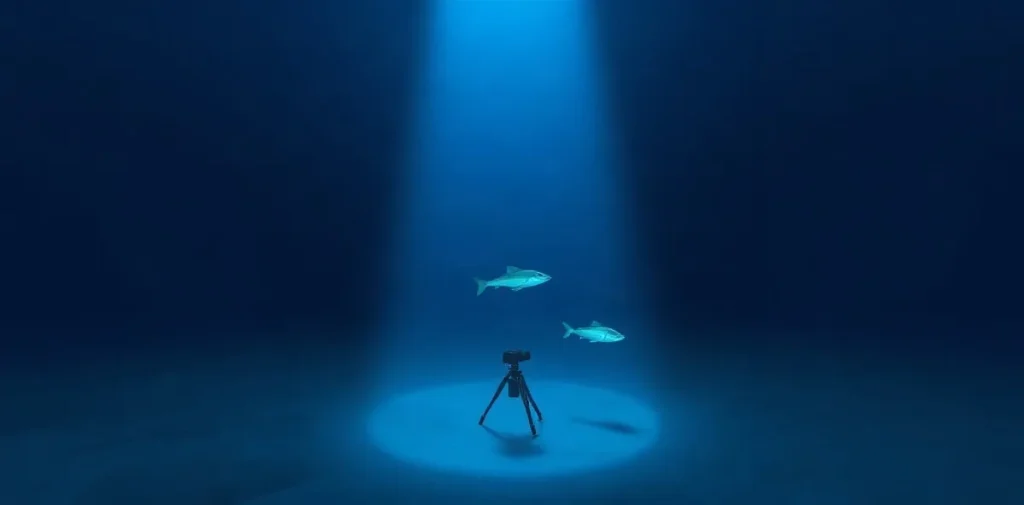
The marine twilight zone in the Gulf of Eilat is the dimly lit water below the sunlit surface, where light fades but the deep seafloor has not yet taken over as the defining environment. Studying this layer means asking how organisms live, move and interact there—and how divers can investigate it without disturbing a world that is difficult to observe.
What makes the twilight zone a distinct research problem?
Sunlight weakens with depth, changing the conditions for photosynthesis and the behaviour of animals. The resulting transition is not a sharp boundary: light, temperature, pressure and food availability vary through the water column, and the mix of organisms changes with them.
In the Gulf of Eilat, research on this zone connects marine ecology with the practical limits of underwater observation. Scientists may ask which organisms occupy particular depths, when they move, what they feed on and how their distribution relates to reefs and open water. These are questions about a changing habitat, not simply a census of species.
How can divers and instruments study it?
Direct observation is valuable because it records animals in their surroundings, but it is constrained by visibility, light, time and a diver’s exposure. A careful investigation can combine visual surveys with photography, sampling and measurements of environmental conditions. Each method answers different questions, and the choice depends on the organisms and depth being examined.
Several considerations shape the design of such work:
- Depth and light: record the conditions at the observation depth, since illumination affects both what a diver can see and how organisms behave.
- Time: repeated observations can distinguish a persistent pattern from movement that varies by time of day or season.
- Method: visual counts, images and physical samples differ in what they detect and how much they disturb the habitat.
- Diver exposure: depth, duration, workload and ascent planning constrain how long a survey can continue.
Remote cameras and other instruments can extend observation beyond a diver’s working time, while still requiring careful placement and interpretation. Comparing observations across methods helps researchers notice what each approach misses.
Why does the work matter to divers?
For scientific divers, the twilight zone is both a research subject and a demanding operating environment. Lower light can complicate navigation, communication and recognition of hazards. The dive plan must account for the task as well as the depth and time needed to collect useful observations.
Ecological work also depends on consistent, low-impact practice. A diver’s position, lighting, bubbles and contact with the reef can alter the scene being studied or damage fragile organisms. Good survey technique therefore supports both safety and data quality: observations are more useful when the method is repeatable and the diver’s presence is controlled.
What physiological limits shape underwater observation?
At depth, ambient pressure increases and breathing gas becomes denser. These changes affect gas exchange and breathing effort; workload, cold and stress can add further demands. A scientific task that requires sustained attention or precise positioning should be treated as part of the dive’s total physiological load, not as an activity separate from it.
Longer or deeper dives also require appropriate decompression planning. The organisms may be the focus of the survey, but the diver’s exposure determines how the work can be conducted. Dive plans, training and equipment must fit the actual conditions, and questions about an individual’s fitness to dive belong with a diving-medicine physician.
How does this field connect ecology with diving science?
Underwater research has long depended on divers to observe habitats that are difficult to reach by other means. Work in a dim midwater environment brings that tradition together with marine ecology, underwater imaging and the physiology of exposure to pressure. Its broader value lies in developing ways to investigate life through the water column while keeping observations comparable and dives controlled.
The same problem appears in many forms: a researcher must decide whether a pattern reflects animal behaviour, environmental change or a limitation of the observation method. Matching survey design to the question—and recording depth, conditions and procedure—makes it possible to interpret observations with appropriate care.
Frequently asked questions
What does “marine twilight zone” mean?
Can scuba divers survey this habitat?
Why does survey technique matter?
An original research-library explainer written by the Rubicon editors. It is not a summary of a specific publication.