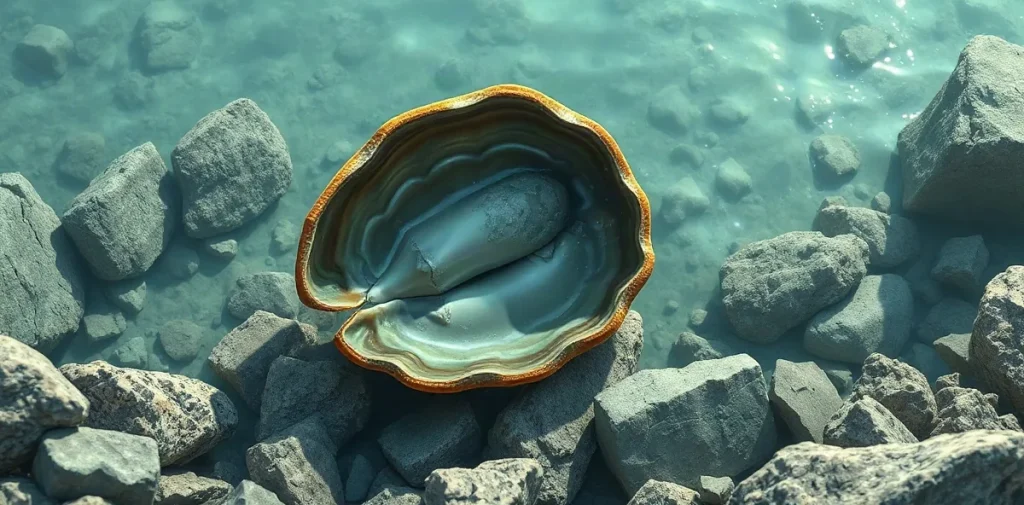
Assessment of Abalone Stocks in Southern California: The First Stage of Recovery is a 2005 publication by Haaker and colleagues about assessing abalone populations in Southern California. Its subject connects underwater field research with the ecological question of how depleted marine stocks are evaluated during recovery—a concern for scientific divers and those studying coastal ecosystems.
What does an assessment of abalone stocks address?
Stock assessment is the process of evaluating the condition of a population and the evidence available to describe it. For a marine species such as abalone, the subject may involve the relationship between animals, their habitat and the conditions that shape survival and reproduction.
The title places the work at an early stage of recovery assessment. In this context, recovery is not simply a matter of observing individual animals: researchers need ways to describe population status over time and to distinguish meaningful change from the limits of what can be observed underwater.
Abalone are marine invertebrates associated with the seafloor, making their populations a subject of direct underwater observation. Their assessment therefore sits at the intersection of marine ecology, field methods and the practical challenges of gathering reliable information in a submerged environment.
Why is this subject relevant to scientific divers?
Scientific divers can observe underwater habitats and organisms in place, an important advantage when research concerns species living on the seabed. At the same time, diving is a constrained way to work: visibility, depth, current, bottom conditions and available time can affect what a team can inspect and record.
Those constraints make careful planning and consistent observation central to field research. Researchers must consider how survey areas are chosen, what counts as an observation, and whether methods can be applied comparably on later visits. These are general design questions for underwater ecological work, not claims about the specific procedures used in this publication.
- Population status: describing the condition and distribution of a stock.
- Habitat context: considering the seafloor and environmental setting in which the species occurs.
- Repeatability: using observations that can be compared across places or times.
- Dive operations: matching the survey plan to environmental conditions and diver limitations.
What does diving physiology contribute?
Underwater research depends on divers working in an environment where pressure rises with depth and breathing gas is supplied through diving equipment. These factors influence dive planning and exposure, while exertion, cold and workload can add to the physiological demands of a scientific task.
Data quality and diver safety are linked. A survey plan has to account for the time needed to make observations as well as the conditions under which divers can work. Decompression, gas management, thermal comfort and task loading are relevant considerations in diving operations generally; they should not be mistaken for the ecological subject of this paper.
For diving physicians and hyperbaric clinicians, ecological survey publications provide context about the kinds of work divers may undertake, rather than clinical evidence by themselves. Individual questions about fitness to dive, symptoms or medical risk require assessment by a diving-medicine physician.
How does stock assessment fit into wider research?
Marine population assessment is part of a broader effort to understand how species and habitats change, and how recovery can be evaluated. It complements research on ecology and conservation by focusing attention on the evidence needed to describe a population, rather than treating recovery as an assumption.
Underwater studies also raise methodological questions shared across diving science: how to make observations in a difficult environment, reduce inconsistency, and interpret records in their ecological setting. The 2005 symposium proceedings place this publication within a scientific-diving forum, where underwater methods serve research questions that cannot be separated from field conditions.
For readers in diving medicine, the connection is indirect but useful. A clear understanding of scientific-diving work helps frame the operational and physiological demands faced by divers collecting ecological information, while keeping the biological assessment itself distinct from medical research.
What should readers take from the title?
The title signals a focus on the assessment of abalone stocks in Southern California and frames that assessment as an initial stage of recovery. It identifies a subject and research setting, while leaving the practical significance broad: reliable population assessment is one component of understanding ecological change.
Readers can approach the publication as a contribution to underwater ecological research and the methods used to examine a marine stock. Its place in a diving-science proceedings volume also highlights the role of divers as observers and researchers in environments that are otherwise difficult to study directly.
Frequently asked questions
What is the publication about?
Who wrote the publication, and when?
Why is the topic relevant to diving science?
Citation details
- Title: Assessment of Abalone Stocks in Southern California: The First Stage of Recovery
- Authors: Haaker, PL; Taniguchi, I; Artusio, M
- Year: 2005
- Published in: Godfrey, JM; Shumway, SE. Diving For Science 2005. Proceedings of the American Academy of Underwater Sciences Symposium on March 10-12, 2005 at the University of Connecticut at Avery Point, Groton, Connecticut.
- Identifiers: 1-878301-10-1
- Repository record: Rubicon Research Repository, handle 123456789/9013
This page is an original summary written by the Rubicon editors from the publication’s bibliographic record. It does not reproduce the paper, its abstract or its data; consult the publication itself for its methods and findings.
Related reading on Rubicon
- Google Scholar Research: Search and Assess Sources
- Scuba Diving Basics: Gear, Training, First Steps
- How Dive-Induced Stress Impacts Immune Function and Recovery
- Why Dive Site Safety Assessments Are Essential for Divers
- Thesis Research in Diving and Hyperbaric Medicine
- HPNS Suppression in Deep Human Dives: Research Summary
- More on Diving Science
- Browse the Research Library
