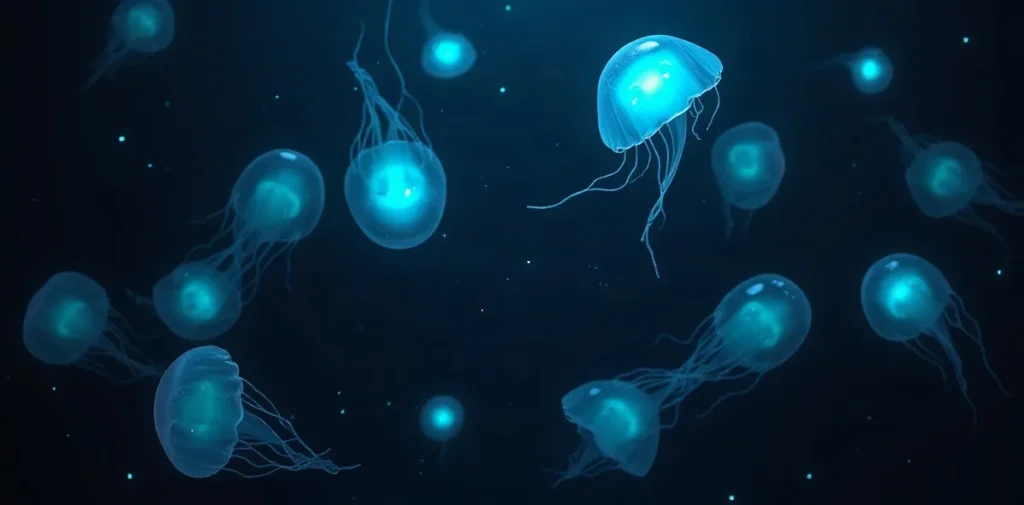
Bioluminescence is light produced by living organisms, including gelatinous zooplankton such as jellyfish and comb jellies. In polar seas, studying when and how these animals glow connects marine ecology with underwater observation: their light can reveal biological activity in darkness, while the conditions for seeing it shape what divers and scientific observers can learn.
What does bioluminescence reveal about gelatinous animals?
Bioluminescence is a chemical process in which an organism produces light. In marine animals, it can occur in specialised light-producing structures or through chemical reactions involving substances within the animal. The resulting glow may be steady, diffuse or emitted in response to disturbance; the form depends on the organism and the circumstances.
Gelatinous zooplankton are drifting animals with soft, water-rich bodies. The group includes organisms with very different shapes and life histories, so “gelatinous” describes a broad ecological category rather than one uniform kind of animal. Their light is one feature researchers can examine alongside distribution, behaviour and interactions with the surrounding water.
For an observer, a flash is not simply a picturesque event. Its timing and location can prompt questions about what triggered it, which animal produced it and whether the light serves a biological function. Identifying the organism and observing it without changing its behaviour are central challenges.
Why is the polar setting scientifically interesting?
The Greenland and Barents Seas are high-latitude marine environments where seasonal daylight differs sharply from conditions at lower latitudes. The phrase “midnight sun” refers to the season when the sun remains above the horizon around midnight; it does not mean that darkness is absent year-round. This changing light environment makes timing and observation conditions important to interpreting reports of animal glow.
Bioluminescence is visible only when its emitted light can be distinguished from ambient illumination. Researchers therefore have to consider the natural light field, water clarity, depth and the observer’s own light sources. A bright lamp can help locate an animal but may obscure faint emissions or alter the conditions being observed.
Polar work also brings practical constraints: cold water, limited access and the need to protect delicate animals during observation. These factors affect what can be seen and how observations are made, whether from a vessel, a laboratory or underwater.
How do researchers study light in drifting animals?
Studies of this kind combine ecological observation with careful control of light and handling. Researchers may record the animal’s appearance and behaviour, observe whether light is emitted during undisturbed movement or after stimulation, and document the surrounding conditions. The method must suit the question: a field observation captures behaviour in context, while controlled observation can help isolate a trigger.
Key considerations include:
- Light conditions: ambient illumination and artificial lights affect whether a glow can be detected.
- Animal identification: appearance and behaviour help distinguish among different gelatinous organisms.
- Observation conditions: depth, water clarity and handling can influence what the observer sees.
- Biological context: a light emission needs to be considered alongside the animal’s behaviour and environment.
Each approach has trade-offs. Capturing an animal may make close examination possible but can change its behaviour; observing it in open water preserves more of its natural setting but makes identification and measurement harder. Clear records of conditions help researchers interpret observations without treating every flash as equivalent.
What does this mean for divers and underwater observers?
For divers, bioluminescence is both an ecological phenomenon and an observation problem. A diver’s torch, camera light or movement can affect visibility and may influence how animals respond. When the aim is to observe natural light, limiting unnecessary illumination and disturbance can make the encounter more informative.
Scientific diving adds operational demands to that task. Cold exposure, restricted visibility, equipment use and attention to delicate organisms all need to be managed alongside normal dive planning. The work belongs to diving science because underwater observation is a method of studying marine life, not because bioluminescence itself is a medical treatment or decompression process.
Bioluminescent animals are not a reliable indicator of dive safety. A glow does not establish that water conditions are safe, identify a hazard or replace ordinary planning. Divers should treat unusual encounters as observations, maintain their planned procedures and avoid handling unfamiliar animals.
How does the topic connect to wider diving research?
Underwater science links biological questions to the conditions of observation. Research on glowing zooplankton sits alongside work on reef organisms, marine population processes and the physiology of diving: each asks how to gather sound evidence in an environment where access, visibility and human exposure impose constraints.
It also illustrates why diving is more than a way to reach a study site. A diver is part of the observation system, carrying lights, making movement and working under physiological limits. The quality of a biological record depends on both understanding the organism and accounting for how the observer and equipment affect what can be seen.
Frequently asked questions
What does bioluminescence mean?
Does every jellyfish or gelatinous animal glow?
Should divers use a torch to look for bioluminescence?
An original research-library explainer written by the Rubicon editors. It is not a summary of a specific publication.
Related reading on Rubicon
- Diving: Science, Practice, and Destinations
- Diving Science: Key Physiological and Environmental
- Diving: Exploring Underwater Activities, Science, and Safety
- The Science of Diving SSI: Education and Physiology Insights
- Rebreathers: Diving Science Research Summary
- Hydrogen Diving and Decompression Science
- More on Diving Science
- Browse the Research Library