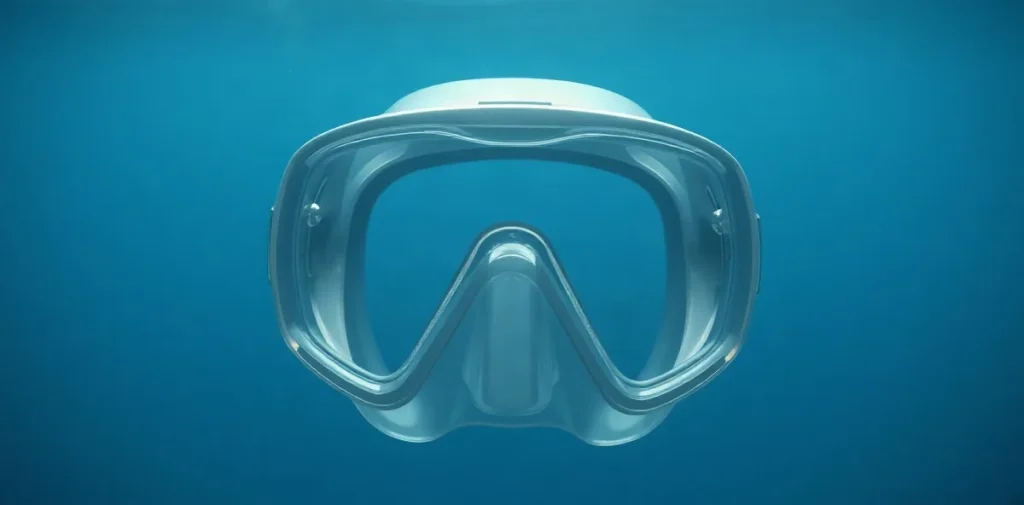
Orbital hemorrhage following face-mask barotrauma is a 2001 journal article by Butler and Gurney, published in Undersea and Hyperbaric Medicine 28(1). Its subject is bleeding within the eye socket associated with pressure injury to a diving face mask, a rare but important intersection of dive equipment, facial anatomy and clinical medicine.
How can a face mask create pressure injury?
A diving mask encloses air in front of the eyes and nose. As a diver descends, the surrounding water pressure rises and compresses the gas in that space. If the diver does not add air by exhaling gently through the nose, the pressure difference can draw the mask and surrounding soft tissues inward.
This mechanism is called mask squeeze, a form of barotrauma: tissue injury caused by a pressure difference across an enclosed space. It can affect the skin and small blood vessels around the eyes. The orbital region is the bony cavity containing the eyeball, muscles, nerves, blood vessels and other soft tissues; hemorrhage there means bleeding within that space.
What makes orbital bleeding a significant concern?
Bruising around the eyes after a dive may reflect superficial tissue injury, but bleeding within the orbit raises a different concern. The orbit has limited room to accommodate swelling. Depending on its location and severity, pressure from blood or swollen tissue can affect eye movement, vision or the structures that support the eyeball.
That distinction matters in diving medicine because an apparently local mask-related injury can require assessment beyond the skin. Symptoms involving vision, eye movement, pain or swelling warrant prompt medical evaluation. A diving-medicine physician can help assess the injury and its implications for returning to diving.
Which mechanisms and clinical questions matter?
Clinical consideration of orbital hemorrhage after mask barotrauma brings together the pressure change during descent, the fit and enclosed volume of the mask, and the anatomy of the face and orbit. The central issue is not simply whether the mask felt tight, but whether pressure-related tissue injury has affected structures around or within the eye socket.
- Pressure equalisation: whether air was added to the mask as ambient pressure increased.
- Injury location: whether signs are confined to superficial tissues or involve the orbit.
- Eye function: whether vision, eye movement or other ocular function is affected.
- Dive context: the timing of symptoms in relation to descent and mask pressure.
These considerations help frame assessment; they do not replace an examination. The appropriate evaluation depends on the symptoms and clinical findings.
How does this subject fit into diving medicine?
Dive medicine has long had to account for pressure effects in air-filled spaces, from the middle ear and sinuses to the lungs and mask. Mask barotrauma belongs to that broader field, but eye-socket bleeding draws attention to an uncommon consequence involving a confined anatomical space rather than only the mask’s contact with the face.
Case-oriented medical literature can help clinicians recognise unusual presentations and connect a diving mechanism with an injury pattern. For divers, the practical context is prevention: equalise the mask during descent by adding air through the nose, and address a mask that does not fit or cannot be cleared comfortably before continuing a dive.
Frequently asked questions
What is orbital hemorrhage?
What is face-mask barotrauma?
When should an eye injury after diving be assessed?
Citation details
- Title: Orbital hemorrhage following face-mask barotrauma
- Authors: Butler, FK; Gurney, N
- Year: 2001
- Published in: Undersea and Hyperbaric Medicine 28(1)
- Identifiers: PMID 11732882
- Record type: Journal article
- Repository record: Rubicon Research Repository, handle 123456789/2365
This page is an original summary written by the Rubicon editors from the publication’s bibliographic record. It does not reproduce the paper, its abstract or its data; consult the publication itself for its methods and findings.
Related reading on Rubicon
- Full-Face vs Traditional Dive Masks: Usability and Safety
- Scuba Equipment: Stop Your Mask Fogging
- Scuba Diving After Flying: How Long to Wait
- Comparative Review of Dive Masks for Wide Field of Vision
- Orbital Hemorrhage and Mask-Squeeze Barotrauma
- Diver Breathing: Mouthpiece vs Full-Face Mask
- More on Dive Medicine
- Browse the Research Library