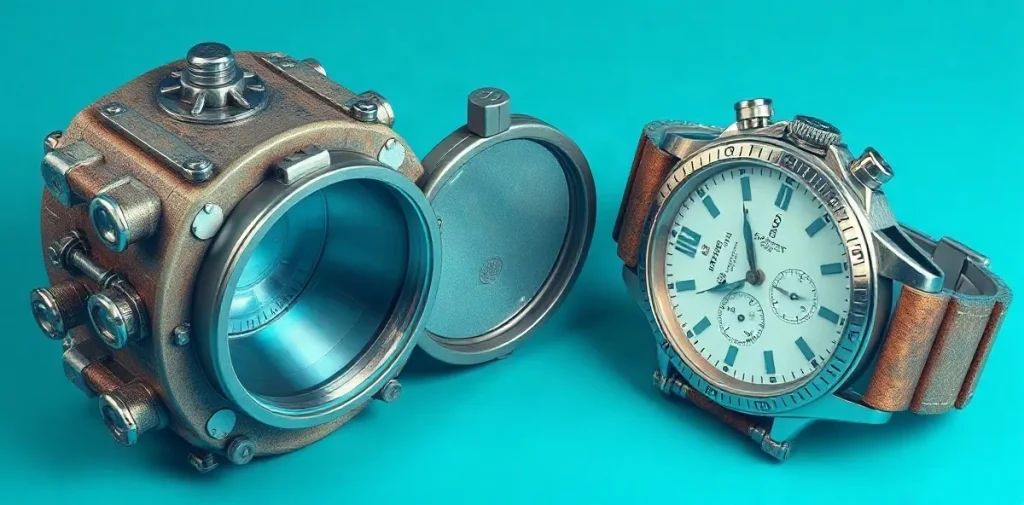
Submersible wristwatches sit at the intersection of pressure-resistant design and practical underwater timekeeping. Research into them asks how a watch performs when immersed and exposed to the conditions of diving. That matters because a diver may rely on elapsed time to manage a planned dive, while a device’s label alone cannot establish how it behaves in use.
What makes a wristwatch suitable for underwater use?
Water resistance depends on more than the watch’s visible face. The case, crystal, crown, seals and their interfaces must work together to keep water out as external pressure rises. A small defect, wear or poor closure can undermine that barrier.
Pressure also acts on the watch as a whole. With increasing depth, the surrounding water exerts greater pressure; the design must resist leakage and mechanical damage while preserving the function of the movement. A watch intended for immersion is therefore a piece of pressure-exposed equipment, not merely a timekeeper with a sealed case.
How can a watch be evaluated for diving?
Equipment assessment begins by defining the conditions and the function being examined. For a wristwatch, the questions include whether the case remains watertight, whether the mechanism continues to keep time, and whether the display can be read underwater. These are related but distinct performance questions.
Testing may examine a watch before and after exposure to pressure or immersion, looking for water ingress, damage and changes in operation. The choice of test conditions matters: a result applies to the conditions tested, and cannot automatically establish performance under every depth, duration, temperature or state of wear.
- Sealing: whether water enters through the case or its closures.
- Pressure resistance: whether the watch retains its structure and function under external pressure.
- Timekeeping: whether the mechanism continues to operate consistently during and after exposure.
- Readability: whether the diver can distinguish the display in the underwater environment.
- Repeatability: whether comparable testing produces comparable assessments.
Why does reliable timekeeping matter underwater?
Divers use time as one part of managing exposure and following a dive plan. A wristwatch can provide elapsed-time information, but it does not measure depth, breathing-gas supply or physiological status. It cannot replace a dive computer, depth gauge, pressure gauge or sound planning.
Readability is also a functional issue. Underwater, lighting, visibility, viewing angle and the diver’s attention can make a display harder to read than it is on land. A watch that remains watertight but is difficult to interpret may still be poorly suited to a particular task.
Where does watch testing fit in diving research?
Diving research spans physiology, breathing equipment, decompression and the performance of equipment exposed to pressure. Wristwatch evaluation belongs to the engineering side of that broader field: it considers whether a device designed for use at the surface remains useful in an underwater environment.
That question is narrower than the study of diver health, but it shares a central concern with other diving investigations: performance must be considered under the conditions in which equipment is expected to work. The practical value of an assessment depends on the test conditions, the functions examined and how closely those conditions match the intended use.
What should divers consider when choosing a watch?
Look for clear information about the watch’s intended use and water-resistance rating, and follow the manufacturer’s instructions for operation and maintenance. A rating is not a guarantee that a watch will remain watertight after impact, wear, improper closure or neglected seals.
Do not treat a wristwatch as a safety instrument unless it is designed and used for that role. If a dive depends on accurate timing, use equipment appropriate to the plan and maintain a backup means of tracking time. Questions about how equipment fits a particular dive should be addressed with a qualified instructor or equipment specialist.
Frequently asked questions
Does a water-resistance rating guarantee suitability for diving?
Can a wristwatch replace a dive computer?
Why test timekeeping as well as water resistance?
An original research-library explainer written by the Rubicon editors. It is not a summary of a specific publication.