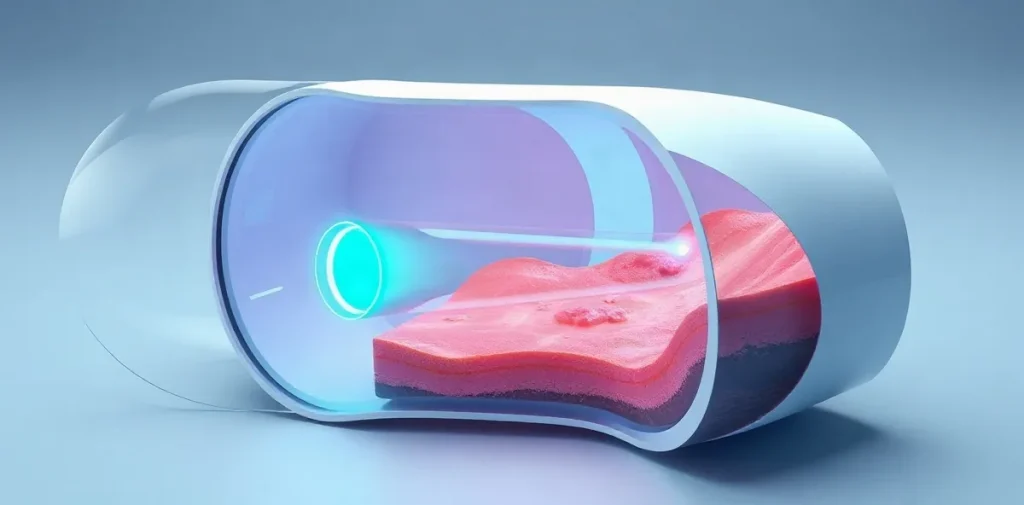
Research on hyperbaric oxygen and necrotizing fasciitis examines whether breathing oxygen under increased pressure can support care for a rapidly progressive infection of soft tissue. It matters to diving medicine because it brings oxygen physiology, pressure exposure and urgent clinical decision-making into the same field—while surgery and antimicrobial treatment remain central to care.
What is necrotizing fasciitis?
Necrotizing fasciitis is a serious infection that damages fascia, the connective tissue surrounding muscles, and can extend through adjacent soft tissue. The infection may impair local blood flow and produce tissue injury faster than the body can contain it. Prompt recognition and treatment are essential.
Its seriousness makes it a subject for multidisciplinary care and clinical research. Studies of hyperbaric oxygen in this setting ask how oxygen delivered under pressure might interact with the infection, tissue damage and other treatments—not whether pressure can replace urgent conventional care.
How could pressure change oxygen delivery?
At increased ambient pressure, breathing oxygen raises the amount dissolved in blood plasma. That is distinct from oxygen carried by haemoglobin: plasma oxygen can contribute to delivery where circulation is compromised, although pressure cannot restore blood flow through tissue that has been irreversibly damaged.
In infected, injured tissue, oxygen availability is one part of a larger biological environment. Hyperbaric oxygen is investigated for possible effects on tissue oxygenation, host defence and wound repair. The relevance and size of any effect depend on the disease, the condition of the tissue and the wider treatment plan.
- Pressure and oxygen: increased pressure changes how much oxygen can dissolve in plasma.
- Perfusion: oxygen delivery still depends on blood reaching the affected tissue.
- Infection and tissue injury: local conditions can limit how oxygen and immune responses act.
- Combined care: hyperbaric treatment is considered alongside, not instead of, urgent medical and surgical management.
What questions do clinical studies examine?
Research can examine whether adding hyperbaric oxygen to standard care changes clinically important outcomes, and which patients or disease stages might be relevant. It also has to account for differences in how quickly care begins, the extent of infection, surgery and antimicrobial treatment, and the patient’s overall condition.
These factors make comparisons difficult. A study may describe treatment practices, compare groups or review earlier clinical reports; each method answers different questions and has different limits. For a complex emergency, researchers must distinguish an association between treatment and outcome from evidence that treatment itself caused the difference.
Practical questions matter too: when treatment can be started, how a patient can be transported safely, and whether chamber care can be coordinated without delaying essential interventions. Those are clinical and operational questions, not simply measurements of oxygen pressure.
Why does this topic belong in diving medicine?
Hyperbaric medicine applies pressure to clinical problems beyond diving injuries. This research area therefore sits beside work on decompression, oxygen physiology and other medical uses of pressurised oxygen. It shares a central concern with diving science: how pressure changes gas behaviour and what those changes mean for living tissue.
For divers, the connection is useful but should not be confused with self-treatment. A serious infection is not a diving emergency to manage in a chamber on one’s own. Divers and clinicians need to distinguish medical hyperbaric treatment from recreational diving, where pressure exposure, gas choice and decompression involve different aims and risks.
What should clinicians and divers keep in view?
Hyperbaric oxygen has to be weighed within the complete treatment pathway. For necrotizing fasciitis, urgent assessment and established medical and surgical care cannot be put on hold while considering chamber treatment. The timing, suitability and practical risks of hyperbaric exposure are matters for the treating team.
Pressure also creates its own clinical considerations, including the need to assess a patient’s ability to tolerate chamber exposure and oxygen administration. A diving-medicine physician or hyperbaric clinician can evaluate those issues in the context of the illness; general information is not a substitute for individual medical care.
Frequently asked questions
Can hyperbaric oxygen replace surgery or antibiotics?
Why is oxygen under pressure studied for this infection?
Is this the same as diving treatment for decompression illness?
An original research-library explainer written by the Rubicon editors. It is not a summary of a specific publication.
Related reading on Rubicon
- The Physiology Behind Oxygen Toxicity in Deep Dives
- Understanding Oxygen Toxicity Risks and Prevention in Diving
- Oxygen Partial Pressure: Key to Dive Safety and Performance
- Myth Busting: Clarifying Oxygen Toxicity Limits in Diving
- Hyperbaric Oxygen for Necrotizing Fasciitis
- Hyperbaric Oxygen Therapy for Lyme Disease
- More on Dive Medicine
- Browse the Research Library