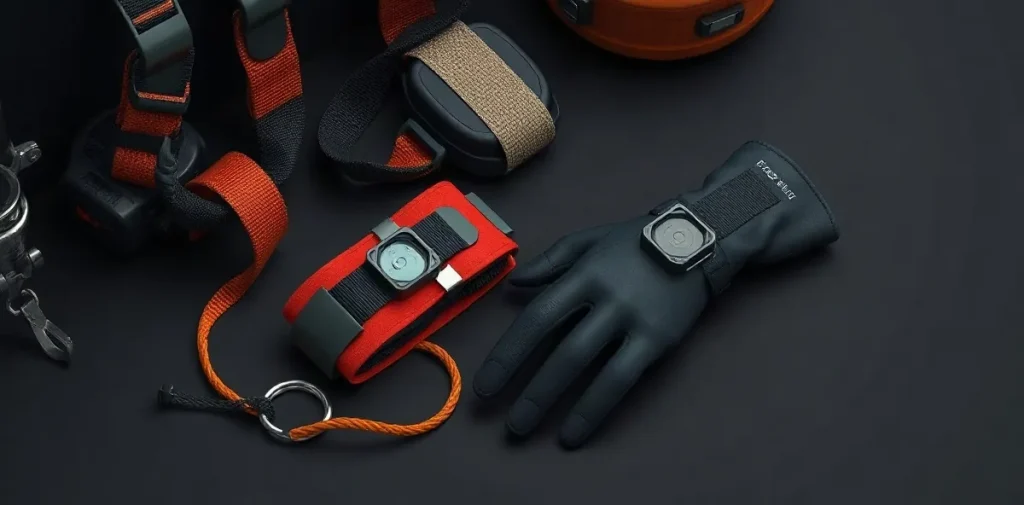
Self-applied tourniquets are devices intended to control life-threatening bleeding from an arm or leg when a person must act on their own. Their evaluation concerns whether a user can place and tighten a device effectively under demanding conditions—a practical question for combat care and for divers facing an injury far from immediate medical support.
What does a tourniquet do?
A tourniquet compresses the limb enough to stop blood flow beyond the device. This can prevent catastrophic blood loss from severe limb injuries, but it is not a treatment for bleeding from the torso, neck or other sites where a limb tourniquet cannot be applied.
Effective use depends on more than the device itself. The user must reach the injured limb, position the tourniquet correctly, tighten it sufficiently and secure it, often while injured, under pressure or with reduced dexterity.
Why examine self-application?
Many emergency plans assume that a rescuer will apply the device. Self-application tests a different capability: whether someone can treat their own injury when another person is unavailable, delayed or unable to help. That distinction matters in combat settings and in remote or underwater work, where rescue may take time.
Evaluation of this kind can examine how design, placement and operating steps affect use. It also raises human-factors questions: can the device be found and handled quickly, can a user operate it with one hand, and does the method remain workable when attention and movement are constrained?
What changes in a diving emergency?
A diver may have gloves, exposure protection and equipment that restrict movement or access to the injured limb. In-water emergencies add buoyancy, environmental exposure and the need to manage breathing equipment and ascent priorities. Once out of the water, cold, fatigue or other injuries may further complicate self-care.
These conditions do not change what a tourniquet is for, but they affect whether a person can apply it reliably. Dive teams should consider where first-aid equipment is carried, how quickly it can be reached and whether training reflects the clothing and equipment actually used.
What do studies of tourniquet use examine?
Research on self-applied devices can assess usability, application technique and whether bleeding control is achieved under specified conditions. A sound assessment distinguishes a device’s mechanical performance from a user’s ability to operate it; success in one does not guarantee success in the other.
Useful considerations include:
- Access: whether the device can be reached and removed from its carrier.
- Handling: whether the user can position, tighten and secure it with limited dexterity.
- Fit: whether the design works across limb sizes and over the clothing or equipment involved.
- Training: whether the user can recall the steps under stress and recognise when the device is not controlling bleeding.
- Follow-up: whether the casualty can be transferred promptly for professional care.
Laboratory or controlled exercises can isolate particular factors, while realistic scenarios test how several demands interact. Neither approach alone captures every emergency; training and equipment choices should account for the setting in which they will be used.
How does this fit into diving medicine?
Diving medicine addresses problems that begin underwater as well as the injuries and illnesses that emerge during evacuation and treatment. A severe bleeding injury is not a decompression illness, but it can coexist with dive-related hazards and compete for attention during rescue. Managing immediate threats and arranging appropriate medical assessment remain central.
Tourniquet use is one part of trauma first aid, not a substitute for evacuation or definitive care. If you dive in a team, discuss emergency roles and equipment with a qualified instructor or medical professional; individual treatment decisions should be guided by a diving-medicine physician.
Frequently asked questions
What is a self-applied tourniquet?
Can a tourniquet treat every serious injury?
Why should divers consider self-application?
An original research-library explainer written by the Rubicon editors. It is not a summary of a specific publication.
Related reading on Rubicon
- The Diving Reflex: What Happens Underwater
- Scuba Diving Fins: Split vs. Paddle Designs
- Scuba Diving Regulators: Balanced vs. Unbalanced
- Scuba Diving Ear Equalization: Why Valsalva Fails
- Thesis Research in Diving and Hyperbaric Medicine
- HPNS Suppression in Deep Human Dives: Research Summary
- More on Dive Medicine
- Browse the Research Library