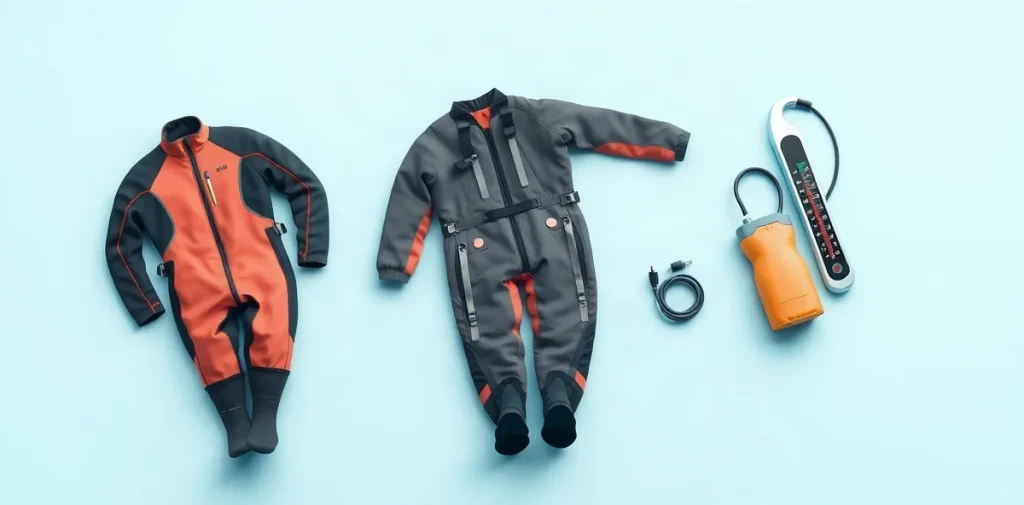
Exposure suits: a review of thermal protection for the recreational diver is a 2003 journal article by Williams and Acott in South Pacific Underwater Medicine Society journal 33(1). Its subject is how divers’ exposure suits provide thermal protection—a practical equipment question with direct consequences for comfort, performance and safe time underwater.
Why does thermal protection matter underwater?
Water draws heat from the body more effectively than air at the same temperature. A diver can therefore lose heat even when the water does not feel especially cold at the surface, and exertion or a long immersion can add to the burden.
As the body cools, shivering and discomfort can interfere with task performance, concentration and coordination. More substantial cooling can become a medical concern. Thermal protection is consequently relevant not only to equipment selection but also to dive planning and the assessment of a diver’s condition.
Exposure suits address this heat loss by limiting the transfer of heat from the body to the surrounding water. Their effectiveness depends on the suit and the conditions in which it is used, rather than on the garment’s label alone.
How do exposure suits reduce heat loss?
Insulation slows heat transfer. In a wetsuit, a layer of insulating material is worn close to the body; the suit’s fit and the movement of water through gaps affect how well it retains warmth. A drysuit keeps water away from the body, while insulation beneath it provides much of the thermal barrier.
These approaches involve different design and use considerations. A wetsuit’s protection is affected by compression and water exchange, while a drysuit depends on maintaining a dry environment and managing the suit’s gas during the dive. Neither type can be judged apart from fit, exposure and the diver’s activity.
Heat balance also reflects factors beyond the suit, including water temperature, time immersed, depth, workload and individual differences. A diver who is comfortable at the start of a dive may become cold later, particularly during a quiet period or when conditions change.
What should divers consider when choosing protection?
Thermal protection is a system: suit construction, fit, undergarments where applicable, and the planned dive all contribute. A suit that is too loose can allow unwanted water exchange; one that restricts movement can make essential tasks harder. Check that the equipment allows you to operate controls and complete the dive’s intended work.
- Water and exposure: Consider the expected temperature, time in the water and whether the dive includes long periods of low activity.
- Fit and condition: Inspect seals, closures and material for a secure fit and signs of damage.
- Depth and workload: Account for changes in insulation and the physical effort required during the dive.
- Individual response: Previous experience, fatigue and health can affect how a diver tolerates cold.
These considerations are especially important for scientific divers, who may need to remain still or repeat tasks underwater, and for recreational divers planning multiple or extended immersions. A dive plan should include a response to cold stress, not just an equipment choice.
Where does suit research fit in diving medicine?
Thermal protection sits at the intersection of equipment design, human physiology and operational safety. Research on exposure suits can examine how materials and garment construction affect insulation, how diving conditions alter heat loss, and how thermal comfort relates to a diver’s ability to perform tasks.
That work belongs alongside broader investigations of immersion, cold stress and the demands of underwater activity. For diving physicians and hyperbaric clinicians, understanding suit performance helps frame discussions about exposure and cold-related symptoms; it does not replace clinical assessment when a diver becomes unwell.
The 2003 publication’s title places it within this practical research area: thermal protection for recreational divers. Its subject remains relevant wherever people work or spend time submerged, because the surrounding water continues to shape the body’s heat balance.
Frequently asked questions
What is an exposure suit?
Does a wetsuit keep a diver completely dry?
When should a diver seek medical advice about cold exposure?
Citation details
- Title: Exposure suits: a review of thermal protection for the recreational diver
- Authors: Williams, Guy; Acott, Chris J
- Year: 2003
- Published in: South Pacific Underwater Medicine Society journal 33(1)
- Record type: Journal article
- Repository record: Rubicon Research Repository, handle 123456789/7764
This page is an original summary written by the Rubicon editors from the publication’s bibliographic record. It does not reproduce the paper, its abstract or its data; consult the publication itself for its methods and findings.
Related reading on Rubicon
- Choosing the Right Exposure Suit: Balancing Thermal
- Comparing Dive Suit Materials: Thermal Protection &
- Why Divers Get Cold Faster Underwater
- Scuba Diving Equipment: Essential Gear for Every Diver
- Brain Lesions and PFO in Sport Divers
- Brain Lesions in Professional Divers?
- More on Equipment
- Browse the Research Library