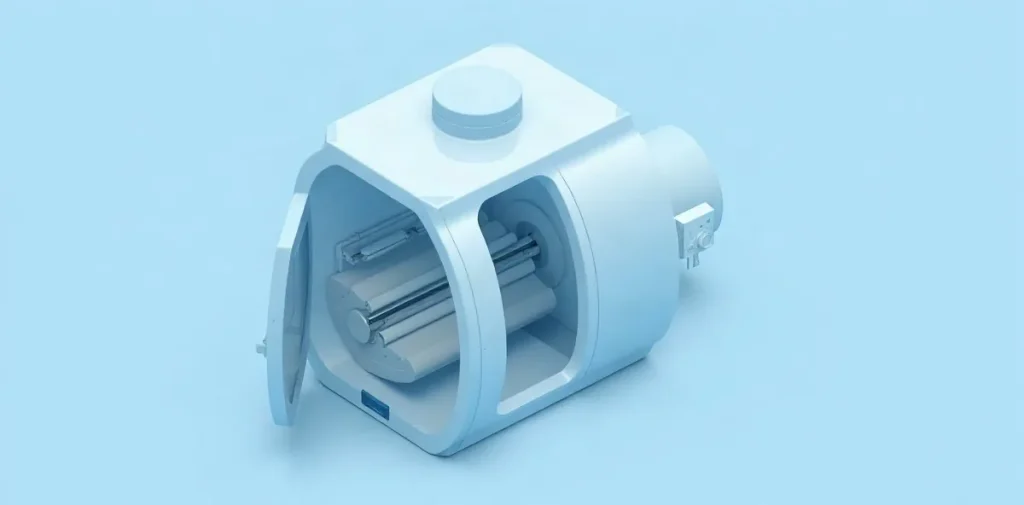
Predictors of middle ear barotrauma associated with hyperbaric oxygen therapy is a 2003 journal article by Lehm Jan P and Bennett Michael H, published in South Pacific Underwater Medicine Society Journal 33. Its subject is the factors associated with middle ear injury during hyperbaric oxygen therapy—a pressure-related problem shared with diving.
What is middle ear barotrauma?
The middle ear is an air-filled space behind the eardrum. As surrounding pressure changes, the pressure in this space must adjust to keep the eardrum and nearby tissues from being pushed inward or outward.
The Eustachian tubes connect the middle ear to the back of the nose and throat. They normally open during swallowing or yawning, allowing air to pass and pressure to equalise. If pressure changes faster than the tubes can open, or they do not open effectively, a pressure difference can develop.
That imbalance may cause discomfort, difficulty equalising, or tissue injury. The term barotrauma refers to injury caused by a pressure difference; its severity can vary, and symptoms alone do not establish the extent of injury.
Why does hyperbaric oxygen therapy put the ear under pressure?
Hyperbaric oxygen therapy takes place in a chamber where pressure is raised above the pressure at the surface. During compression, the pressure around the patient increases, and gas spaces in the body must adjust. The middle ear is one of the spaces that requires active equalisation.
Pressure changes also occur when chamber pressure is reduced. Equalisation difficulties can therefore matter during both compression and decompression, though the circumstances and sensation may differ. The process has a clear parallel with descent and ascent underwater, even though chamber treatment and diving are not interchangeable activities.
In both settings, the basic concern is the same: a pressure difference across the eardrum. Understanding how that difference develops helps clinicians and divers recognise why a seemingly small failure to equalise can become a medical issue.
What does “predictors” mean in this research question?
A predictor is a characteristic or circumstance examined for its relationship with an outcome. In a study of middle ear barotrauma associated with hyperbaric oxygen therapy, the question is which factors may be linked to the likelihood of ear injury—not simply whether pressure changes occur.
Studies addressing this question can consider patient characteristics, the ability to equalise, and features of the pressure exposure or treatment process. Those are broad domains for investigation, not a list of established risk factors for every patient. The relevance of any factor depends on how it is defined and assessed.
Predictor research is useful because it can help frame prevention and clinical assessment. An association, however, does not by itself prove that a factor causes injury; interpretation depends on study design and the circumstances in which treatment takes place.
Which concepts connect this topic to diving medicine?
Middle ear barotrauma sits at the intersection of pressure physiology, ear health and safe pressure exposure. The concepts below help explain why the issue matters to divers, diving physicians, hyperbaric clinicians and scientific divers.
- Pressure equalisation: movement of gas into or out of the middle ear to reduce a pressure difference.
- Eustachian tube function: the route through which the middle ear typically equalises with the surrounding environment.
- Compression and decompression: pressure increases and decreases that require body gas spaces to adapt.
- Barotrauma: tissue injury related to an imbalance between pressure inside a gas space and pressure outside it.
- Risk prediction: examining which features may be associated with an outcome, while distinguishing association from cause.
For divers, equalisation problems can interrupt a descent or ascent and may cause ear injury. For hyperbaric clinicians, the same physiology matters during chamber treatment, where pressure exposure is part of care. The shared mechanism makes this a useful subject across diving and hyperbaric medicine.
How should readers use research on this subject?
Research on predictors belongs to a wider effort to understand how people respond to pressure exposure and how complications can be anticipated. It complements work on other pressure-sensitive spaces, such as the sinuses, while addressing the specific anatomy and function of the middle ear.
Clinical decisions still require attention to the individual and the treatment context. If ear pain, difficulty equalising or other concerning symptoms arise during hyperbaric treatment or diving, assessment by an appropriate diving-medicine or hyperbaric-medicine physician is important. This page is general education, not individual medical advice.
The article’s bibliographic record is: Lehm Jan P and Bennett Michael H, “Predictors of middle ear barotrauma associated with hyperbaric oxygen therapy,” South Pacific Underwater Medicine Society Journal 33 (2003).
Frequently asked questions
What is middle ear barotrauma?
Why is the topic relevant to divers?
What does a predictor study examine?
Citation details
- Title: Predictors of middle ear barotrauma associated with hyperbaric oxygen therapy
- Authors: Lehm Jan P; Bennett Michael H
- Year: 2003
- Published in: South Pacific Underwater Medicine Society Journal 33
- Record type: Journal article
- Repository record: Rubicon Research Repository, handle 123456789/8076
This page is an original summary written by the Rubicon editors from the publication’s bibliographic record. It does not reproduce the paper, its abstract or its data; consult the publication itself for its methods and findings.
Related reading on Rubicon
- First Aid Essentials for Diving Ear Barotrauma
- The Physiology Behind Oxygen Toxicity in Deep Dives
- Understanding Oxygen Toxicity Risks and Prevention in Diving
- Oxygen Partial Pressure: Key to Dive Safety and Performance
- Middle-Ear Barotrauma in Hyperbaric Oxygen Therapy
- Middle-Ear Barotrauma and Hyperbaric Oxygen
- More on Dive Medicine
- Browse the Research Library