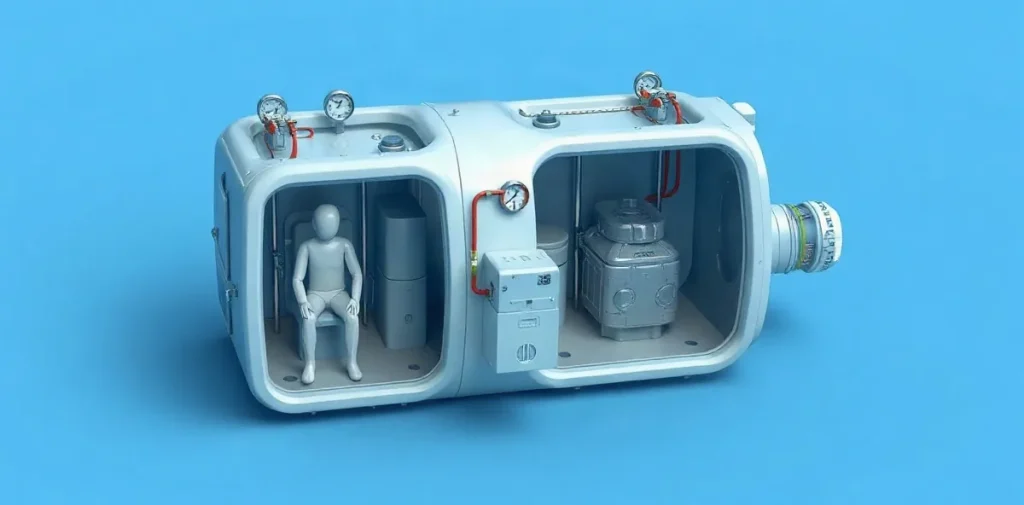
Research comparing monoplace and multiplace chambers examines how treatment setting and equipment affect care for diving-related illness. The distinction matters because recompression depends on delivering pressure and oxygen safely while clinicians assess and support a potentially unwell diver.
What makes the two chamber types different?
A monoplace chamber is built for one patient and is generally pressurised with oxygen. A multiplace chamber accommodates several people and is pressurised with air; oxygen can be delivered to a patient through a mask or hood. These arrangements shape how treatment is delivered and how staff interact with the patient.
The comparison is not simply about chamber size. It concerns the clinical consequences of different pressure environments, oxygen-delivery systems, monitoring arrangements and access to the patient during treatment.
Why does recompression matter in diving illness?
Decompression illness includes decompression sickness, associated with inert gas coming out of solution and forming bubbles, and arterial gas embolism, in which gas enters the arterial circulation. Symptoms can range from pain or skin changes to problems affecting the nervous system, breathing or circulation. A suspected case requires prompt medical assessment.
Recompression treatment raises ambient pressure and commonly uses oxygen to support recovery. Pressure can reduce bubble size, while breathing oxygen increases the gradient for inert gas to leave tissues and helps limit further inert-gas uptake. The exact treatment plan depends on the clinical presentation and the chamber team’s assessment.
What questions does chamber research examine?
Studies of chamber configuration can examine whether a treatment can be delivered safely and consistently, how well the patient can be observed, and how readily clinicians can intervene if the patient deteriorates. They may also consider operational demands, including the equipment and staff needed to run treatment.
- Pressure and oxygen: how the chamber environment and breathing system deliver the prescribed treatment.
- Patient access: how easily staff can communicate with, monitor and support the patient during pressurisation.
- Clinical capability: whether necessary monitoring and emergency interventions can be maintained inside the chamber.
- Service logistics: how chamber availability, patient transfer and team experience affect treatment pathways.
These questions make clear why a chamber comparison needs clinical context. A configuration that suits one patient, facility or treatment pathway may not offer the same practical advantages in another.
How does chamber choice affect care?
Chamber design can influence whether a patient can be accompanied, how staff communicate during treatment and what monitoring or support is feasible. Multiplace chambers allow trained staff to enter the pressure environment, while monoplace treatment relies on external observation and the chamber’s patient-contact systems. The patient’s condition and the facility’s capabilities therefore matter alongside the chamber itself.
Care also involves decisions before and after pressurisation: recognising possible decompression illness, stabilising the patient, arranging transport and coordinating with a hyperbaric service. Chamber research sits within this larger clinical system, rather than treating the pressure vessel as an isolated device.
What should divers and clinicians take from this field?
For divers, the central practical point is to report symptoms after diving promptly and seek qualified medical assessment; suspected decompression illness should not be managed by choosing a chamber independently. A diving-medicine physician or emergency service can assess the situation and coordinate appropriate care.
For clinicians and scientific divers, chamber research connects physiology with treatment delivery and service design. It asks how the properties of a treatment environment affect safe, effective care, while recognising that decisions depend on the patient, the treatment protocol and local clinical resources.
Frequently asked questions
What is the main difference between monoplace and multiplace chambers?
Are chamber types interchangeable for every diving illness?
What should I do if symptoms develop after a dive?
An original research-library explainer written by the Rubicon editors. It is not a summary of a specific publication.
Related reading on Rubicon
- The Diving Reflex: What Happens Underwater
- Scuba Diving Fins: Split vs. Paddle Designs
- Scuba Diving Regulators: Balanced vs. Unbalanced
- Scuba Diving Buddy Checks: Catch Problems Early
- Monoplace vs. Multiplace Chambers for Diving Diseases
- Thesis Research in Diving and Hyperbaric Medicine
- More on Dive Medicine
- Browse the Research Library