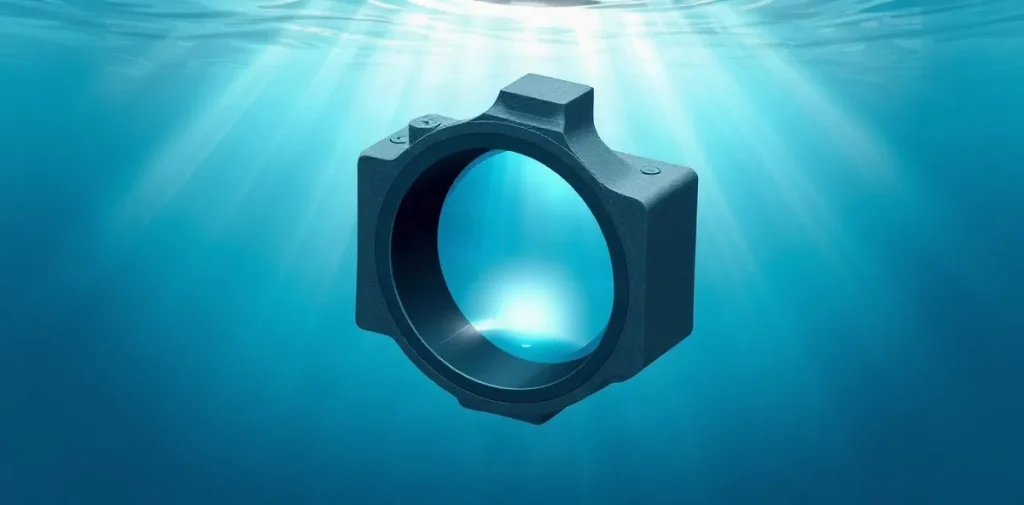
Underwater camera design asks how a camera can form a clear image through water while protecting its delicate optical and mechanical systems. Water-contact optics place optical elements in direct contact with the surrounding water, making the boundary between lens and environment part of the design. Understanding that approach helps divers assess how equipment works, what it demands underwater, and why specialised designs have a place in diving technology.
What changes when optics meet water?
Light behaves differently when it passes between materials with different refractive properties. At the air–water boundary, light bends substantially; this changes how an ordinary camera lens sees a scene underwater and can limit the field of view. A flat housing port adds another optical interface, so the camera-and-housing combination must be considered as a system rather than as a camera alone.
Water-contact optics alter that arrangement by putting an optical surface in contact with water. The design must account for the surrounding medium, the lens, and the camera’s image-forming system together. The practical question is not simply whether a camera is waterproof, but how its optical geometry performs in the environment where it will be used.
How do designers assess an underwater camera?
Equipment evaluation brings optical performance together with mechanical reliability and usability. A camera may produce a useful image yet be difficult to operate with gloves, awkward to configure underwater, or demanding to maintain after exposure to salt water. Conversely, a specialised optical arrangement may suit particular photographic tasks without being the simplest choice for every diver.
- Optical performance: field of view, focus, distortion, and image clarity in water.
- Sealing: how the camera and its interfaces prevent water ingress.
- Operation: access to controls, focusing, and viewfinding while submerged.
- Maintenance: care of seals and optical surfaces before and after a dive.
- System compatibility: how the lens, camera body, and underwater configuration work together.
These considerations are connected. A change to a port or lens can affect both image formation and the physical configuration of the equipment. Assessment therefore asks how the whole setup behaves in use, not just what any single component promises.
Why does camera history matter to divers?
Specialist equipment reflects the problems its designers set out to solve and the compromises they accepted. A historical account of an unusual underwater camera design can help readers understand why a technology appeared, what made it distinctive, and how equipment development responds to the demands of underwater work. It also places modern choices in a longer technical history rather than treating each new product as an isolated advance.
For divers, that context is practical. A camera system can shape how a subject is framed, how close a photographer must approach, and how much attention the equipment takes during a dive. Scientific divers may also use underwater images as records of observations, so repeatable framing and dependable operation can matter alongside visual appeal.
What are the limits and safety considerations?
A camera housing protects equipment; it does not remove the physical constraints of diving. Added bulk and controls can affect handling, while photography can draw attention away from buoyancy, navigation, depth, or a buddy. The appropriate setup depends on the dive, the diver’s experience, and whether the camera is essential to the task.
Underwater equipment also needs inspection and care. Seals, closures, and optical surfaces should be handled according to the equipment maker’s instructions, and a housing should not be treated as reliable merely because it worked on a previous dive. If a camera problem could affect an operational or scientific task, plan for it before entering the water.
How does this topic fit into diving research?
Underwater imaging sits at the intersection of optics, equipment engineering, and field practice. Its questions differ from those in decompression medicine or breath-hold physiology, but the same broad discipline applies: understand the operating environment, identify constraints, and evaluate the complete system under relevant conditions. Camera design matters because observing underwater environments often depends on tools that function predictably in water.
For a diver choosing or using a camera, the useful questions are concrete: what optical arrangement is involved, what conditions is the equipment designed for, and what inspection or operating steps does it require? The answers belong in the equipment documentation and in the dive plan, especially when imaging is part of scientific work.
Frequently asked questions
What does water-contact optics mean?
Why can an ordinary camera behave differently underwater?
What should divers check before using an underwater camera?
An original research-library explainer written by the Rubicon editors. It is not a summary of a specific publication.
Related reading on Rubicon
- The Diving Reflex: What Happens Underwater
- Scuba Diving Fins: Split vs. Paddle Designs
- Why Divers Get Cold Faster Underwater
- Diving Safety: Key Insights into Underwater Exploration
- Underwater SLR Camera with Water Contact Optics
- Underwater SLR Cameras and Water-Contact Optics
- More on Equipment
- Browse the Research Library