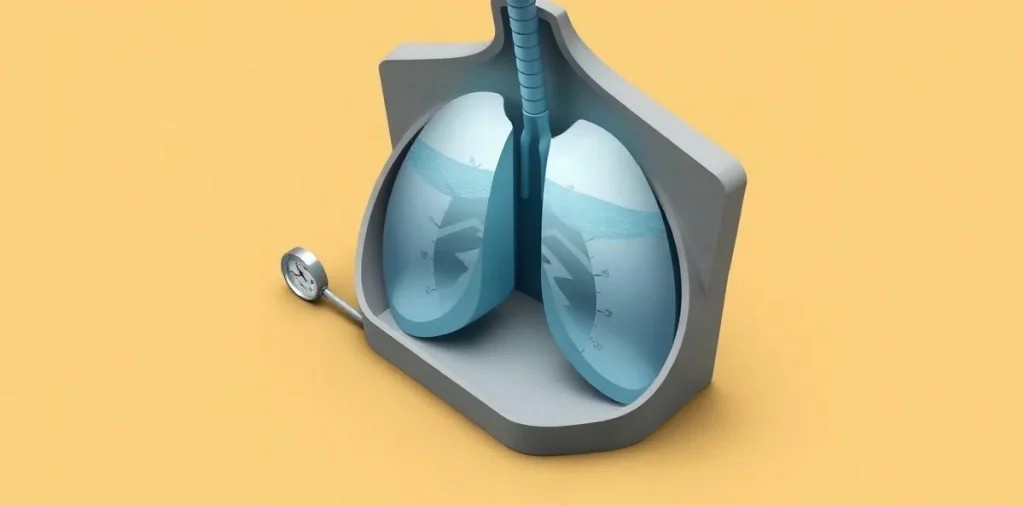
Pneumomediastinum is air in the space between the lungs, around the heart and central airways. In diving medicine, its connection with lung packing raises a practical question: how do deliberate changes in lung volume and pressure affect tissues during breath-hold diving, and how should chest symptoms be assessed?
What are lung packing and pneumomediastinum?
Lung packing is a breathing manoeuvre used by some breath-hold divers to increase the amount of air in the lungs beyond a comfortable full inspiration. It involves taking additional small breaths into already inflated lungs. That can increase pressure inside the chest, particularly when the lungs and rib cage are near their expansion limit.
The mediastinum is the central compartment of the chest, containing the heart, major blood vessels, oesophagus and trachea. Pneumomediastinum occurs when air escapes into this compartment, often after delicate air sacs or airways are disrupted by pressure. It is distinct from a pneumothorax, in which air collects in the space between a lung and the chest wall.
Why examine pressure during breath-hold diving?
Breath-hold diving exposes the lungs to changing pressure as a diver descends and ascends. Lung packing adds a separate pressure challenge before descent: extra air is forced into a chest already close to its maximum expansion. The research question is therefore not simply how deep a diver goes, but how the starting lung volume and the manoeuvre itself affect the structures that contain air.
Pressure-related injury is relevant to divers because air can move through tissues when the barrier between an air space and surrounding structures is damaged. Symptoms may overlap with other causes of chest pain or breathing difficulty. Recognising the possibility of mediastinal air can guide clinical assessment, while distinguishing it from other pressure injuries remains important.
How do clinicians and researchers approach the question?
Work in this area connects diving physiology with clinical evaluation of chest injury. A case-focused investigation typically asks what manoeuvre preceded symptoms, when symptoms began, and whether the examination or imaging identifies air in the mediastinum or another part of the chest. These questions help separate a plausible mechanism from other explanations.
The assessment also depends on context: whether the person was breath-hold diving, using lung packing, or exposed to another pressure change; what symptoms occurred; and whether there are signs of complications. The clinical priority is to evaluate potentially serious chest symptoms rather than assume they are a routine consequence of diving.
- Lung volume: how full the lungs are before a manoeuvre or descent.
- Pressure: the forces acting within the lungs and chest as volume changes.
- Air leakage: movement of air from the lungs or airways into surrounding tissues.
- Differential diagnosis: distinguishing pneumomediastinum from pneumothorax and other causes of chest symptoms.
What does this mean for divers and diving medicine?
Lung packing sits at the intersection of performance technique and respiratory risk. More air in the lungs may appear useful to a breath-hold diver, but increasing lung volume also changes pressure and strain in the chest. The relevant medical question is how an individual’s technique, anatomy and circumstances combine, not whether a manoeuvre is universally safe.
For diving physicians and hyperbaric clinicians, the subject belongs to the broader study of pressure-related injury and the limits of human physiology underwater. Pneumomediastinum is not itself the same condition as decompression sickness, though chest symptoms after diving require careful assessment because several mechanisms may be possible. A diving-medicine physician should evaluate concerning symptoms, especially chest pain or difficulty breathing.
Frequently asked questions
Is pneumomediastinum the same as a collapsed lung?
Why can lung packing matter in breath-hold diving?
What should a diver do about chest symptoms after a dive?
An original research-library explainer written by the Rubicon editors. It is not a summary of a specific publication.
Related reading on Rubicon
- Liveaboard Diving: Plan, Pack, Dive
- The Diving Reflex: What Happens Underwater
- Scuba Diving Fins: Split vs. Paddle Designs
- Scuba Diving Regulators: Balanced vs. Unbalanced
- Thesis Research in Diving and Hyperbaric Medicine
- HPNS Suppression in Deep Human Dives: Research Summary
- More on Dive Medicine
- Browse the Research Library